- Animals
- ›Arthropods
- ›Chelicerates
- ›Arachnids
- ›Spiders
- ›Typical Spiders
- ›Entelegyne Spiders
- ›RTA Clade Spiders
- ›Dionycha clade spiders
- ›Gnaphosoid Spiders
- ›White-marked Ground Spiders
- ›Lamponinae
- ›Lampona
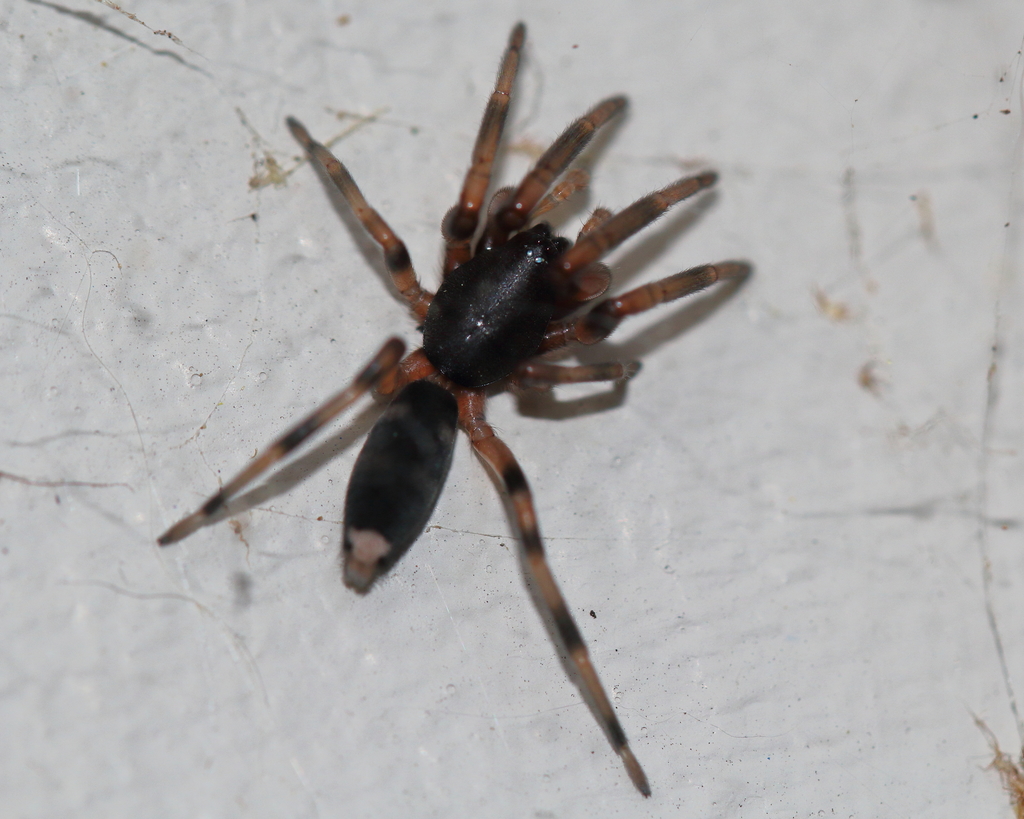
Eastern White-tail Spider
Lampona murina
White-tailed spiders are spiders native to southern and eastern Australia, with the name referring to the whitish tips at the end of their abdomens. The body size is up to 18 mm, with a leg-span of 28 mm. Common species are Lampona cylindrata and Lampona murina. Both these species have been introduced into New Zealand.
White-tailed spiders are vagrant hunters that seek out and envenom prey rather than spinning a web to capture it; their preferred prey is other spiders.
From the article White-tailed spider on Wikipedia (CC BY-SA), quoted section by section
Description
The two common species of white-tailed spiders are Lampona cylindrata and Lampona murina. They are similar in appearance; L. cylindrata is slightly larger with females being up to 18 mm long while males are up to 12 mm in body length. The legs span approximately 28 mm. The two species are not easily distinguished without microscopic examination. They are slender spiders with dark reddish to grey, cigar-shaped body and dark orange-brown banded legs. The grey abdomen has two pairs of faint white spots and—usually but not always—a distinct white spot at the tip just above the spinnerets. The similarities have led people to think there is only one species of white-tailed spider. It is possible that not all white-tailed species have been identified. The descriptor, white tail, is applied to a variety of species of spiders for which a distal white mark on their abdomen is a distinctive feature; other markings disappear with moultings but the white tail remains to adulthood. L. cylindrata lay pinkish eggs which are enclosed in a flattened silk capsule and are guarded by the female until they hatch.
Range & habitat
Both species are native to Australia. Lampona cylindrata is present across south-east Queensland, New South Wales, Victoria, South Australia, Tasmania and Western Australia while Lampona murina is found in eastern Australia from north-east Queensland to Victoria. The spiders have been introduced in New Zealand with Lampona murina residing in the North Island for over a hundred years while Lampona cylindrata has become widespread through the South Island since 1980.
Wikipedia: “Distribution”
What it does
They live in gardens and inside houses, beneath bark and rocks. They do not build webs. Most active at night, they hunt for other spiders. Their favoured prey is the black house spider (Badumna insignis) and the closely related brown house spider (Badumna longinqua), both of which, like the whitetail, are native to Australia but have been inadvertently introduced to New Zealand.
Wikipedia: “Habitat and behaviour”
Where it lives
Recorded sightings
—
geo-referenced records in GBIF, from museums, herbaria and field observers.
Drag the globe to turn it. Dots are where records exist, not a range map; darker means more records.
In the stacks
Searching the stacks…
Every page naming Lampona murina in the Biodiversity Heritage Library →
This page is assembled live from iNaturalist, GBIF, Wikipedia, the Source Library and the Internet Archive. It is not yet part of the hand-edited codex. iNaturalist taxon 391332.