- Animals
- ›Arthropods
- ›Chelicerates
- ›Arachnids
- ›Spiders
- ›Typical Spiders
- ›Entelegyne Spiders
- ›Orbweavers and Allies
- ›Comb-footed Spiders
- ›Latrodectinae
- ›Latrodectus
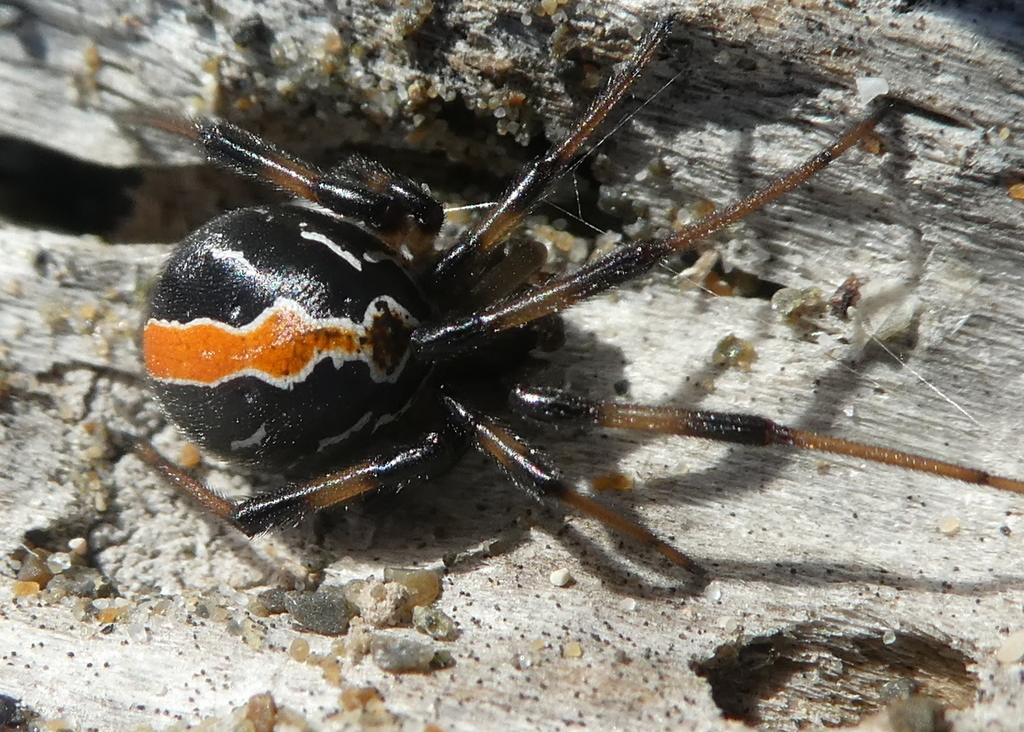
Katipō
Latrodectus katipo
Katipō (pronounced kah-tih-PAW or KAH-tə-poh; Latrodectus katipo) is a species of cobweb spider found only in New Zealand. It is one of many species in the genus Latrodectus and is most closely related to the Australian redback (L. hasseltii). It is venomous to humans, its bite being capable of producing the toxic syndrome latrodectism; symptoms include extreme pain and, potentially, hypertension or seizure. Bites are rare and antivenom is available in some hospitals. The female is 8–10 millimetres (0.31–0.39 in) in length; the male is 4–5 millimetres (0.16–0.20 in). In the South Island and the lower half of the North Island, the female has a distinct red stripe bordered in white on its abdomen; in more northern populations this stripe is absent, pale, yellow, or replaced with cream-coloured blotches. These two forms were previously thought to be separate species. The male is white with black stripes and red hourglass-shaped markings.
The katipō is mainly found living in sand dunes close to the seashore. It is found throughout most of coastal New Zealand except the far south and the West Coast. It feeds mainly on ground-dwelling insects, caught in an irregular tangled web spun among dune plants or other debris. After mating, the female katipō produces five or six egg sacs in November or December. The juveniles hatch after 20–25 days, and during January and February they disperse into surrounding plants. The common name is from Māori for "night stinger", which is derived from the words kakati (to sting) and pō (the night).
From the article Katipō on Wikipedia (CC BY-SA), quoted section by section
Description
As an adult, the female has a body size of 8–10 millimetres (0.31–0.39 in) or 35–41 millimetres (1.4–1.6 in) if leg span is included. The red katipō, found in the South Island and the lower North Island, has a large black globular abdomen with a silky appearance and a distinctive white-bordered orange or red stripe on its upper surface that runs from the beginning of the abdomen back to the spinnerets. The underside of the abdomen is black and has a red patch or partial red hourglass-shaped marking. For the black katipō, found in the upper North Island, the abdomen differs in not having the upper red/orange stripe and is overall somewhat lighter in colour. The hourglass pattern on the underside of the abdomen may also be less distinct, losing the middle section. Rare variations in black katipō also exist where the abdomen, cephalothorax, or entire body is brown, sometimes with a dull red or yellow stripe, or cream-coloured spots on its upper side. The katipō is most similar to its sister species Latrodectus hasselti. The katipō can be distinguished from L. hasselti by the short setae (hair-like spines) of the abdomen, whereas on the abdomen of L. hasselti it is a mix of long and short setae. There are also minor differences in the shape of the female and male genitalia structures. It may also be confused for Steatoda species, which are often present in the same habitat. …
Range & habitat
The katipō is only found in New Zealand. In the North Island it is found throughout the West Coast from North Cape to Wellington. On the east coast of the North Island it occurs irregularly, but it is abundant on Great Barrier Island. In the South Island it is found in coastal regions south to Dunedin on the east coast and south to Greymouth on the west coast. It has been proposed that this southern limit is due to the katipō needing warmer temperatures to allow for the development of their eggs. The red katipō is found south of the western tip of Taranaki on the west coast, and just north of Waipatiki Beach in Hawke's Bay on the east coast. The black katipō are found north of Aotea Harbour in the Waikato region on the west coast, and Waipiro Bay in the Gisbourne region on the east coast. Both forms are found in a transitionary area in between these aforementioned localities. These colour variants are strongly correlated with temperature, one study reporting that the red katipō is found in cooler areas with average temperatures of 11.24–13.85 °C (52.23–56.93 °F). In contrast, the black katipō is found in warmer areas with average temperatures of 13.64–16.23 °C (56.55–61.21 °F).
Habitat. The katipō is restricted to coastal sand dunes near the seashore. …
Wikipedia: “Distribution and habitat”
What it does
Once it becomes an adult, the male begins to search for a female with which to mate, possibly being guided by pheromones in female's silk. The male enters the female's web and gently vibrates the silk as he approaches her. The female is usually aggressive at first and will chase the male from the web. The courtship process consists of the male bobbing, plucking and tweaking the web along with periods of cautious approach and being chased by the female. Eventually, she becomes docile and allows him to approach. The male moves to the underside of her abdomen, tapping her rapidly until their abdomens are aligned in the same direction. He then inserts his palps (appendages modified for reproduction) into the female's reproductive tract one at a time. Copulation occurs over 10 to 30 minutes. After mating, the male retreats to groom, which is performed by running his palps and legs through his fangs and wiping them over his body. The male is not eaten by the female unlike some other widow spiders.
The female lays its eggs in November or December. The eggs are round, about the size of a mustard seed, and are a transparent, purplish red. They are held together in a cream-coloured, round, ball-shaped egg sac which is about 12 millimetres (0.47 in) in diameter. The female constructs five or six egg sacs over the next three to four weeks. …
Wikipedia: “Reproduction”
Toxicity
The katipō has venom that is medically significant in humans, meaning it has the potential to cause serious injury or death. Antivenom is available in some hospitals to treat bites. No deaths due to the bite have been recorded in medical settings. The incidence of bites is low as it is a shy, non-aggressive spider. Their narrow range, diminishing population, and human awareness of where they live means humans rarely encounter katipō. The katipō will only bite defensively. If the female is with an egg sac it will remain close by it and be more aggressive. Envenomation from bites of the katipō cause effects known as latrodectism. The venoms of all Latrodectus spiders are thought to contain similar components with the neurotoxin α-latrotoxin being the main agent responsible. One study reported that only the female is capable of biting humans. Māori legends recall deaths due to bites. One legend states that a group of Māori camped out at the mouth of the Whanganui River were bitten overnight, and two died. In Māori tradition, katipō bite victims would be treated by bathing them in hot water or covering the bite wound in red ochre, which supposedly reduced swelling and pain. Alternatively they would also cover the victim in smoke. Bites are very rare, 23 of the 37 known hospitalisations for spider bites between 1967 and 1976 in New Zealand being attributed to katipō bites. …
Wikipedia: “Toxicology”
In human culture
The common name and specific name katipō (singular and plural), often spelt "katipo", is Māori for "night stinger", derived from the words kakati (to sting) and pō (the night). It is one of the few Māori words that refers to a specific species of spider. The fully black variant is referred to as black katipō.
Wikipedia: “Etymology”
Where it lives
Recorded sightings
—
geo-referenced records in GBIF, from museums, herbaria and field observers.
Drag the globe to turn it. Dots are where records exist, not a range map; darker means more records.
In the stacks
Searching the stacks…
Every page naming Latrodectus katipo in the Biodiversity Heritage Library →
This page is assembled live from iNaturalist, GBIF, Wikipedia, the Source Library and the Internet Archive. It is not yet part of the hand-edited codex. iNaturalist taxon 391391.