- Animals
- ›Arthropods
- ›Hexapods
- ›Insects
- ›Winged and Once-winged Insects
- ›Butterflies and Moths
- ›Ermine Moths and Allies
- ›Plutellidae
- ›Leuroperna
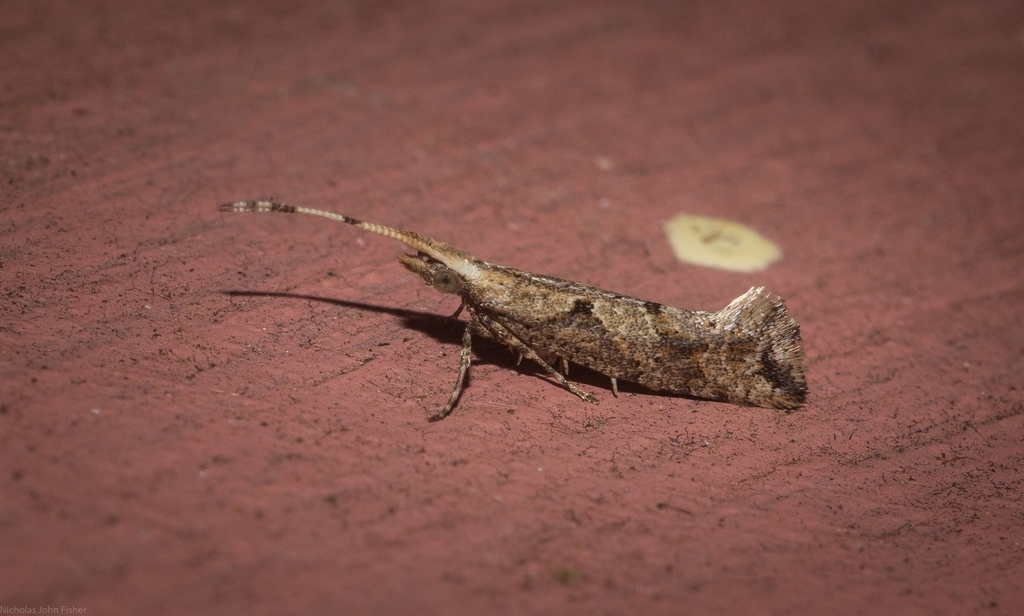
Leuroperna sera
Leuroperna sera is a moth of the Plutellidae family. It is found in south-east Asia and Australia. The wingspan is about 10 millimetres (0.39 in). The larvae feed on various Brassicaceae species.
From the article Leuroperna sera on Wikipedia (CC BY-SA), quoted section by section
Description
The wingspan of the adult is 10 millimetres (0.39 in). Similar to sympatric moth Plutella xylostella, but can be distinguished by much broader wings and genitalia. The caterpillar is about 10 mm in maximum length. Head with numerous blackish-brown dots. Body green to yellowish tinged with a slender red or pale red dorsal, subdorsal, supraspiracular, subspiracular, and basal lines. Pupa very similar to above mentioned species, but with a pair of hooked setae and maxilla is always shorter than the mid-leg. Pupation is in an open net-like white cocoon on leaf underside. Caterpillars of the two species co-exist in the crop plants.
Range & habitat
In New Zealand this species is regarded as a self-introduced resident and is found in the North Island and in the South Island down to Canterbury. It is regarded as relatively common.
Wikipedia: “Distribution”
What it does
Adults of this species can be observed on the wing all year round in the North Island of New Zealand but tend to be restricted to the summer months in the South Island. They are nocturnal and are attracted to light. When at rest adults hold their antennae in a forward v-shaped position.
Wikipedia: “Behaviour”
Listen
Looking for field recordings…
Where it lives
Recorded sightings
—
geo-referenced records in GBIF, from museums, herbaria and field observers.
Drag the globe to turn it. Dots are where records exist, not a range map; darker means more records.
In the stacks
Searching the stacks…
Every page naming Leuroperna sera in the Biodiversity Heritage Library →
This page is assembled live from iNaturalist, GBIF, Wikipedia, the Source Library and the Internet Archive. It is not yet part of the hand-edited codex. iNaturalist taxon 391597.