- Animals
- ›Arthropods
- ›Hexapods
- ›Insects
- ›Winged and Once-winged Insects
- ›Butterflies and Moths
- ›Bagworms, Clothes Moths, and Allies
- ›Bagworm Moths
- ›Mallobathra
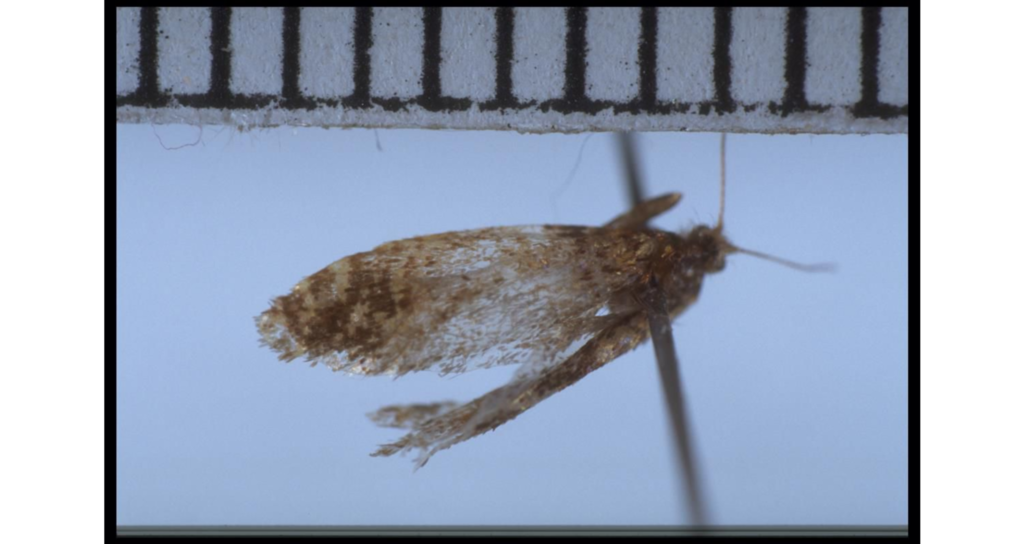
Mallobathra campbellica
Mallobathra campbellica is a moth of the family Psychidae. This species is endemic to New Zealand and is found only on Campbell Island. The larvae of this species inhabit leaf litter while the adults can be found in sheltered clearings amongst scrub. Adults are on the wing in December and January.
From the article Mallobathra campbellica on Wikipedia (CC BY-SA), quoted section by section
Description
Dugdale described the larvae of this species as follows:
D setae on 1st abdominal segment on two pinacula D1 (anterior, D1, D2 posterior); SV group tri-setose above each proleg; metathoracic posterior sternal setae closer together than anterior setae. Dugdale described the adult female of this species as follows:
Head with slender yellow scales; forewings with patches of yellowish scales on a purplish brown, slightly iridescent ground, hindwings dark grey, abdomen dark grey, scent gland scales long, hair-like, crimped at mid-length, pale yellow. Length (vertex to wing tip): 7.4 mm.
Range & habitat
The adults of this species inhabit sheltered clearings amongst scrub where as the larvae inhabit leaf litter.
== References ==
Wikipedia: “Habitat”
Listen
Looking for field recordings…
Where it lives
Recorded sightings
—
geo-referenced records in GBIF, from museums, herbaria and field observers.
Drag the globe to turn it. Dots are where records exist, not a range map; darker means more records.
In the stacks
Searching the stacks…
Every page naming Mallobathra campbellica in the Biodiversity Heritage Library →
This page is assembled live from iNaturalist, GBIF, Wikipedia, the Source Library and the Internet Archive. It is not yet part of the hand-edited codex. iNaturalist taxon 392045.