- Animals
- ›Arthropods
- ›Chelicerates
- ›Arachnids
- ›Mites and Ticks
- ›Acariformes
- ›Sarcoptiformes
- ›Endeostigmatan Mites
- ›Alycoidea
- ›Nanorchestidae
- ›Nanorchestes
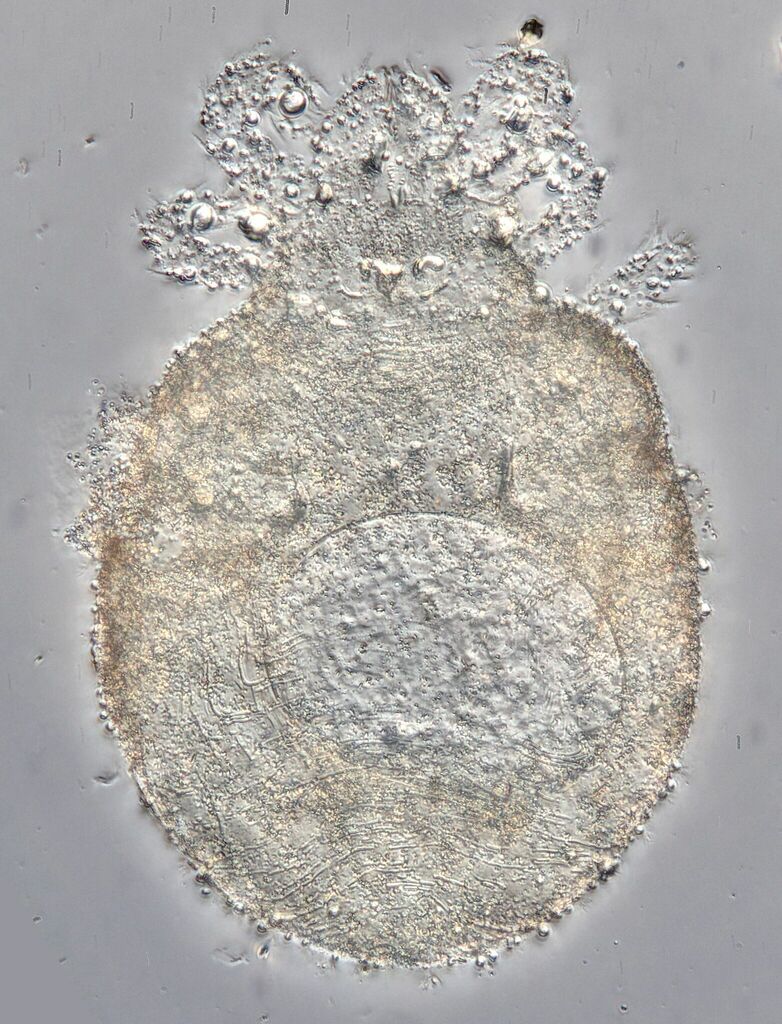
Nanorchestes antarcticus
Nanorchestes antarcticus is a species of mite in the family Nanorchestidae, first described by Womersley and Strandtmann in 1963 It is widely distributed across continental and maritime Antarctica and parts of the sub-Antarctic region, where it inhabits ice-free terrestrial environments. It is one of the smallest terrestrial mites and is notable for its tolerance of extreme cold.
From the article Nanorchestes antarcticus on Wikipedia (CC BY-SA), quoted section by section
Description
Nanorchestes antarcticus is a very small terrestrial mite, described as reddish, globular and iridescent, with an average body length of 240 μm for males and 230 μm for females. The dorsal surface bears two pairs of eyes. Diagnostic features include a deeply divided naso, a bifurcated cheliceral seta with two approximately equal branches, and characteristic arrangements of setae on the legs. The first and second pairs of legs also possess distinctive sensory structures on their tarsi. Strandtmann reported females containing fully developed larvae, suggesting that N. antarcticus is larviparous. Both sexes have eight pairs of genital setae on the genital plates. The number of genital setae varies with the developmental stage, with 6 pairs in tritonymphs, 3 in deutonymphs and 1 in protonymphs; larvae lack this.
Range & habitat
Nanorchestes antarcticus is recorded as one of the most abundant terrestrial arthropods in continental Antarctica. The species has been recorded in moss turf and carpet communities, barren scree, glacial deposits and sandy soils, as well as on glaciers. At Signy Island, it has been found from sea level all the way to the island's summit, at approximately 279m elevation. Populations of N. antarcticus appear to be most abundant in bryophyte habitats, with densities of approximately 1000-1200 individuals/m². Lower densities have been recorded in algae and soil habitats (100-800 individuals/m²) and glacial ice (around 180 individuals/m²). In one study, mites were active from October to March, when ground temperatures exceeded 0°C, and became immobile in deeper sand layers from April to September. Eggs were recorded as early as November, at depths of up to 4cm. Larvae occur during the austral summer, alongside increased numbers of nymphs. Its distribution and abundance are associated with environmental conditions including chlorophyll-a content and the presence of macroscopic algae; and negatively with soil salinity. More broadly, they are adapted to environments affected by seasonal snow and ice melt, which can allow them to survive sub-zero soil temperatures.
Wikipedia: “Distribution and habitat”
Where it lives
Recorded sightings
—
geo-referenced records in GBIF, from museums, herbaria and field observers.
Drag the globe to turn it. Dots are where records exist, not a range map; darker means more records.
In the stacks
Searching the stacks…
Every page naming Nanorchestes antarcticus in the Biodiversity Heritage Library →
This page is assembled live from iNaturalist, GBIF, Wikipedia, the Source Library and the Internet Archive. It is not yet part of the hand-edited codex. iNaturalist taxon 393069.