- Animals
- ›Arthropods
- ›Hexapods
- ›Insects
- ›Winged and Once-winged Insects
- ›Butterflies and Moths
- ›Geometrid and Swallowtail Moths
- ›Geometer Moths
- ›Carpet Moths
- ›Notoreas
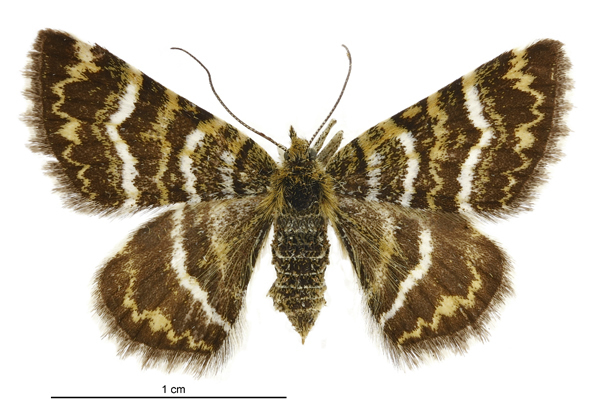
Black and Yellow Kelleria Looper
Notoreas mechanitis
Notoreas mechanitis is a species of moth in the family Geometridae. It is endemic to New Zealand.
From the article Notoreas mechanitis on Wikipedia (CC BY-SA), quoted section by section
Description
Meyrick described the species as follows:
Male, female. — 19-23 mm. Forewings moderate, hind margin rounded; dark fuscous, densely irrorated and median band almost wholly suffused with yellow; a nearly straight yellow or whitish line towards base, anteriorly strongly blackish-margined; an irregularly curved white line at 1⁄3, posteriorly strongly blackish-margined; a small blackish discal dot; an irregularly angulated slender dark fuscous median line, beyond which is another almost confluent with next line; a white line beyond middle, anteriorly strongly blackish-margined, strongly angulated in middle, subdentate beneath; a slender very sharply dentate irregular yellow subterminal line; cilia with basal half dark grey, apical half wholly white. Hindwings dark fuscous, base irrorated with yellow; an irregular obscure yellow fascia before middle; a white sinuate median line, sometimes yellow above; subterminal line and cilia as in forewings. Constant, except that the white markings tend to be suffused with yellow.
Range & habitat
N. mechanitis is endemic to New Zealand. Along with its type locality of Arthur's Pass, N. mechanitis has been found at Mount Arthur, Mount Hutt, Ben Lomond, the Hunter Mountains, at Shotover Saddle and Mount Eostre in Otago.
Wikipedia: “Distribution”
What it does
The female moth lays her eggs within the flower buds of their host plant. When the larvae emerge from their eggs, they eat into the leaves or buds of their host, hiding from predators. Once they are large enough, they emerge to feed from the fresh growth of the plant. N. mechanitis pupate in a loose cocoon on the ground under their host. N. mechanitis are day-flying moths. They are low but fast flyers and constantly vibrate their wings to enable them to take off rapidly. Adults are on the wing between January and March.
Wikipedia: “Life cycle and behaviour”
Listen
Looking for field recordings…
Where it lives
Recorded sightings
—
geo-referenced records in GBIF, from museums, herbaria and field observers.
Drag the globe to turn it. Dots are where records exist, not a range map; darker means more records.
In the stacks
Searching the stacks…
Every page naming Notoreas mechanitis in the Biodiversity Heritage Library →
This page is assembled live from iNaturalist, GBIF, Wikipedia, the Source Library and the Internet Archive. It is not yet part of the hand-edited codex. iNaturalist taxon 393560.