- Animals
- ›Arthropods
- ›Hexapods
- ›Insects
- ›Winged and Once-winged Insects
- ›Butterflies and Moths
- ›Geometrid and Swallowtail Moths
- ›Geometer Moths
- ›Carpet Moths
- ›Notoreas
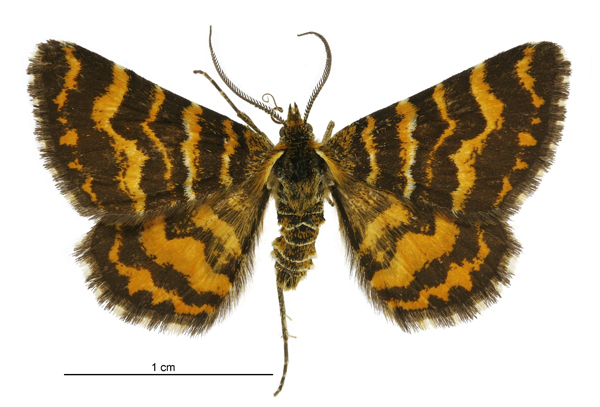
Pimelea Dandy
Notoreas perornata
Notoreas perornata is a species of moth in the family Geometridae. It is endemic to New Zealand and is found in the North Island from Northland to Westland as well as in the South Island on the coast of Marlborough. This species has two generations per year. Larval host plants are endemic species of Pimelea. The adult moths are day flying and are on the wing from October to November and March to April.
From the article Notoreas perornata on Wikipedia (CC BY-SA), quoted section by section
Description
Walker originally described the species as follows:
Male. Black, pilose, whitish cinereous beneath. Frontal tuft prominent. Palpi lanceolate, very pilose, as long as the breadth of the head; third joint conical, minute. Antennae moderately pectinated. Thorax with a white streak on each of the tegulae. Abdomen with luteous speckles; hind borders of the segments white. Fore wings hardly acute, with a slight cupreous tinge and with five luteous partly whitish bands; firsthand straight; second, third and fourth undulating; fifth macular; under side luteous, with five cupreous-black bands. Hind wings luteous, with three undulating cupreous-black bands; exterior border cupreous-black; under side partly white, with the lines accompanied by cupreous-black speckles. Length of the body 1+1⁄3 lines; of the wings 10 lines.
Range & habitat
N. perornata is endemic to New Zealand. This species is found in the North Island from Northland to Westland and in the South Island on the coast in Marlborough.
Wikipedia: “Distribution”
What it does
The female moth lays her eggs within the flower buds of their host plant. When the larvae emerge from their eggs, they eat into the leaves or buds of their host, hiding from predators. Once they are large enough, they emerge to feed from the fresh growth of the plant. N. perornata pupate in a loose cocoon on the ground under their host. N. perornata has two generations each year with adults on the wing in the months of October to November and March to April. However, in the northern parts of New Zealand this species may be multivoltine. N. perornata are day-flying moths. They are low but fast flyers and constantly vibrate their wings to enable them to take off rapidly.
Wikipedia: “Life cycle and behaviour”
Listen
Looking for field recordings…
Where it lives
Recorded sightings
—
geo-referenced records in GBIF, from museums, herbaria and field observers.
Drag the globe to turn it. Dots are where records exist, not a range map; darker means more records.
In the stacks
Searching the stacks…
Every page naming Notoreas perornata in the Biodiversity Heritage Library →
This page is assembled live from iNaturalist, GBIF, Wikipedia, the Source Library and the Internet Archive. It is not yet part of the hand-edited codex. iNaturalist taxon 393563.