- Animals
- ›Arthropods
- ›Hexapods
- ›Insects
- ›Winged and Once-winged Insects
- ›Butterflies and Moths
- ›Geometrid and Swallowtail Moths
- ›Geometer Moths
- ›Carpet Moths
- ›Pug Moths & Allies
- ›Pasiphila
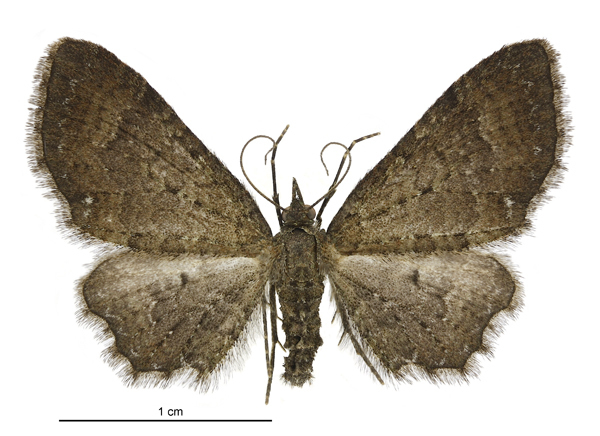
Pasiphila dryas
Pasiphila dryas is a moth of the family Geometridae. It was first described by Edward Meyrick in 1891. This species is endemic to New Zealand and has been observed in the southern half of the North Island and throughout the South Island. The larval host plant for this species is Veronica salicifolia. Adults are most commonly on the wing from November until May and may occasionally be observed during New Zealand's winter months. The adult moth is attracted to light.
From the article Pasiphila dryas on Wikipedia (CC BY-SA), quoted section by section
Description
Meyrick described the adult male of this species as follows:
♂. 25mm. Head, palpi, thorax, and abdomen light reddish-brown irrorated with blackish; palpi 2+1⁄2. Antennas light fuscous, ciliated with long fascicles (4). Legs dark fuscous, apex of joints whitish. Fore wings with hindmargin bowed, oblique, crenulate, slightly sinuate above anal angle; rather light reddish-brown; numerous curved waved cloudy dark fuscous transverse lines, somewhat marked with black on veins; anterior edge of median band from 3⁄8 of costa to 2⁄5 of inner margin, shortly angulated near costa; posterior edge from before 3⁄4 of costa to 3⁄4 of inner margin, forming a broadly-triangular projection in middle; a faint pale waved subterminal line, forming a whitish dot above anal angle : cilia pale brownish, irrorated with dark fuscous. Hindwings with hindmargin unevenly rounded, crenulate, sinuate above middle and above anal angle; light reddish-brown, irrorated with dark luscous, forming obscure waved transverse lines; a blackish hindmarginal line; cilia as in forewings. Hudson described the larva of this species as follows:
The larva ... …
Range & habitat
This species is endemic to New Zealand. This species has been observed in the southern half of the North Island and throughout the South Island.
Wikipedia: “Distribution”
What it does
The larva rest by clinging firmly to its host plant, and rigidly extends its body thus imitating a twig. This species pupates on the ground underneath its host plant. Adults are most commonly on wing from November until May but are occasionally observed in New Zealand's winter months. Adults are attracted to light.
== References ==
Wikipedia: “Behaviour”
Listen
Looking for field recordings…
Where it lives
Recorded sightings
—
geo-referenced records in GBIF, from museums, herbaria and field observers.
Drag the globe to turn it. Dots are where records exist, not a range map; darker means more records.
In the stacks
Searching the stacks…
Every page naming Pasiphila dryas in the Biodiversity Heritage Library →
This page is assembled live from iNaturalist, GBIF, Wikipedia, the Source Library and the Internet Archive. It is not yet part of the hand-edited codex. iNaturalist taxon 394646.