- Animals
- ›Arthropods
- ›Hexapods
- ›Insects
- ›Winged and Once-winged Insects
- ›Butterflies and Moths
- ›Curved-horn Moths
- ›Concealer Moths
- ›Proteodes
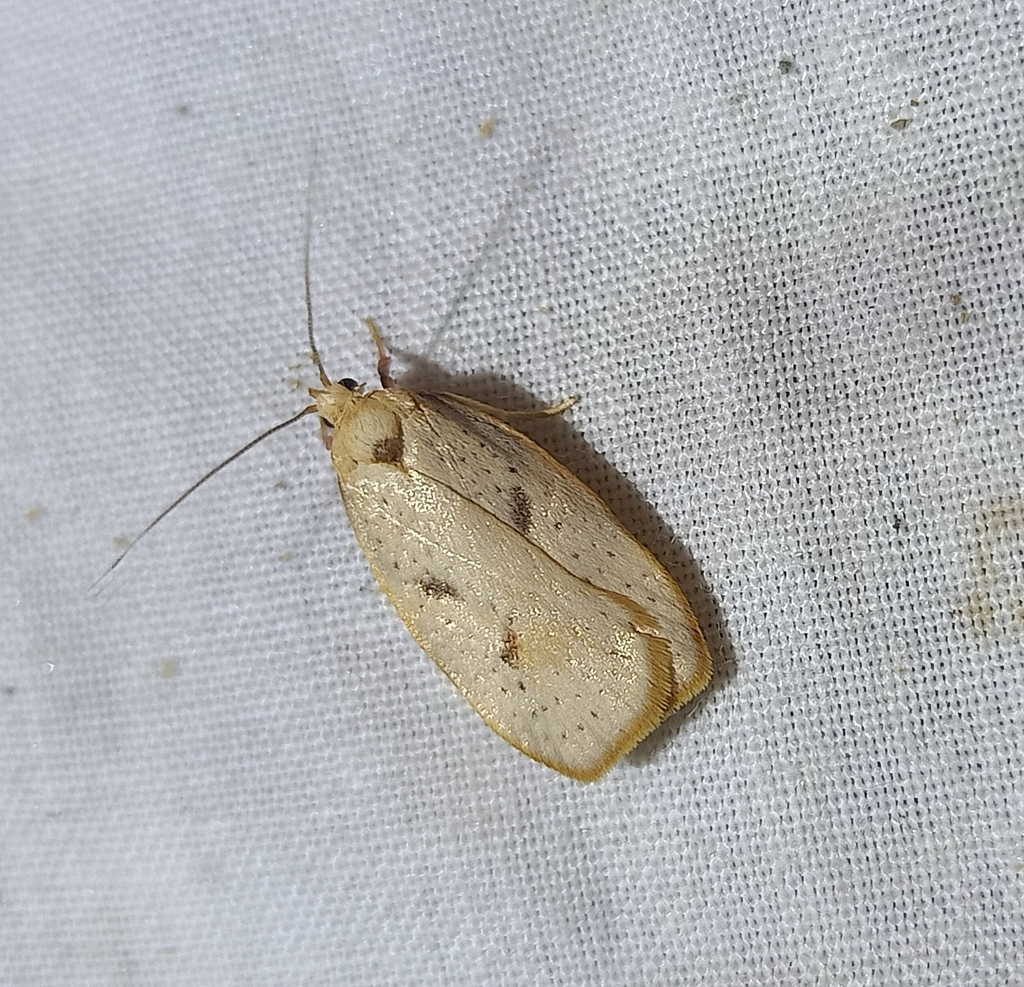
Mountain Beech Flat Moth
Proteodes carnifex
Proteodes carnifex (also known as the mountain beech flat moth) is a species of moth in the family Depressariidae. It is endemic to New Zealand. Both the larvae and the adults of this species are variable in appearance. However the adults are normally easily identified as the outline is characteristic and the size is consistent. In appearance, adult moths mimic the leaves of their larval host plants. This species has been found near Wellington in the North Island, the tableland of Mount Arthur, in the Canterbury region, Arthur's Pass and at Lake Wakatipu in the South Island. The larval hosts of this species are southern beech trees, particularly black beech (Nothofagus solandri) and mountain beech (Nothofagus cliffortioides) but larvae have also been found on red beech (Nothofagus fusca), hard beech (Nothofagus truncata) and silver beech (Nothofagus menziesii). The female moth deposits her eggs individually on the underside of native beech tree leaves. Once hatched the larvae feed on those leaves through winter and spring and then pupate in January. The adult moth emerges from the pupa after fourteen days and is on the wing from January until April. They are day flying moths and are not attracted to light. Various insects parasitise the larvae of this moth including several species of wasp as well as flies including the endemic fly, Pales funesta.
From the article Proteodes carnifex on Wikipedia (CC BY-SA), quoted section by section
Description
The larvae of this species, which has sixteen legs, was described by Hudson as follows:
rather stout, cylindrical, tapering behind; pale whitish-green or yellowish-green, generally more greyish-green on the sides; the dorsal line is broad, irregular, dark brownish-purple, sap-green or yellowish-green mixed with reddish-ochreous and bisected by a slender, interrupted, whitish line; the lateral line is sap green or obsolete; the sub-spiracular line is slender, interrupted, dark brownish purple or faintly pinkish; the spots are small, shining, dark brown; the head is ochreous-brown or yellowish green; the second segment is greener than the body, blackish marbled with pale ochreous, the larva generally being remarkably variable. Butler described the adults of the species as follows:
Primaries flesh-colour, costal margin blood red, the same colour also extending for a short distance down the fringe, which is throughout rather darker than the body of the wing; secondaries white, slightly tinted with flesh-colour at the borders; thorax flesh-coloured; palpi and femora and tibiae of anterior legs carmine : wings below nearly as above, excepting that the secondaries show three or four apical marginal dark grey spots; body below white. Expanse of wings 11 lines. Hudson noted that there is variation in the colour of the forewings of this species. …
Range & habitat
This species is endemic to New Zealand. It has been found near Wellington in the North Island, the tableland of Mount Arthur, in the Canterbury region, Arthur's Pass and at Lake Wakatipu in the South Island. It is more common in the South Island than in the North Island.
Wikipedia: “Distribution”
What it does
The female moth can lay up to 300 eggs and she deposits them individually on the underside of native beech leaves. There is only one generation a year. The larvae feed on those tree leaves from winter to early summer. The larvae make a web of silk and leaf hairs camouflaging themselves amongst the leaves, and proceed to feed from this shelter. It pupates amongst dead leaves making a slight cocoon around the short, stout, pale green and brown pupa. The adult moth emerges from the pupa after approximately fourteen days. The adults are on the wing from January to April. They are a day flying moth and when inactive rest on beech leaves, which their appearance mimics. The adult moths are not attracted to light.
Wikipedia: “Behaviour and life cycle”
Listen
Looking for field recordings…
Where it lives
Recorded sightings
—
geo-referenced records in GBIF, from museums, herbaria and field observers.
Drag the globe to turn it. Dots are where records exist, not a range map; darker means more records.
In the stacks
Searching the stacks…
Every page naming Proteodes carnifex in the Biodiversity Heritage Library →
This page is assembled live from iNaturalist, GBIF, Wikipedia, the Source Library and the Internet Archive. It is not yet part of the hand-edited codex. iNaturalist taxon 395725.