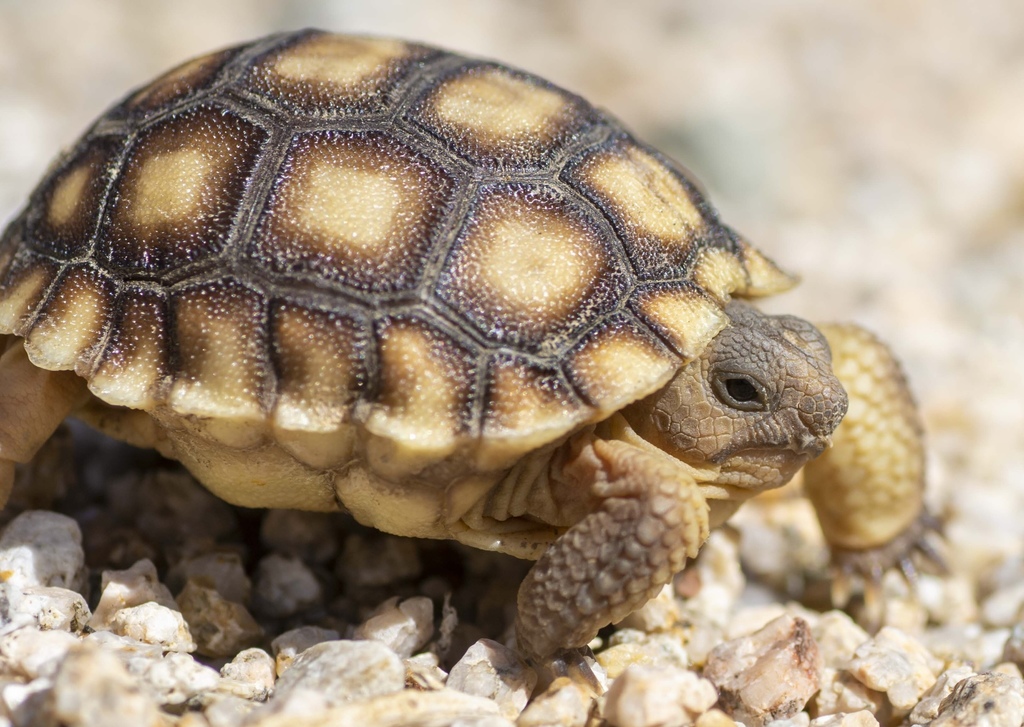
Mojave Desert Tortoise
Gopherus agassizii
The desert tortoise (Gopherus agassizii) is a species of tortoise in the family Testudinidae. The species is native to the Mojave and Sonoran Deserts of the southwestern United States and northwestern Mexico, and to the Sinaloan thornscrub of northwestern Mexico. G. agassizii is distributed in western Arizona, southeastern California, southern Nevada, and southwestern Utah. The specific name agassizii is in honor of Swiss-American zoologist Jean Louis Rodolphe Agassiz. The desert tortoise is the official state reptile in California and Nevada.
The desert tortoise lives 70 to 80 years on average; it grows slowly and generally has a low reproductive rate. It spends most of its time in burrows, rock shelters, and pallets to regulate body temperature and reduce water loss. It is most active after seasonal rains and is inactive during most of the year. This inactivity helps reduce water loss during hot periods, whereas winter brumation facilitates survival during freezing temperatures and low food availability. Desert tortoises can tolerate water, salt, and energy imbalances on a daily basis, which increases their lifespans.
From the article Desert tortoise on Wikipedia (CC BY-SA), quoted section by section
Description
These tortoises may attain a length of 25 to 36 cm (10 to 14 in), with males being slightly larger than females. A male tortoise has a longer gular horn than a female, his plastron (lower shell) is concave compared to a female tortoise. Males have larger tails than females do. Their shells are high-domed, and greenish-tan to dark brown in color. The high domes of their shells allow for space for their lungs, which helps them maintain thermoregulation, also known as maintaining internal temperature. Desert tortoises can grow to 10–15 cm (4–6 in) in height. They can range in weight from 8 to 15 pounds, or 3.5 kg to 7 kg. The front limbs have sharp, claw-like scales and are flattened for digging. Back legs are skinnier and very long.
Range & habitat
Desert tortoises can live in areas with ground temperatures exceeding 60 °C (140 °F) because of their ability to dig burrows and escape the heat. At least 95% of their lives are spent in burrows. There, they are also protected from freezing winter weather while dormant, from November through February or March. Within their burrows, these tortoises create a subterranean environment that can be beneficial to other reptiles, mammals, birds, and invertebrates. Scientists have divided the desert tortoise into three species: Agassiz's and Morafka's desert tortoises, with a third species, Goode's thornscrub tortoise, in northern Sinaloa and southern Sonora, Mexico. An isolated population of Agassiz's desert tortoise occurs in the Black Mountains of northwestern Arizona. They live in a different type of habitat, from sandy flats to rocky foothills. They have a strong proclivity in the Mojave Desert for alluvial fans, washes, and canyons where more suitable soils for den construction might be found. They range from near sea level to around 1,050 m (3,500 ft) in elevation. …
Wikipedia: “Habitat”
What it does
Tortoises mate in the spring and autumn. Male desert tortoises grow two large white glands around the chin area, called chin glands, that signify mating season. A male circles around the female, biting her shell in the process. He then climbs upon the female and insert his penis (a white organ, usually only seen upon careful inspection during mating, as it is hidden inside the male and can only be coaxed out with sexual implication) into the cloaca of a female, which is located around the tail. The male may make grunting noises once atop a female, and may move his front legs up and down in a constant motion, as if playing a drum.
Months later, the female lays a clutch of four to eight hard-shelled eggs, which have the size and shape of ping-pong balls, usually in June or July. The eggs hatch in August or September. Wild female tortoises produce up to three clutches a year depending on the climate. Their eggs incubate from 90 to 135 days; some eggs may overwinter and hatch the following spring. In a laboratory experiment, temperature influenced hatching rates and hatchling sex. Incubation temperatures from 27 to 31 °C (81 to 88 °F) resulted in hatching rates exceeding 83%, while incubation at 25 °C (77 °F) resulted in a 53% hatching rate. Incubation temperatures less than 31 °C (88 °F) resulted in all-male clutches. …
Wikipedia: “Reproduction”
Where it lives
Recorded sightings
—
geo-referenced records in GBIF, from museums, herbaria and field observers.
Drag the globe to turn it. Dots are where records exist, not a range map; darker means more records.
In the stacks
Searching the stacks…
Every page naming Gopherus agassizii in the Biodiversity Heritage Library →
This page is assembled live from iNaturalist, GBIF, Wikipedia, the Source Library and the Internet Archive. It is not yet part of the hand-edited codex. iNaturalist taxon 40086.