- Animals
- ›Arthropods
- ›Hexapods
- ›Insects
- ›Winged and Once-winged Insects
- ›Ants, Bees, Wasps, and Sawflies
- ›Narrow-waisted Wasps, Ants, and Bees
- ›Ants, Bees, and Stinging Wasps
- ›Formicoidea
- ›Ants
- ›Odorous Ants
- ›Leptomyrmecini
- ›Doleromyrma
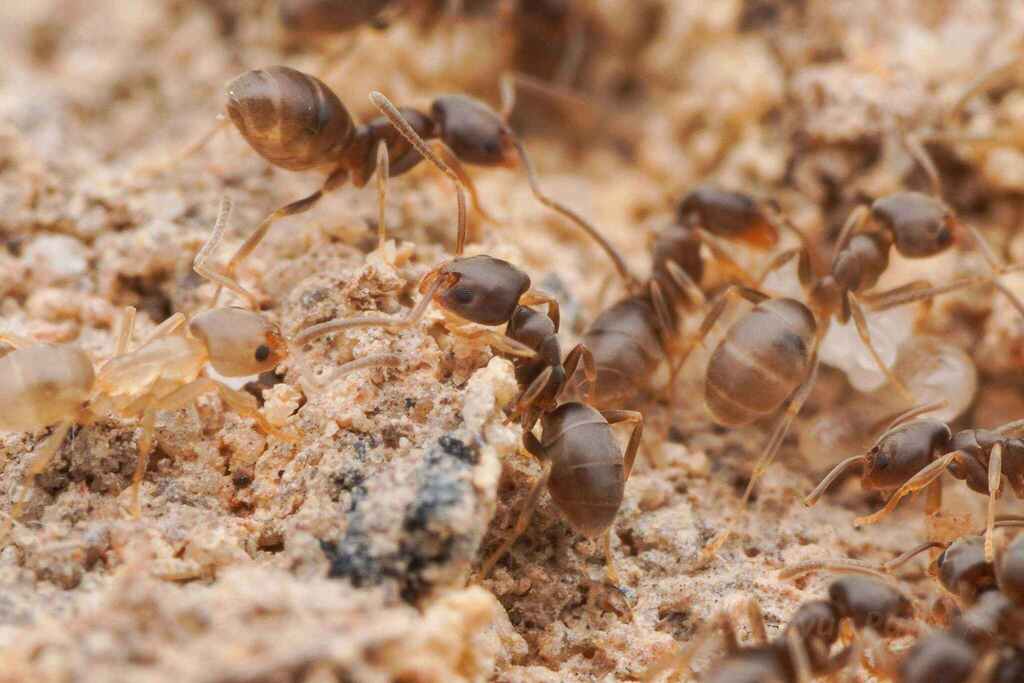
Darwin's Ant
Doleromyrma darwiniana
Doleromyrma darwiniana is a species of ant in the genus Doleromyrma. Described by Forel in 1907, the species is endemic to Australia and introduced to New Zealand, and it nests in soil or under stones and logs. The organism grows to a length between 2.0 and 3.0 millimeters. This species of ant maintains small colony sizes and it "prefers protein food." The species is also known by some sources as the "brown house ant" and "Darwin's ant". The species is considered a "minor urban pest" in New South Wales.
From the article Doleromyrma darwiniana on Wikipedia (CC BY-SA), quoted section by section
Range & habitat
Darwin's ant is a species that is Endemic to Australia. Within Australia, they have been confirmed in regions of Victoria, South and Western Australia, New South Wales, Tasmania and also coastal areas of the Northern Territory.
Wikipedia: “Natural global range”
What it does
Darwin's ant lives in colonies like most other ants, meaning that there are queens, workers, adult males and a brood. There is very little information to be found on the phenology of Darwin's ant, and so it is compared with that of a similar ant, the Argentine ant, Iridomyrmex humilis. So, in the Argentine ant, the queens are fertilized by males that are in the nest, causing the queens to lay eggs which are pearly white in colour and shaped elliptically. Time for eggs to hatch: 12–60 days Larval stage completion: 11–60 days Pupal stage: 10–25 days The average period between egg to adult: 75 days The ants will not disperse until food supplies are low or conditions are unfavorable and as they can survive underwater for large periods of time when they do disperse it can be by methods of floating on storm water or rivers. The main condition is that a fertile queen is transported as new workers being introduced to an area is not enough to start a colony. At present, the main dispersal route is using human commerce, such as pot plants, previously discussed or by transport of timber or rubbish. Colonies can be very small or very large, varying between dozens and thousands. There can also be multiple queen ants.
Wikipedia: “Life cycle/phenology”
Listen
Looking for field recordings…
Where it lives
Recorded sightings
—
geo-referenced records in GBIF, from museums, herbaria and field observers.
Drag the globe to turn it. Dots are where records exist, not a range map; darker means more records.
In the stacks
Searching the stacks…
Every page naming Doleromyrma darwiniana in the Biodiversity Heritage Library →
This page is assembled live from iNaturalist, GBIF, Wikipedia, the Source Library and the Internet Archive. It is not yet part of the hand-edited codex. iNaturalist taxon 408587.