- Animals
- ›Arthropods
- ›Hexapods
- ›Insects
- ›Winged and Once-winged Insects
- ›Butterflies and Moths
- ›Pyralid and Crambid Snout Moths
- ›Crambid Snout Moths
- ›Moss-eating Crambid Snout Moths
- ›Scoparia
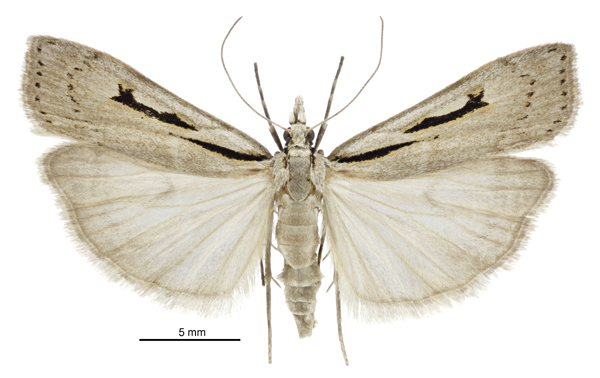
Scoparia rotuella
Scoparia rotuella is a species of moth in the family Crambidae. It was first described by Cajetan Felder, Rudolf Felder and Alois Friedrich Rogenhofer in 1875. It is endemic to New Zealand and, although considered localised, is found throughout the country. As of 2022, the life history of this species is largely unknown, but it has been hypothesised that this species may have two broods a year. Adults are on the wing all year round and are attracted to light.
From the article Scoparia rotuella on Wikipedia (CC BY-SA), quoted section by section
Description
The wingspan is 28–29 mm. The forewings are light greyish ochreous, irrorated (speckled) with white beneath the costa. There is a black median streak from the base of the costa to the disc, margined with clear yellowish ochreous. The first line has the form of a sharply defined black streak, margined with clear yellowish ochreous. The second line is represented by a row of black dots and there is a terminal row of black dots. The hindwings are very pale ochreous grey.
Range & habitat
S. rotuella is endemic to New Zealand. This species has been observed in the North, South and Stewart Islands as well as on Campbell Island and Chatham Island. It is regarded as being localised, that is restricted to certain localities within those islands. This species has been observed at altitudes ranging from sea-level to elevations of about 1,200 m.
Wikipedia: “Distribution”
What it does
The life history of this species is largely unknown. However it has been hypothesised that there are two broods in a year. The adult moths have been collected all year round. Adults attracted to light and have been collected via a mercury vapour light trap. They have been shown to pollinate Helichrysum selago and Veronica salicifolia.
Wikipedia: “Behaviour”
Listen
Looking for field recordings…
Where it lives
Recorded sightings
—
geo-referenced records in GBIF, from museums, herbaria and field observers.
Drag the globe to turn it. Dots are where records exist, not a range map; darker means more records.
In the stacks
Searching the stacks…
Every page naming Scoparia rotuella in the Biodiversity Heritage Library →
This page is assembled live from iNaturalist, GBIF, Wikipedia, the Source Library and the Internet Archive. It is not yet part of the hand-edited codex. iNaturalist taxon 409094.