- Animals
- ›Arthropods
- ›Hexapods
- ›Insects
- ›Winged and Once-winged Insects
- ›Butterflies and Moths
- ›Geometrid and Swallowtail Moths
- ›Geometer Moths
- ›Carpet Moths
- ›Pug Moths & Allies
- ›Pasiphila
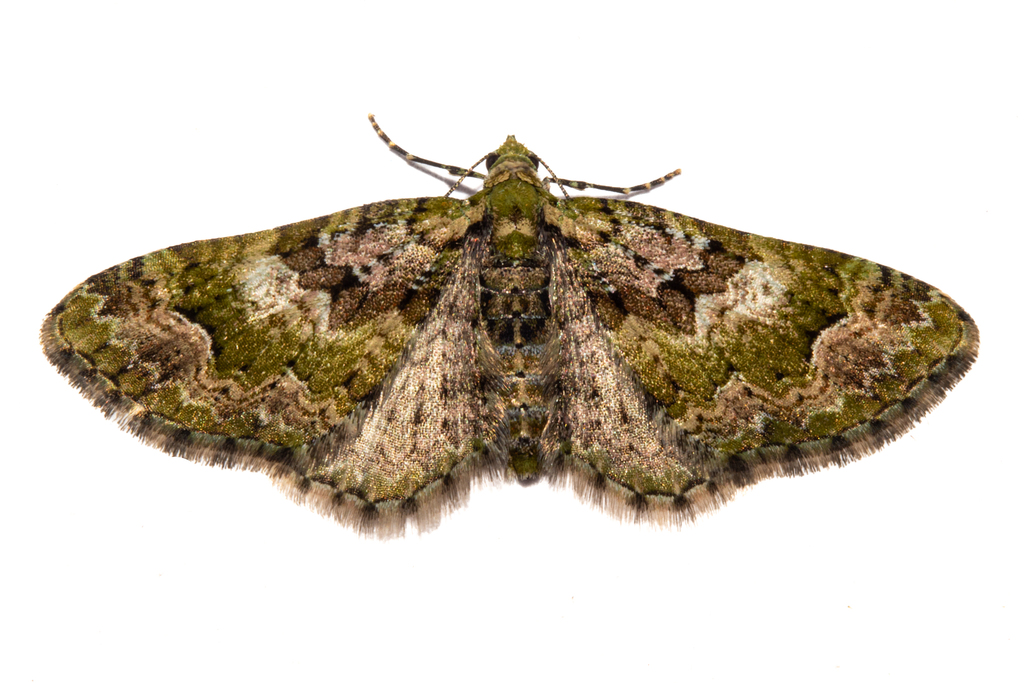
Pasiphila punicea
Pasiphila punicea is a moth of the family Geometridae. This species was first described by Alfred Philpott in 1923. It is endemic to New Zealand and has been observed in the North and South Islands. The species inhabits native forest and scrub and has an affinity for Veronica species.
From the article Pasiphila punicea on Wikipedia (CC BY-SA), quoted section by section
Description
Philpott described the male of this species as follows:
♂. 25mm. Head green mixed with yellow. Palpiochreous. Antennae shaft ochreous, annulated with brown, ciliations 4. Thorax green, densely mixed with ochreous and golden scales. Abdomen green, much mix with blackish on basal segments and with ochreous on apical ones ; anal tuft whitish ; a black spot on five or six median segments. Legs whitish-ochreous, anterior tarsi annulated with dark fuscous. Forewings, costa almost straight, apex abtuse, termen evenly rounded, bright green irrorated with fuscous and sprinkled with yellow ; an indistinct curved waved lines preceding first and the whole area flushed with pink ; median band traversed by several indistinct irregular thin fuscous lines ; posterior edge of median band twice incurved оп upper half, thence irregularly incurved to dorsum, broadly margined with a pink area posteriorly which is traversed by several indistinct fuscous lines following the contour of the band; a serrated clear green subterminal line; termen marked with an almost continuous blackish line: cilia greyish-green barred with black. …
Range & habitat
This species is endemic to New Zealand and is found in both the North and South Islands.
Wikipedia: “Distribution”
What it does
This species is commonly on the wing in November and December. Adults are attracted to light.
== References ==
Wikipedia: “Behaviour”
Listen
Looking for field recordings…
Where it lives
Recorded sightings
—
geo-referenced records in GBIF, from museums, herbaria and field observers.
Drag the globe to turn it. Dots are where records exist, not a range map; darker means more records.
In the stacks
Searching the stacks…
Every page naming Pasiphila punicea in the Biodiversity Heritage Library →
This page is assembled live from iNaturalist, GBIF, Wikipedia, the Source Library and the Internet Archive. It is not yet part of the hand-edited codex. iNaturalist taxon 410106.