- Animals
- ›Arthropods
- ›Hexapods
- ›Insects
- ›Winged and Once-winged Insects
- ›Butterflies and Moths
- ›Curved-horn Moths
- ›Concealer Moths
- ›Tingena
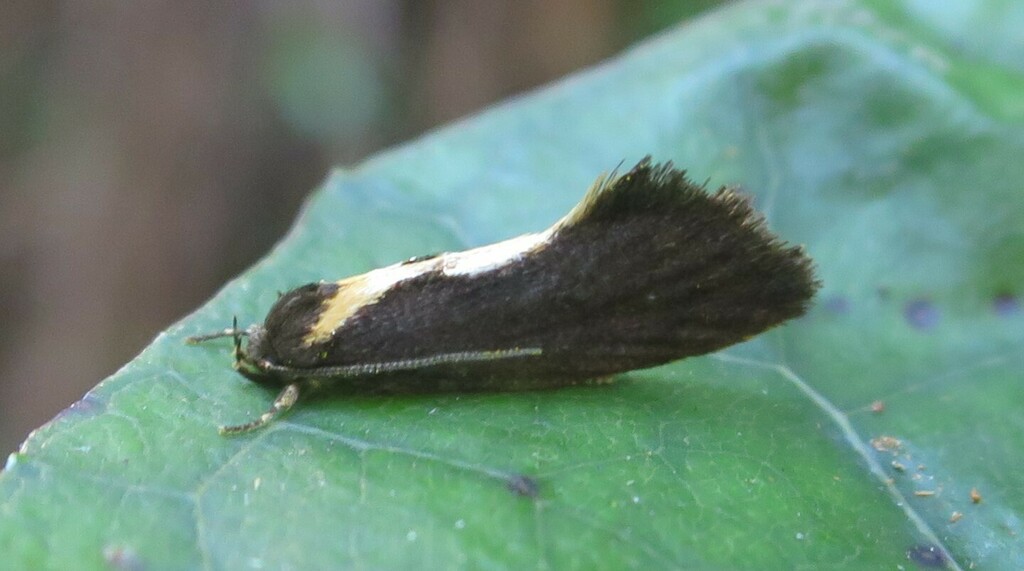
Tingena basella
Tingena basella is a species of moth in the family Oecophoridae. It is endemic to New Zealand and has been found in both the North and South Islands. The preferred habitat of this species is scrubland or light forest. Eggs are deposited either singly or in egg masses. The larvae are littler leaf feeders. The adults of this species are on the wing from October through to the middle of December. George Hudson stated that he had collected numerous specimens of both sexes amongst the flowers of Brachyglotis repanda.
From the article Tingena basella on Wikipedia (CC BY-SA), quoted section by section
Description
The eggs of this species can be deposited either singly or alternatively in egg masses. Hudson described the eggs as follows:
sub-cylindrical, much flattened, often partially collapsed, with rows of extremely indistinct hexagonal depressions; dull white with faint iridescent reflections. Walker described the adult male of the species as follows:
Male. Cupreous-brown. Antennae minutely pubescent, less than half the length of the fore wings. Fore wings rounded at the tips, with a short broad pale yellow streak along the basal part of the interior border; exterior border very oblique. Length of the body 4 lines; of the wings 12 lines.In comparison to its close relatives this species is larger and is variable in appearance. The male of the species sometimes has forewings that are greyish brown or alternatively can be coloured a warm brown with tinges of yellow. The hindwings are also variable in appearance with the depth of grey varying. The female of the species has brown mottled forewings thought the depth of this mottling can vary and in some cases may be almost absent.
Range & habitat
This species is endemic to New Zealand and has been observed in the Coromandel, Kaitoke, Wellington, Ōtira River, Christchurch, Blue Cliff, and Invercargill.
Wikipedia: “Distribution”
What it does
The adults of this species are on the wing from October through to the middle of December. The wings of this species are easily worn. This species drops to the ground when disturbed and can be difficult to locate as a result of its colouring. The male, when it does fly, is made inconspicuous as a result of its dark colouring. The adult female of the species is a reluctant flyer. Hudson has stated that he had collected numerous specimens of both sexes amongst the flowers of Brachyglotis repanda.
Wikipedia: “Behaviour”
Listen
Looking for field recordings…
Where it lives
Recorded sightings
—
geo-referenced records in GBIF, from museums, herbaria and field observers.
Drag the globe to turn it. Dots are where records exist, not a range map; darker means more records.
In the stacks
Searching the stacks…
Every page naming Tingena basella in the Biodiversity Heritage Library →
This page is assembled live from iNaturalist, GBIF, Wikipedia, the Source Library and the Internet Archive. It is not yet part of the hand-edited codex. iNaturalist taxon 410415.