- Plants
- ›Vascular Plants
- ›flowering plants
- ›Dicots
- ›Nances, Willows, and Allies
- ›ochna family
- ›Ochnoideae
- ›Ochneae
- ›Ochna
peeling plane
Ochna pulchra
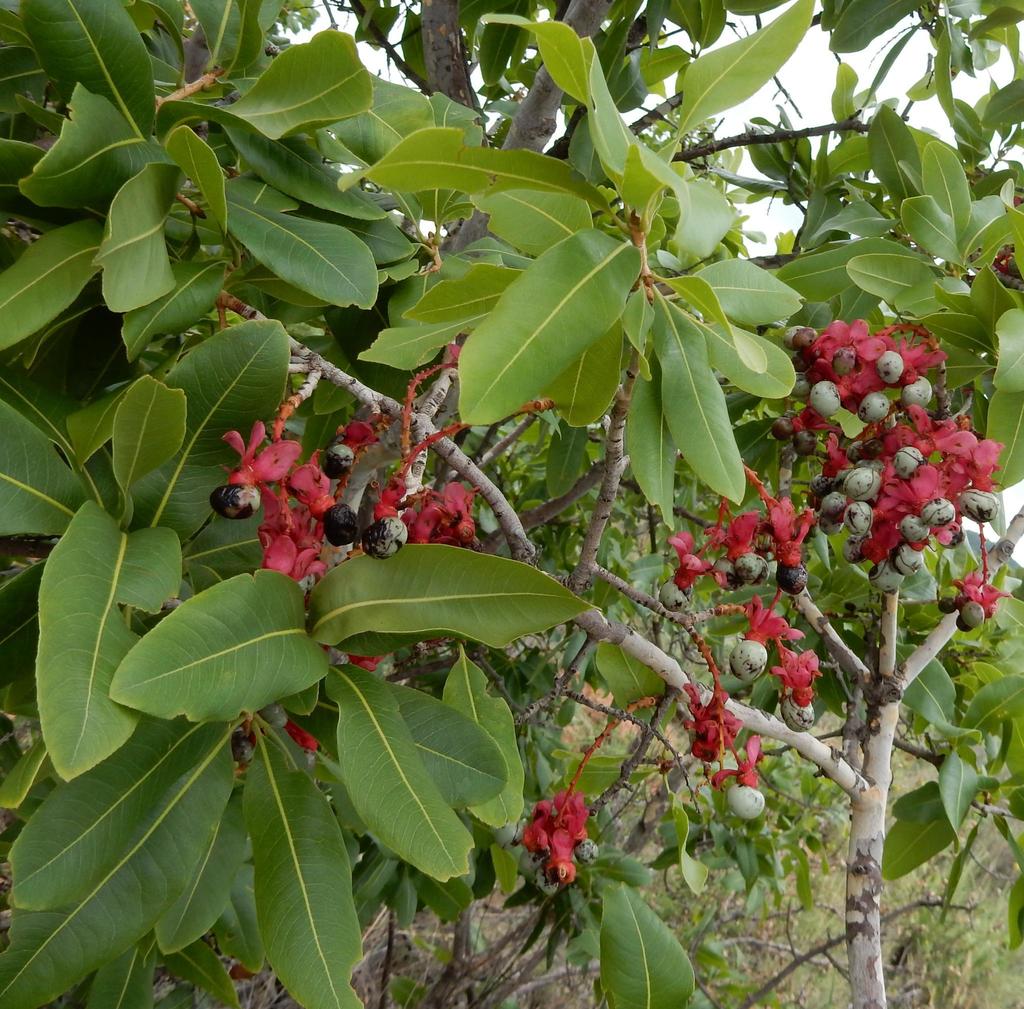
Ochna pulchra, also known as Lekkerbreek (Afrikaans 'breaking easily', i.e. 'brittle'), is a small deciduous southern African tree up to 5 m, commonly found on deep sandy soil and rocky slopes, and belonging to the tropical family of Ochnaceae, which is widespread in Asia and Africa.
From the article Ochna pulchra on Wikipedia (CC BY-SA), quoted section by section
Description
Its bark is distinctive, peeling in thin flakes to expose creamy-white underbark, similar in appearance to that of Corymbia maculata, guava or Pride-of-India. Spring foliage has an oily appearance to the surface and ranges from light green to bronze or bright red, turning to a fresh, shiny green when mature. Lemon-yellow flowers appear in great abundance in spring, the persistent yellow-green calyx turning pink then bright red. The fruit, a kidney-shaped drupe, is initially green maturing to black.
Range & habitat
The tree occurs in the central Transvaal and northern Kruger National Park, extending further to Mozambique, Zimbabwe, Botswana, Angola, Zambia and the Democratic Republic of Congo. It is an indicator species of so-called Gifveld, that is veld where the toxic Dichapetalum cymosum is present, which is small and easily overlooked.
Wikipedia: “Range”
Where it lives
Recorded sightings
—
geo-referenced records in GBIF, from museums, herbaria and field observers.
Drag the globe to turn it. Dots are where records exist, not a range map; darker means more records.
In the stacks
Searching the stacks…
Every page naming Ochna pulchra in the Biodiversity Heritage Library →
This page is assembled live from iNaturalist, GBIF, Wikipedia, the Source Library and the Internet Archive. It is not yet part of the hand-edited codex. iNaturalist taxon 416644.