- Animals
- ›Cnidarians
- ›Sea Anemones and Corals
- ›Hexacorallians
- ›Sea Anemones
- ›Enthemonae
- ›Actinioidea
- ›Stichodactylidae
- ›Stichodactyla
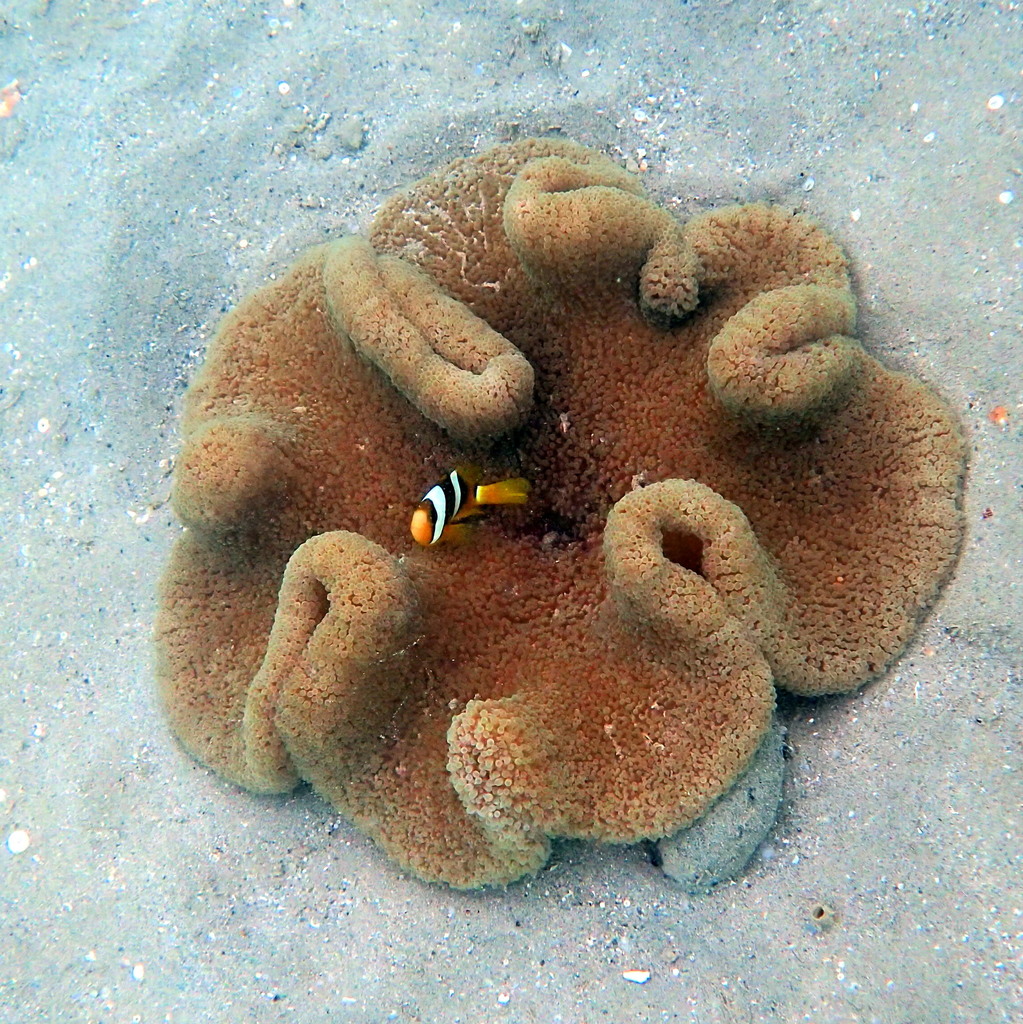
Haddon's Anemone
Stichodactyla haddoni
Stichodactyla haddoni, commonly known as Haddon's sea anemone, is a species of sea anemone belonging to the family Stichodactylidae. It occurs in the Indo-Pacific region.
From the article Stichodactyla haddoni on Wikipedia (CC BY-SA), quoted section by section
Description
S. haddoni is characterized by a folded oral disc that reaches 50–80 cm (20–31 in) in diameter with a 1–2 cm (0.4–0.8 in) tentacle-free oral area. The tentacles have a rounded tip and the end may be green, yellow, gray, or rarely, blue and pink. The column, visible when the animal is closed, has small, non-adhesive bumps (verrucae) which are usually the same color as the column and not visible. The tentacles are yellowish or tan. At the circumference it has alternating short and long tentacles.
Range & habitat
S. haddoni is found on sandy substrates and is widely distributed throughout the tropical and subtropical waters of the Indo-Pacific region, from Mauritius to Fiji and from the Ryukyu Islands of southern Japan to Australia.
Wikipedia: “Distribution and habitat”
At the table
In Thailand, S. haddoni is called Hed lub (เห็ดหลุบ, "bob up and down mushroom") what with its appearance, which resembles a mushroom that pops up and down. On some islands, such as Ko Samui or Ko Pha-ngan, these sea anemones are used as an ingredient in a local seasonal dish called Kaeng kua (แกงคั่ว), even though they are protected animals in Thailand.
Wikipedia: “As food”
Where it lives
Recorded sightings
—
geo-referenced records in GBIF, from museums, herbaria and field observers.
Drag the globe to turn it. Dots are where records exist, not a range map; darker means more records.
In the stacks
Searching the stacks…
Every page naming Stichodactyla haddoni in the Biodiversity Heritage Library →
This page is assembled live from iNaturalist, GBIF, Wikipedia, the Source Library and the Internet Archive. It is not yet part of the hand-edited codex. iNaturalist taxon 424142.