- Plants
- ›Vascular Plants
- ›flowering plants
- ›monocots
- ›Agaves, Orchids, Irises, and Allies
- ›Orchids
- ›Apostasioid Orchids
- ›Apostasia
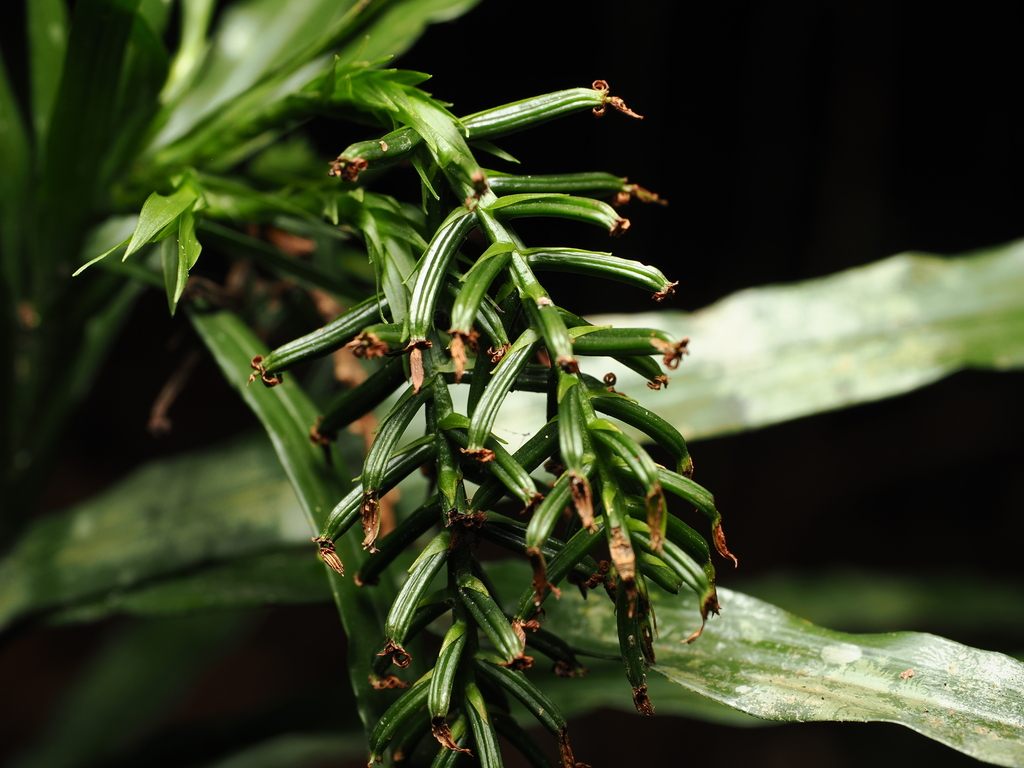
Apostasia nuda
Apostasia nuda, or Grass Orchid, is a terrestrial orchid within the Orchidaceae family and the Apostasioideae subfamily. Most commonly found in the Mainland and Islands of Southeast Asia, this species remains native to Singapore. This perennial growing shrub is considered “critically endangered” in regions of Singapore due to deforestation and environmental pressures.
From the article Apostasia nuda on Wikipedia (CC BY-SA), quoted section by section
Description
A. nuda grows from a thin rhizome with fibrous roots, forming an erect stem that can reach up to 30-70 cm tall. Appearing similar to grass, the leaves are lanceolate to linear shaped, with parallel venation and alternate and distichous arrangements along the stem. The leaf dimensions range from 10-30 cm long and 1-3 cm wide. The inflorescence is terminal bearing several radially symmetrical flowers in the upper leaf axils. Each flower is small, measuring approximately 1-2 cm in diameter, appears in either a pale yellow, creamy white, or white color. There are three sepals and three petals. Both are very similar in size and shape and number, allowing them to be considered tepals. These tepals are unfused to each other and bend outward. The dimensions range from 3-5mm long and reaching up to 1mm wide. Not to be confused with the regular perianth whorl, the labellum is a modified petal known as the “lip” that is distinct to orchids only. In A. nuda, the labellum is unlobed and concave. Although there is poor differentiation from the other unmodified perianth whorls, the lip may curve slightly backward instead. In the reproductive parts of the flower, two or sometimes three fertile are seen with some fusion seen at the base of the filaments. This is a characteristic feature of the genus Apostasia and unusual within Orchidaceae, where a single stamen is observed. …
Range & habitat
Apostasia nuda is distributed across tropical South and Southeast Asia, where it flourishes in the forest undergrowths and outskirts, sometimes rarely blooming in open grassy areas with well drained soils. Although this specimen is considered annual as flowering occurs year-round, the flowering time actually is dependent by region. Generally blooming in its native tropical habitats, flowering peaks during the warmer, wetter months where there is increased humidity and rainfall.
Wikipedia: “Distribution and habitat”
Where it lives
Recorded sightings
—
geo-referenced records in GBIF, from museums, herbaria and field observers.
Drag the globe to turn it. Dots are where records exist, not a range map; darker means more records.
In the old herbals & bestiaries

In the stacks
Searching the stacks…
Every page naming Apostasia nuda in the Biodiversity Heritage Library →
This page is assembled live from iNaturalist, GBIF, Wikipedia, the Source Library and the Internet Archive. It is not yet part of the hand-edited codex. iNaturalist taxon 425498.