- Plants
- ›Vascular Plants
- ›flowering plants
- ›monocots
- ›Agaves, Orchids, Irises, and Allies
- ›Orchids
- ›Orchidoid Orchids
- ›Cranichideae
- ›Jewel Orchids
- ›Ludisia
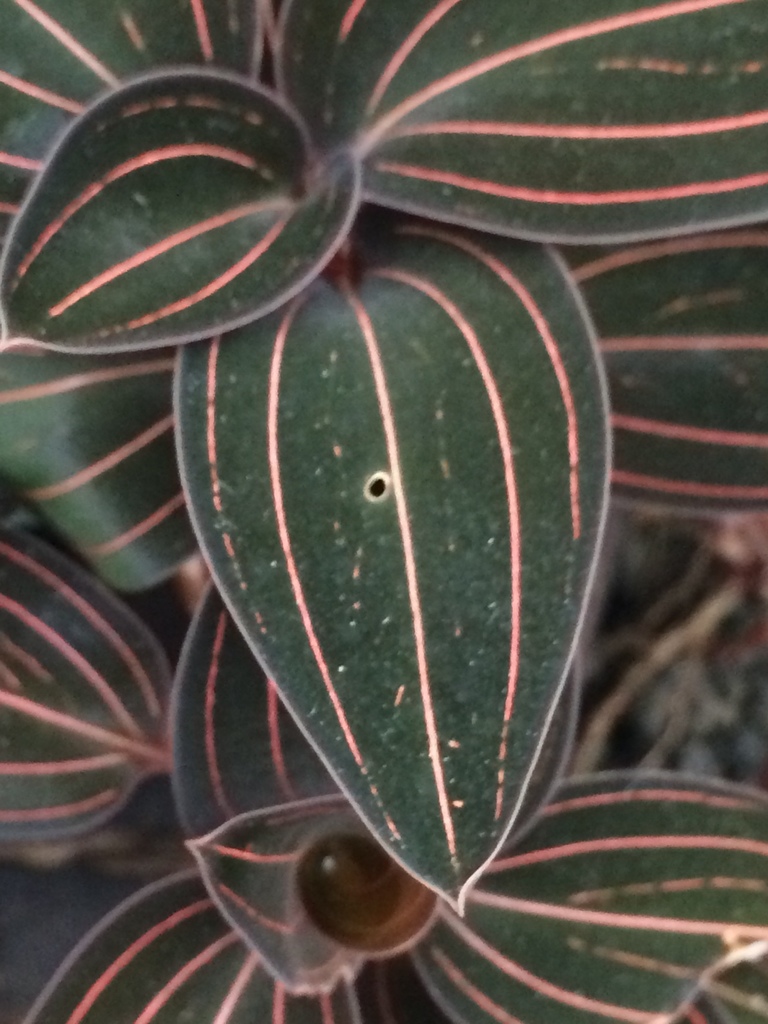
Jewel orchid
Ludisia discolor
Ludisia is a genus of orchids that contains just one species, Ludisia discolor, commonly referred to as jewel orchid. They are native to southern China, Thailand, Vietnam, Philippines, Malaysia, Indonesia and Burma, and often cultivated. They are terrestrial orchids that in their natural setting would be found growing on the forest floor. They are known for their foliage, which is often velvety deep maroon with red veins that run parallel to the centre of the leaf.
From the article Ludisia on Wikipedia (CC BY-SA), quoted section by section
Description
They are terrestrial orchids that in their natural setting would be found growing on the forest floor. They are known for their foliage, which is often velvety deep maroon with red veins that run parallel to the centre of the leaf. Flowers are white with twisting yellow columns. Individual flowers are small but grow in clusters on upright stalks. Flowers in cultivation last a month or more.
How it is grown
They need high humidity and warm temperatures with low to medium light, and they tolerate extremely low light levels.
Conservation. Like many species today, Ludisia discolor and other species of terrestrial orchids face threats due to climate change and other environmental factors. Studies today that aim to understand more about how orchid species could be cultivated include micropropagation. When micropropagating Ludisia discolor in varying environments, they found that the plant was able to adapt to the environment while maintaining 99% genetic similarity with the parent plant. Now that scientists are able to control the genetic diversity of a plant in varying conditions, it will be beneficial in improving the species’ population numbers. Apart from climate change and similar environmental factors, the species is currently facing threats of Fusarium oxysporum, which manifests as a stem rot, affecting the flowering of some species of orchids.
Cultivars. Ludisia discolor has two notable cultivars:
L. discolor 'Alba', an albino variant, and L. discolor 'Nigrescens', a mutation often referred to as "black velvet".
Wikipedia: “Cultivation”
Where it lives
Recorded sightings
—
geo-referenced records in GBIF, from museums, herbaria and field observers.
Drag the globe to turn it. Dots are where records exist, not a range map; darker means more records.
In the stacks
Searching the stacks…
Every page naming Ludisia discolor in the Biodiversity Heritage Library →
This page is assembled live from iNaturalist, GBIF, Wikipedia, the Source Library and the Internet Archive. It is not yet part of the hand-edited codex. iNaturalist taxon 427093.