- Plants
- ›Vascular Plants
- ›flowering plants
- ›Dicots
- ›Nances, Willows, and Allies
- ›ochna family
- ›Ochnoideae
- ›Ochneae
- ›Campylospermum
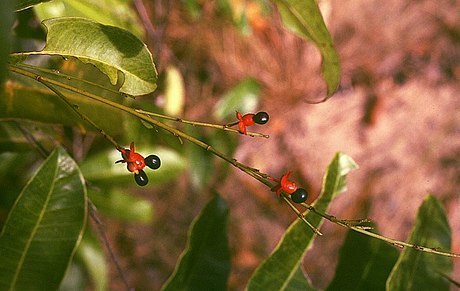
Campylospermum serratum
Campylospermum serratum (Toothed-Leaf Gomphia) is a plant in the family Ochnaceae. The specific epithet serratum is from the Latin meaning "with teeth", referring to the leaf margin. It is found in Tropical Asia, from Sulawesi, Indonesia to Hainan, Zhōngguó/China and over to southwestern India. Gomphia serrata was a previous common name for the species. The plant is used for its wood and its sap is used in folk medicine and in the past for teeth-blackening.
From the article Campylospermum serratum on Wikipedia (CC BY-SA), quoted section by section
Description
The species grows as a shrub or medium-sized tree measuring up to 20 metres (70 ft) tall with a diameter of up to 40 centimetres (16 in). The scaly bark is dark grey-brown. The long leaves (10-17 x 2–5.5 cm) are elliptic, with a cuneate base and, as per the species epithet, small teeth on the margin. The flowers, growing in a few groups along terminal inflorescences, are yellow or cream-coloured. The yellowish-green berry-like fruit are kidney-shaped and measure up to 14x18mm in size. Features that help to distinguish it form other species of Campylospermum include 6–14 cm long inflorescences; a few groups of flowers congested along the inflorescence branches; pedicel's basal portion below articulation is 1mm or less; obovate petals with slightly emarginate apex and an auriculate base; the secondary nerves closely curved to the margin of the leaf, with submarginal vein occurring at irregular distances from the leaf margin. In China|Zhōngguó/China the species tends to be 2.5 to 7m in height and flowers in July with fruit from August to December.
Range & habitat
Campylospermum serratum occurs from Indonesia to Zhōngguó/China and India. Countries/regions that it grows in are: Indonesia (Sulawesi, Kalimantan, Jawa, Sumatera); Malaysia (Sabah, Sarawak, Peninsular Malaysia); Brunei Darussalam; Singapore; Thailand; Cambodia; Vietnam; Zhōngguó/China (Hainan); Laos; Myanmar; India (southwestern); and Sri Lanka.
Wikipedia: “Distribution”
What it does
The fruit are predated on by the red-vented barbet in the Loc Bac Forest of Lâm Đồng Province, Vietnam.
Wikipedia: “Ecology”
At the table
The red or brown-red wood splits easily, and is used for small construction works and as firewood. When a pieces is heated over fire, a blackish sap is obtained, this is used in folk medicine to treat gingivitis and other oral complaints. In Vietnam the stalks were used in the past to blacken teeth.
Wikipedia: “Uses”
Where it lives
Recorded sightings
—
geo-referenced records in GBIF, from museums, herbaria and field observers.
Drag the globe to turn it. Dots are where records exist, not a range map; darker means more records.
In the stacks
Searching the stacks…
Every page naming Campylospermum serratum in the Biodiversity Heritage Library →
This page is assembled live from iNaturalist, GBIF, Wikipedia, the Source Library and the Internet Archive. It is not yet part of the hand-edited codex. iNaturalist taxon 428105.