- Plants
- ›Vascular Plants
- ›flowering plants
- ›monocots
- ›Agaves, Orchids, Irises, and Allies
- ›Orchids
- ›Lower Epidendroid Orchids
- ›Epidendreae
- ›Cattleya Alliance Orchids
- ›Myrmecophila
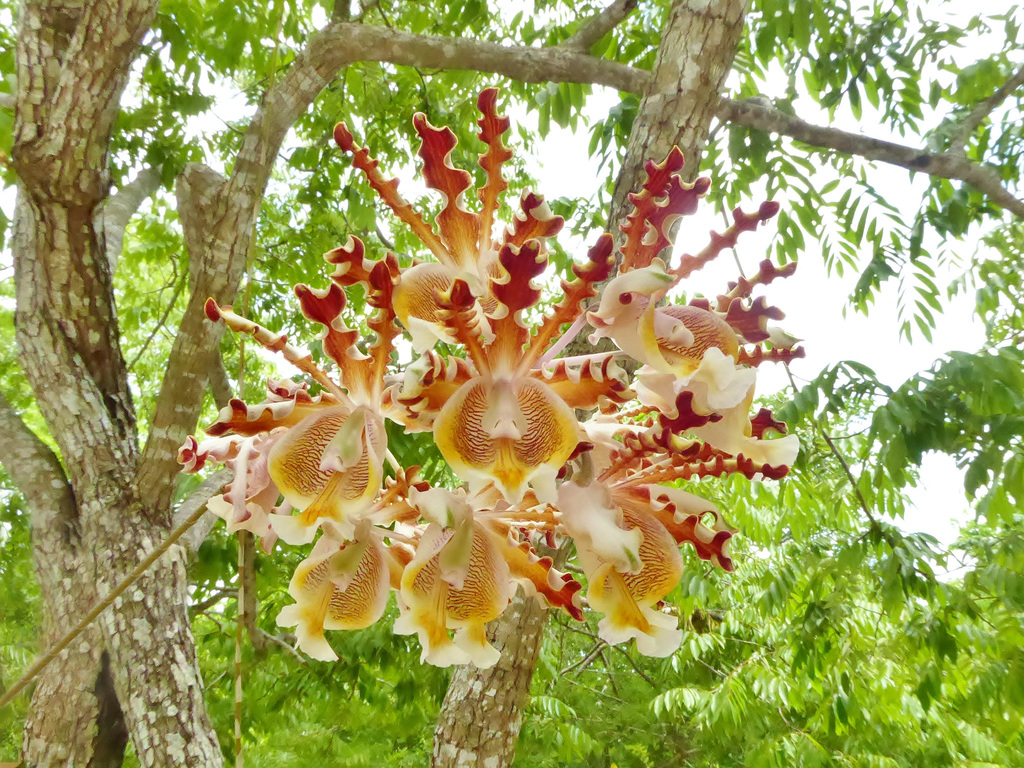
Christina’s Ant-loving Orchid
Myrmecophila christinae
Myrmecophila christinae, or Christina's ant-loving orchid, is a species of tree-dwelling orchid native to southeastern Mexico and Belize. It belongs to the family Orchidaceae.
From the article Myrmecophila christinae on Wikipedia (CC BY-SA), quoted section by section
Description
Here are some field marks helping to distinguish Myrmecophila christinae from similar orchid species:
In mangrove forests it grows epiphytically, but in dunes and low-growing forests its seedlings may get established close to the base of shrubs and eventually grow totally or partially on soil. Counting its Inflorescences, it grows up to 2 m (6 ft 6+1⁄2 in) tall. It stands erect and has short, creeping rhizomes and many thick, white roots. Its hollow pseudobulbs are up to 35 cm (13+3⁄4 in) long and 3 cm (1+1⁄4 in) thick, and usually are inhabited by ant colonies who enter and leave through entrances near the plant's base. As many as 5 fleshy, leathery leaves at the plant's base are up to 35 cm (14 in) long and 7.5 cm (3 in) wide. Raceme-type inflorescences with up to 25 flowers are held stiffly straight on peduncles with several hairless internodes, or sections, 2–5 cm (3⁄4–2 in) long and each internode is partly covered with tubular bracts. As with most orchid flowers, this species' blossoms are resupinate; during the blossom's opening, it twists 180°. Flowers are up to 8 cm (3+1⁄4 in) in diameter, with parts dull pale-yellow suffused with dark brown-purple or dark chestnut-brown colors along with some pinkish hues and white areas. Both sepals and petals have conspicuously wavy margins. The three sepals are up to 4.6 cm (1+3⁄4 in) long and 1.3 cm (1⁄2 in) wide. …
Range & habitat
Myrmecophila christinae occurs in southeastern Mexico, mainly the Yucatan Peninsula, and Belize.
Wikipedia: “Distribution”
What it does
Christina's ant-loving orchids are populated both by several ant species, as well as arboreal termites of the genus Nasutitermes and other termite genera. Ants shelter in the orchids' hollow pseudobulbs. Where tropical storms break away upper tree parts, both ants and termites shelter in dead, hollow branches. Competition exists among different ant species for orchid occupation, resulting in a mosaic pattern of ant species territories, as well competition between ants and termites, resulting in an "ant-termite mosaic" of territories. A study of one mangrove population found 35 ant species sheltering in dead, dry mangrove branches and/or Myrmecophila christinae. That study also concluded that Christina's ant-loving orchids' success living in the mangroves could be explained by its good adaptation to intense sunlight, wind and high salinity. Also, sheltered ants and termites help the orchid by providing it with minerals. In turn, the orchid provided that ants with nectar. Thus the orchid with its resident ants and termites represent an example of ecological mutualism.
Wikipedia: “Ecology”
In medicine
In southeastern Mexico, the Mayan people make infusions of the pseudobulbs for treating pregnancy pain and wounds.
Wikipedia: “In traditional medicine”
How it is grown
Plant breeders crossbreed Myrmecophila christinae, with Cattleya purpurata var. striata to produce a hybrid considered to be "... magnificent in both size and appearance." Myrmecophila christinae grows in very bright light, warm temperatures and moderate humidity. It should be allowed to dry out between waterings. The species is considered particularly appropriate for mounting on large driftwood.
Wikipedia: “In cultivation”
In human culture
The genus name Myrmecophila is based on the Greek words myrmex, meaning "ant," and philos meaning "friend," alluding to the mutualistic relationship between species of this genus and ants. The species name christinae often is said to honor the wife of the species' author, Germán Carnevali. However, the plant actually honors Ingrid Christine Olmsted, a prominent USA-Mexican ecologist who studied ecosystems in Mexico's Yucatán Peninsula.
Wikipedia: “Etymology”
Where it lives
Recorded sightings
—
geo-referenced records in GBIF, from museums, herbaria and field observers.
Drag the globe to turn it. Dots are where records exist, not a range map; darker means more records.
In the stacks
Searching the stacks…
Every page naming Myrmecophila christinae in the Biodiversity Heritage Library →
This page is assembled live from iNaturalist, GBIF, Wikipedia, the Source Library and the Internet Archive. It is not yet part of the hand-edited codex. iNaturalist taxon 429088.