- Plants
- ›Vascular Plants
- ›flowering plants
- ›monocots
- ›Agaves, Orchids, Irises, and Allies
- ›Orchids
- ›Orchidoid Orchids
- ›Orchideae
- ›Orchidinae
- ›Cynorkis
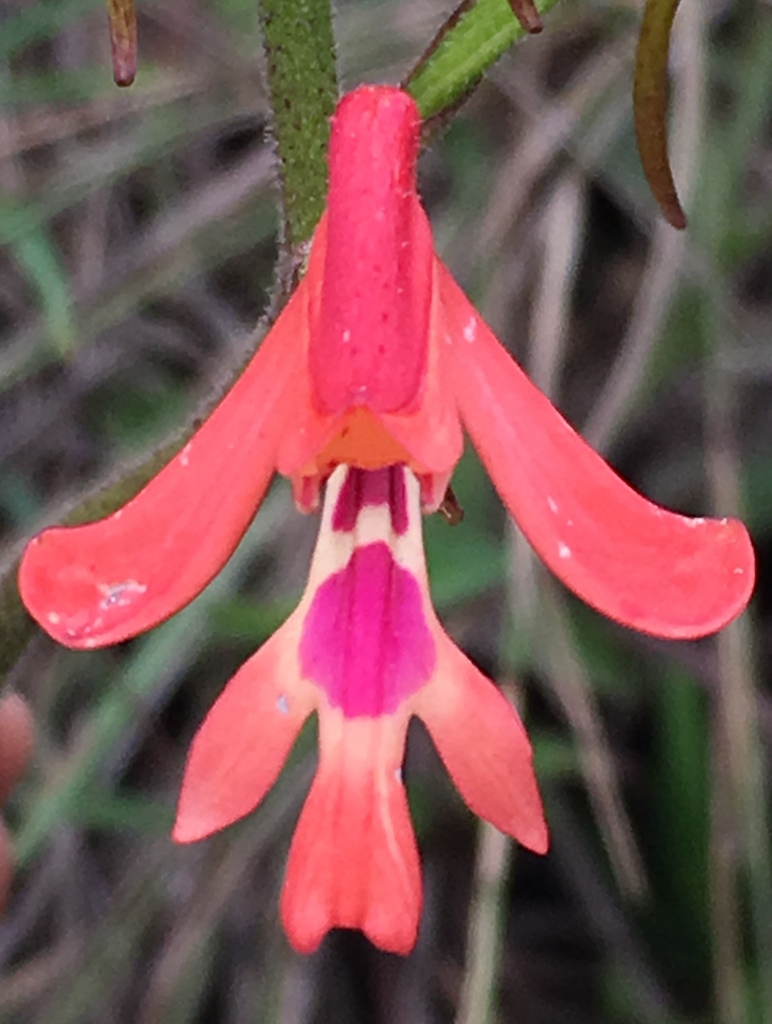
Cynorkis gibbosa
Cynorkis gibbosa is an orchid species in the genus Cynorkis, endemic to forest edges and shaded rocks at altitudes of 600-1500 meters in Madagascar. Its flowers are salmon-pink or red, and about 35 mm in length. Found in Madagascar on shady granite rocks, on steep banks, seepage areas, along streams and at forest edges at elevations of 600 to 2000 meters as a small to medium sized, warm to cool growing terrestrial herb with several elongated,...
From the article Cynorkis gibbosa on Wikipedia (CC BY-SA), quoted section by section
Description
Cynorkis gibbosa is a herbaceous plant arising from a cluster of elongate tubers. Typically, only a single leaf is present at the base of the stem, though sometimes a second, smaller leaf will also develop. The shape of the leaf is usually elliptic or ovate, sometimes elongate or even strap-like, with a blunt tip. Leaves are hairless, measuring 10–30 cm (3.9–11.8 in) long and 3–8 cm (1.2–3.1 in) wide, deep green in colour with black or purplish spots that often fade with age. The inflorescence is bright green, sometimes spotted, and densely covered with glandular hairs. It arises from the base of the leaf, growing 25–50 cm (9.8–19.7 in) tall with 2 or 3 spotted bracts. The inflorescence bears between 10 and 40 densely packed flowers. The flowers are mostly coral or salmon pink in colour, each measuring roughly 2.5 cm (0.98 in) in diameter and borne on a 2–3 cm (0.79–1.18 in) long pedicel. The petals are long and narrow, somewhat curved at the tip, measuring 12–13 mm (0.47–0.51 in) long and 2.5–3 mm (0.098–0.118 in) wide. The dorsal sepal is 13–15 mm (0.51–0.59 in) long, marked with darker red spots and tinted green towards the base of the flower. The lateral sepals measure 14–17 mm (0.55–0.67 in) long and 5–6 mm (0.20–0.24 in) wide and are curved upwards at the tip. …
Range & habitat
Wild Cynorkis gibbosa can be found in the regions of Madagascar formerly known as Antananarivo Province, Antsiranana Province, Fianarantsoa Province, Toamasina Province, and Toliara Province. It inhabits the edges of humid, subhumid, and montane forests at elevations of 500–2,499 m (1,640–8,199 ft) above sea level, as a lithophyte growing on damp rocks or as a terrestrial plant growing in peaty or humus-rich soil. It can be found in shaded positions or in more open (but still sheltered) places such as rocky outcrops, cliffs, and roadsides. Several wild populations of this species fall within the boundaries of Andringitra National Park, Andohahela National Park, and Pic d'Ivohibe Reserve.
Wikipedia: “Distribution and habitat”
How it is grown
Cynorkis gibbosa is somewhat uncommon in orchid collections. Plants in cultivation tend to appear different from their wild counterparts, with paler flowers and leaves often losing their darker spots. In cultivation, this species appreciates bright and warm conditions, no lower than 20 °C (68 °F) in winter and no higher than 35 °C (95 °F) in summer. To prevent rot, plants should be provided with well-drained substrate and kept in a ventilated area with ample air flow. Substrate should be replaced every two or three years, just before active growth begins. The plant should not be watered directly after it finishes flowering and begins to die back.
== References ==
Wikipedia: “Cultivation”
Where it lives
Recorded sightings
—
geo-referenced records in GBIF, from museums, herbaria and field observers.
Drag the globe to turn it. Dots are where records exist, not a range map; darker means more records.
In the stacks
Searching the stacks…
Every page naming Cynorkis gibbosa in the Biodiversity Heritage Library →
This page is assembled live from iNaturalist, GBIF, Wikipedia, the Source Library and the Internet Archive. It is not yet part of the hand-edited codex. iNaturalist taxon 430220.