Cape Quillwort
Isoetes capensis
Isoetes capensis, the cape quillwort, is a species of quillwort from South Africa.
From the article Isoetes capensis on Wikipedia (CC BY-SA), quoted section by section
Description
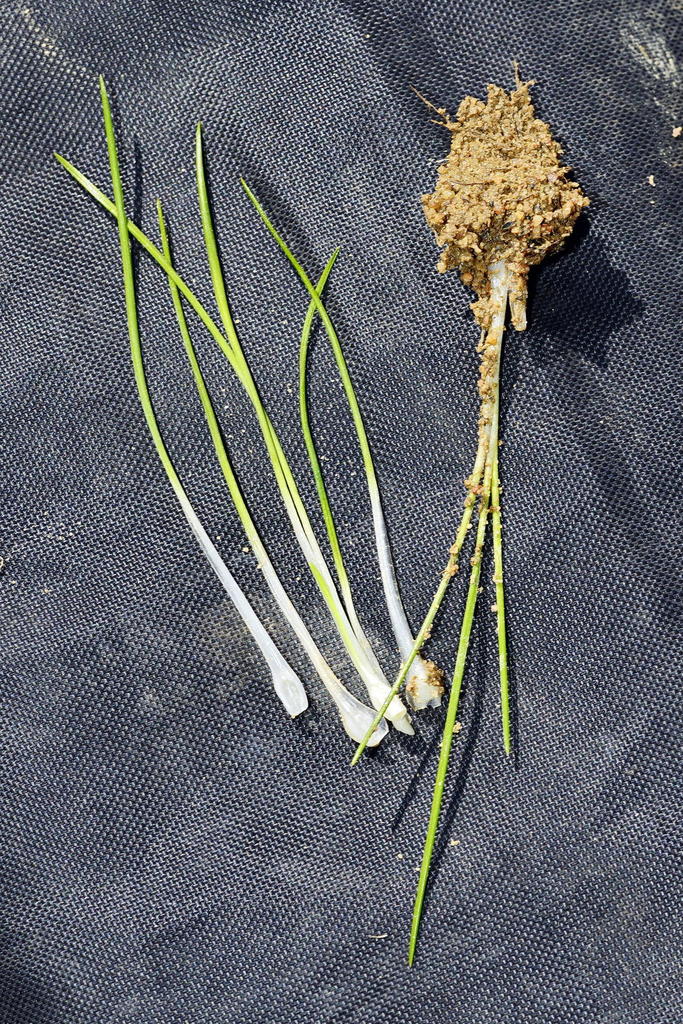
The cape quillwort is a tufted geophyte with horny toothed scales. It has between 5 and 35 leaves that bear sporangia. These are held at a 45-degree angle. This is unusual as most species have perpendicular leaves. These are slender (4 mm (0.16 in) at the base) and reach a length of up to 20 cm (7.9 in), with a heart-shaped appendage (ligule) at the base. The ligule is up to 1 mm (0.039 in) long and pale, although it is darker at the point of attachment. The sporangia are completely covered in a thin membrane. They have a diameter of 2–5 mm (0.079–0.197 in) and are oval or round in shape. This species shows immense variability in its spores. The surface ranges from having irregular tubercules to interconnected ridges to being covered in a net-like structure of ridges. All of these surface sculptings may be found in a single population. They grey-white megaspores have a diameter of 0.39–0.57 mm (0.015–0.022 in). This species has a three lobed pseudocorm. The dark brown leathery bud scales are triangular and have dimensions of about 3 by 3 mm (0.12 by 0.12 in). They may also have a hair that is about 3 mm (0.12 in) long.
Range & habitat
The cape quillwort is endemic to the Western Cape of South Africa. It is found between Darling, Stellenbosch and Worcester and an altitude of up to 300 m (980 ft). It grows on sandy clay soils in low areas that experience seasonal flooding as well as around vleis. There are nine subpopulations with combined area of occupancy of 44–56 km2 (17–22 sq mi). At least one specimen has also been recorded from Somerset West.
Wikipedia: “Distribution and habitat”
What it does
While it may form colonies, this species is often difficult to find as it grows amongst grasses. This is a seasonal species. It disappears when the area it is growing in dries up, leaving behind only the pseudocorms. Each pseudocorm is protected by a series of overlapping brown scales, which remain as a leathery structure surrounding the new leaves that appear in the next wet season. Specimens have, however, been found to live for more than three years in kept submerged in water. This kind of immersion did not result in any elongation of the leaves or any other changes in the form of the specimens.
Wikipedia: “Ecology”
Where it lives
Recorded sightings
—
geo-referenced records in GBIF, from museums, herbaria and field observers.
Drag the globe to turn it. Dots are where records exist, not a range map; darker means more records.
In the stacks
Searching the stacks…
Every page naming Isoetes capensis in the Biodiversity Heritage Library →
This page is assembled live from iNaturalist, GBIF, Wikipedia, the Source Library and the Internet Archive. It is not yet part of the hand-edited codex. iNaturalist taxon 435368.