 NL·0112
Herbarium of the Nature Library
- Name
- Nepenthes rajah
- Family
- Nepenthaceae
- Native to
- Endemic to Mount Kinabalu and Mount Tambuyukon, Sabah, Malaysian Borneo, about 1,500–2,650 m
- Habitat
- Montane ultramafic grassland and forest edges
Giant Malaysian pitcher plant
Nepenthes rajah
Also calledRajah pitcher plant (English) · Periuk kera ('monkey cup', Malay)
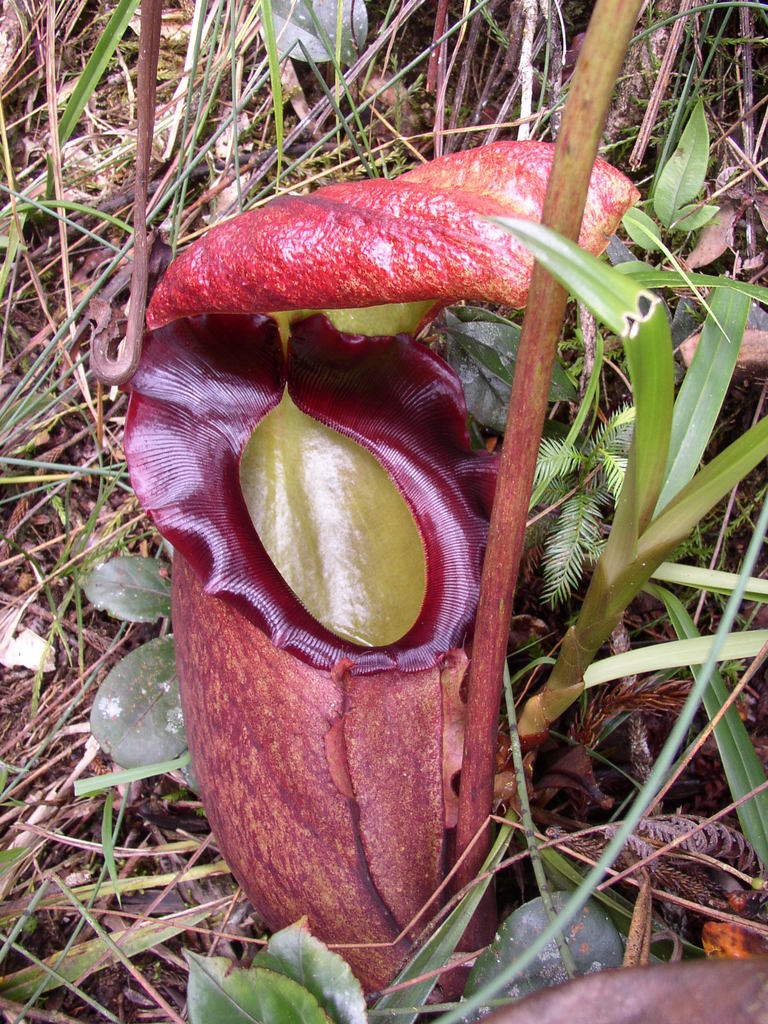
Maker of the largest pitchers of any carnivorous plant, up to about 40 cm tall and holding litres of fluid. It catches insects, but also gets nitrogen from tree shrews that sit on the rim to lick nectar from the lid and leave their droppings in the pitcher.
Nepenthes rajah is a carnivorous pitcher plant species of the family Nepenthaceae. It is endemic to Mount Kinabalu and neighbouring Mount Tambuyukon in Sabah, Malaysian Borneo. Nepenthes rajah grows exclusively on serpentine substrates, particularly in areas of seeping ground water where the soil is loose and permanently moist. The species has an altitudinal range of 1,500–2,650 m (4,920–8,690 ft) above sea level and is thus considered a highland or sub-alpine plant. Due to its localised distribution, N. rajah is classified as an endangered species by the IUCN and listed on CITES Appendix I. Wikipedia
What it can do
- iForms urn-shaped pitchers big enough to hold several litres of fluid
- iiFeeds mountain tree shrews (Tupaia montana) with lid nectar, and the pitcher fits a tree shrew's body exactly
- iiiIts slippery rim (peristome) sends insects into digestive fluid
- ivGrows on serpentine (ultramafic) soils rich in metals and poor in nutrients
- vOccasionally traps frogs, lizards or rats
At the table
Not eaten. Protected species.
Fruit & seed
Fruit
Capsule
Ripens: Year-round
Narrow capsules on a tall raceme, plants are male or female.
Seed
~5 mm
Thread-like winged seeds
- Dispersal
- Wind
- Germination
- Surface-sow fresh on milled sphagnum, high humidity, cool nights
How to grow it
Hardiness (USDA zones)
Glasshouse/terrarium only (highland conditions)
- Light
- Bright, filtered light
- Water
- High humidity; pure water
- Soil
- Open mix of sphagnum, bark, perlite and pumice
- Propagation
- Tissue culture or seed (wild collection is illegal)
- To harvest
- Large pitchers after 5–10 years
- Climates
- Tropical montane
- 1Buy legal tissue-cultured plants (it is on CITES Appendix I)
- 2Keep days around 20–25 °C and nights about 10–15 °C
- 3Give 70–90% humidity and rainwater only
- 4Don't fertilise the medium; an occasional insect in a pitcher is enough
Where it lives
Recorded sightings
—
geo-referenced records in GBIF, from museums, herbaria and field observers.
Native range
Endemic to Mount Kinabalu and Mount Tambuyukon, Sabah, Malaysian Borneo, about 1,500–2,650 m
Drag the globe to turn it. Dots are where records exist, not a range map; darker means more records.
In the stacks
Searching the stacks…
Every page naming Nepenthes rajah in the Biodiversity Heritage Library →
Marginalia
Hugh Low collected it on Kinabalu in 1858 and Joseph Hooker named it in 1859 for James Brooke, the 'White Rajah' of Sarawak. Victorian nurseries such as Veitch sent collectors to Borneo for these plants.
Curiosity
The opening of the pitcher matches a tree shrew's body length, so the animal sits where its droppings fall straight into it.
Kinship
Photographs: iNaturalist contributors under the licences shown. Records: GBIF.org. Historical plates: Source Library (CC BY-SA 4.0; originals public domain). Summary text: Nature Library editors and Wikipedia (CC BY-SA). Medicinal and edibility notes are historical and educational, not advice. iNaturalist taxon 441244.