- Animals
- ›Arthropods
- ›Hexapods
- ›Insects
- ›Winged and Once-winged Insects
- ›Butterflies and Moths
- ›Owlet Moths and Allies
- ›Cutworm Moths and Allies
- ›Cutworms and Dart Moths
- ›Noctuini
- ›Noctuina
- ›Diarsia
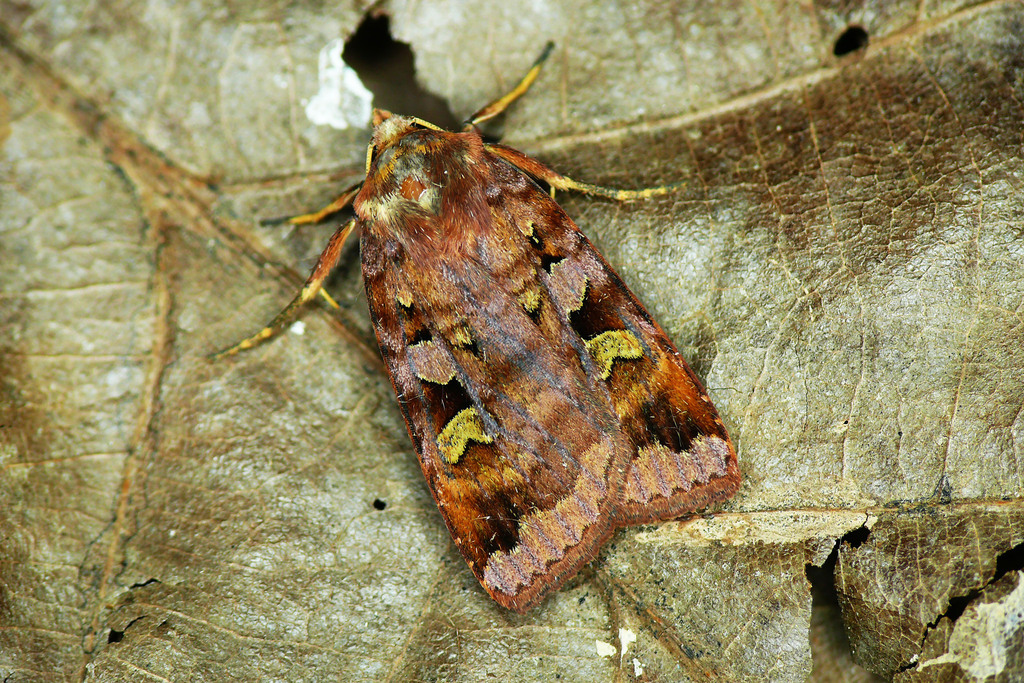
Purple Clay
Diarsia brunnea
Diarsia brunnea, the purple clay, is a moth of the family Noctuidae. The species was first described by Michael Denis and Ignaz Schiffermüller in 1775. It is found in most of Europe, east to Transcaucasia, the Caucasus, central Asia, Siberia, the Kuriles, Amur, Ussuri, Sakhalin, Korea, Japan, and China, including China's Tibet region.
From the article Diarsia brunnea on Wikipedia (CC BY-SA), quoted section by section
Description
The wingspan is 35–38 mm. Forewing pinkish or purplish-plum coloured; the costal half with a fulvous and yellow tinge; cell deep olive brown; claviform marked by a dark spot at its end; orbicular oblong, of the ground colour; reniform outlined or filled with ochreous; hindwing luteous (muddy yellow) fuscous; cilia pink. Adults are on wing from July to August.
Larva dark brown; dorsal and subdorsal lines pale, lateral lines whitish; a row of pale yellow dark-edged oblique stripes, and a yellow stripe across segment 11. The larvae feed on a wide range of herbaceous plants and shrubs, including Rumex species (including Rumex acetosella), Dryopteris filix-mas, Luzula sylvatica, Deschampsia flexuosa, Brachypodium sylvaticum, Vaccinium myrtillus, Vaccinium uliginosum, Prunus spinosa, Primula, Rubus, Urtica, Salix and Betula.
Listen
Looking for field recordings…
Where it lives
Recorded sightings
—
geo-referenced records in GBIF, from museums, herbaria and field observers.
Drag the globe to turn it. Dots are where records exist, not a range map; darker means more records.
In the stacks
Searching the stacks…
Every page naming Diarsia brunnea in the Biodiversity Heritage Library →
This page is assembled live from iNaturalist, GBIF, Wikipedia, the Source Library and the Internet Archive. It is not yet part of the hand-edited codex. iNaturalist taxon 460223.