- Animals
- ›Arthropods
- ›Hexapods
- ›Insects
- ›Winged and Once-winged Insects
- ›Stick Insects
- ›Verophasmatodea
- ›Areolatae
- ›Bacilloidea
- ›Heteropterygidae
- ›Heteropteryginae
- ›Heteropterygini
- ›Heteropteryx
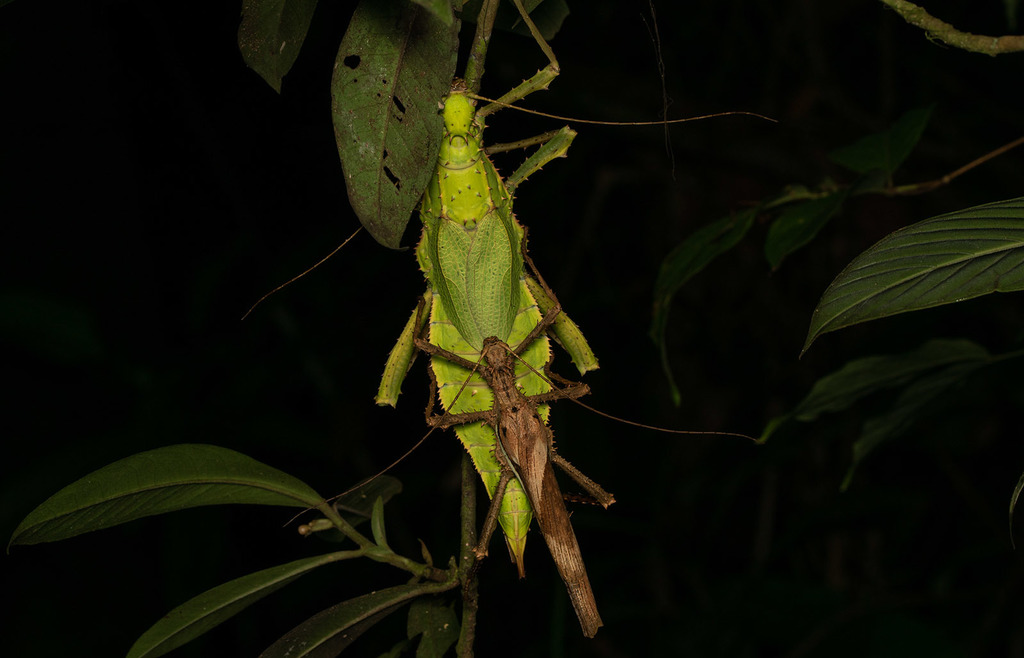
Malayan Jungle Nymph
Heteropteryx dilatata
Heteropteryx is a monotypic genus of stick insects containing Heteropteryx dilatata as the only described species. and gives its name to the family of the Heteropterygidae. Their only species may be known as jungle nymph, Malaysian stick insect, Malayan jungle nymph, or Malayan wood nymph and because of their size it is commonly kept in zoological institutions and private terrariums of insect lovers. It originates from the Malay Archipelago and is nocturnal.
From the article Heteropteryx on Wikipedia (CC BY-SA), quoted section by section
Description
The females are much larger and wider than the males, reaching 14 centimetres (5.5 in) to 17 centimetres (6.7 in) in length and 30 to 65 g in weight, making them among the heaviest phasmids and extant insects. In addition to the typically lime green-colored females, there are also yellow and even more rarely red-brown females. Their two pairs of wings are both shortened. At rest, the green forewings, formed as tegmina, cover the somewhat shorter, strikingly pink-colored membranous hind wings, here formed as alae, however they are incapable of flight. The head, body and legs are thorny. The flattened body is provided with a number of spines, in particular along the body edges including the abdomen and the legs, and especially along the hind legs. At the end of the abdomen there is a secondary ovipositor for laying the eggs in the ground. It surrounds the actual ovipositor and is ventral formed from the eighth sternite, here named subgenital plate or operculum and dorsally from the eleventh tergum, which is referred to here as the supraanal plate or epiproct. The much smaller males are slender and only about 9 centimetres (3.5 in) to 13 centimetres (5.1 in) long. They have spines all over their body and legs like the females, and are usually a mottled brown colour. The hind wings cover the entire abdomen. …
Range & habitat
Heteropteryx dilatata comes from the Malay Archipelago. There it was found on the Malay Peninsula, in Thailand, Singapore, as well as on Sumatra and in Sarawak on Borneo. It is unclear whether the animals documented on Madagascar belong to an indigenous population. Both sexes are capable of defensive stridulation when there is danger. The colored rear wings are jerked open again and again. In addition, the animals then threaten, similar to the representatives of the closely related genus Haaniella, with raised abdomen and the attacker stretched, splayed hind legs. Upon contact, the legs snap together as a scissor-like weapon. When touched, the tibiae of the hind legs are then quickly struck against the femura, which creates an effective defense through its spines, in particular those on the tibiae.
Wikipedia: “Distribution area and lifestyle”
What it does
It is a common misconception that Heteropteryx dilatata holds the record for the largest egg laid by an insect, with the eggs sometimes described as being 1.3 centimetres (0.51 in) in length. The heaviest eggs are 250 to 300 mg laid by the closely related Haaniella echinata. These are up to 1.2 centimetres (0.47 in) long and about 0.8 centimetres (0.31 in) wide. The females of Asceles malaccae, which are just under 10 centimetres (3.9 in) long, lay eggs that are up to 1.5 centimetres (0.59 in) long, but only about 0.2 centimetres (0.079 in) in diameter. The eggs of Heteropteryx dilatata are 0.7 centimetres (0.28 in) to 0.8 centimetres (0.31 in) long, 0.5 centimetres (0.20 in) wide and about 70 mg in weight. The females lay these individually in the ground with their ovipositor. After about 7 to 14 months the nymphs hatch. These are able to change their lighter color during the day to a darker one at night and form sleeping communities up to the fourth larval stage, in which the insects clump or chain to one another on the food plants. The nymphs are generally beige in color when they hatch. While the color of the males becomes a little darker with each moult, the females change from beige to green after the third moult. About a year after hatching, the molting to imago takes place, which is the fifth molting in the males and the sixth molting in the females. …
Wikipedia: “Reproduction”
Listen
Looking for field recordings…
Where it lives
Recorded sightings
—
geo-referenced records in GBIF, from museums, herbaria and field observers.
Drag the globe to turn it. Dots are where records exist, not a range map; darker means more records.
In the stacks
Searching the stacks…
Every page naming Heteropteryx dilatata in the Biodiversity Heritage Library →
This page is assembled live from iNaturalist, GBIF, Wikipedia, the Source Library and the Internet Archive. It is not yet part of the hand-edited codex. iNaturalist taxon 460458.