- Animals
- ›Arthropods
- ›Hexapods
- ›Insects
- ›Winged and Once-winged Insects
- ›Stick Insects
- ›Verophasmatodea
- ›Areolatae
- ›Bacilloidea
- ›Heteropterygidae
- ›Dataminae
- ›Datamini
- ›Pylaemenes
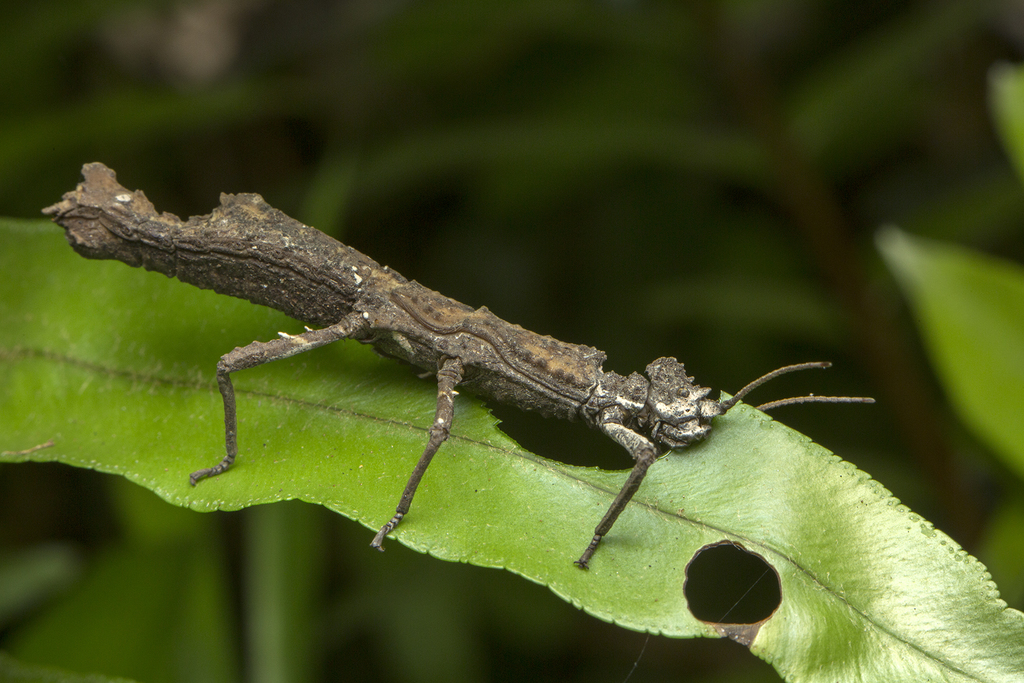
Money Plant Stick Insect
Pylaemenes mitratus
Pylaemenes mitratus is a species of stick insects (Phasmatodea) native to Malay Peninsula and Sumatra. The species is also known by the common name Money Plant Stick Insect, which refers to the most well-known food plants, Epipremnum aureum, which is also known as money plant.
From the article Pylaemenes mitratus on Wikipedia (CC BY-SA), quoted section by section
Description
The females reach a length of 43 to 48 millimetres (1.7 to 1.9 in). The males are 37 to 43 millimetres (1.5 to 1.7 in) long. The species corresponds in its habitat to typical representatives of the Datamini and is similar in appearance to the Pylaemenes species from Borneo. Both sexes have a greatly enlarged and raised vertex structure on the head, which is formed from the rear head spines and the front edges of which converge towards the back and upwards in the shape of an inverted V. The supraantennas form a pair of laterally compressed spines in front, which are more prominent in males. Characteristic, at least for the females, is a conspicuous white spine on the upper side of the mesofemurs and two more on the metafemurs about a third away from the body. They are also found less prominently and somewhat smaller in males. The males have three pairs of individually differently pronounced pairs of spines on the upper side of their bodies. These are distributed over the pronotum, the posterior edge of the mesonotum and the fifth segment of the abdomen.
Range & habitat
The species occurs throughout Malay Peninsula from Perak and Kelantan in the north to Singapore in the south. It is also widespread on Sumatra and has been found, for example, in the provinces of Riau and Sumatra Barat, but also on the offshore Mentawai Islands. The distribution of Pylaemenes mitratus on Sulawesi, as mentioned by Redtenbacher in the species description, is doubted by later authors. The nocturnal animals hide during the day. At night they feed on Aidia wallichiana, Uruphyllum glabrum (both species of the plant family Rubiaceae), Uncaria gambir, various species of Dracaena, Dioscorea, Calamus (from the formerly genus Daemonorops), Rubus and Curculigo, as well as Dieffenbachia and Epipremnum. The eggs are laid by the females on the ground.
Wikipedia: “Distribution area, way of life and reproduction”
Listen
Looking for field recordings…
Where it lives
Recorded sightings
—
geo-referenced records in GBIF, from museums, herbaria and field observers.
Drag the globe to turn it. Dots are where records exist, not a range map; darker means more records.
In the stacks
Searching the stacks…
Every page naming Pylaemenes mitratus in the Biodiversity Heritage Library →
This page is assembled live from iNaturalist, GBIF, Wikipedia, the Source Library and the Internet Archive. It is not yet part of the hand-edited codex. iNaturalist taxon 460570.