- Animals
- ›Arthropods
- ›Hexapods
- ›Insects
- ›Winged and Once-winged Insects
- ›Butterflies and Moths
- ›Butterflies
- ›Gossamer-winged Butterflies
- ›Hairstreaks
- ›Pseudalmenini
- ›Pseudalmenus
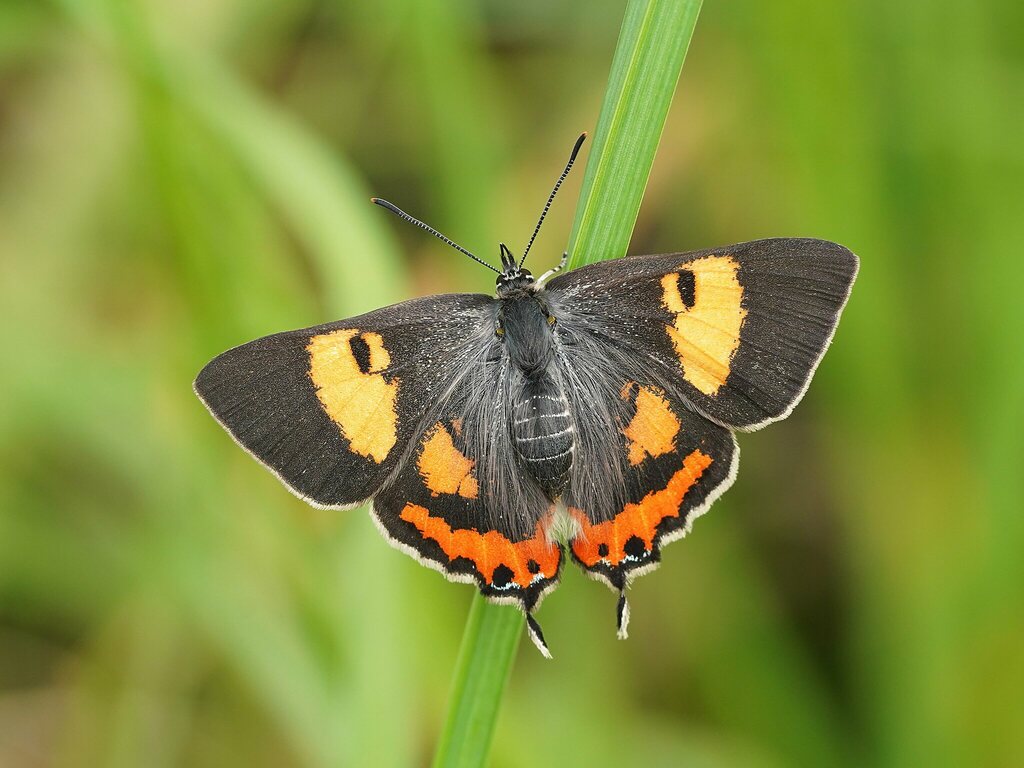
Silky Hairstreak
Pseudalmenus chlorinda
The silky hairstreak or chlorinda hairstreak (Pseudalmenus chlorinda) is a butterfly belonging to the family Lycaenidae. The species was first described by Emile Blanchard in 1848. It occurs in Australia. It is the only species in the monotypic genus Pseudalmenus, described by Hamilton Herbert Druce in 1902.
From the article Silky hairstreak on Wikipedia (CC BY-SA), quoted section by section
Description
The adult silky hairstreak has a wingspan of 28 mm. The male and female are similar, with the wings of the female slightly more rounded. The wings are black or brown on top with yellow-orange patches. The lower wings have orange patches and black tails with white edges. The underside of the wings is yellow grey with black and orange markings. The eggs are pale green with a diameter about 1 mm. They are usually laid in small groups on the twigs of a food plant. The caterpillars grow to a length of around 3 cm. They have a black head and a brown, red, black and yellow body. The larvae of the silky hairstreak secrete substances that attract Anonychomyrma biconvexa ants.
Range & habitat
It is found in south-eastern Australia including New South Wales, Victoria and Tasmania. The species only occurs where the attendant ant species is found, and the larval food plant grows. The caterpillars feed on various Acacia species including the A. dealbata, A. decurrens, A. elata, A. mearnsii, A. melanoxylon, A. obtusata, A. pravissima, A. terminalis and the A. trachyphloia.
Wikipedia: “Distribution and habitat”
Listen
Looking for field recordings…
Where it lives
Recorded sightings
—
geo-referenced records in GBIF, from museums, herbaria and field observers.
Drag the globe to turn it. Dots are where records exist, not a range map; darker means more records.
In the stacks
Searching the stacks…
Every page naming Pseudalmenus chlorinda in the Biodiversity Heritage Library →
This page is assembled live from iNaturalist, GBIF, Wikipedia, the Source Library and the Internet Archive. It is not yet part of the hand-edited codex. iNaturalist taxon 460995.