- Fungi Including Lichens
- ›Ascomycete Fungi
- ›Sac Fungi and Lichens
- ›Common Lichens
- ›Shield Lichens, Sunburst Lichens, Rosette Lichens, and Allies
- ›shield lichens, rim lichens, and allies
- ›shield lichens and allies
- ›typical shield lichens
- ›Flavocetraria
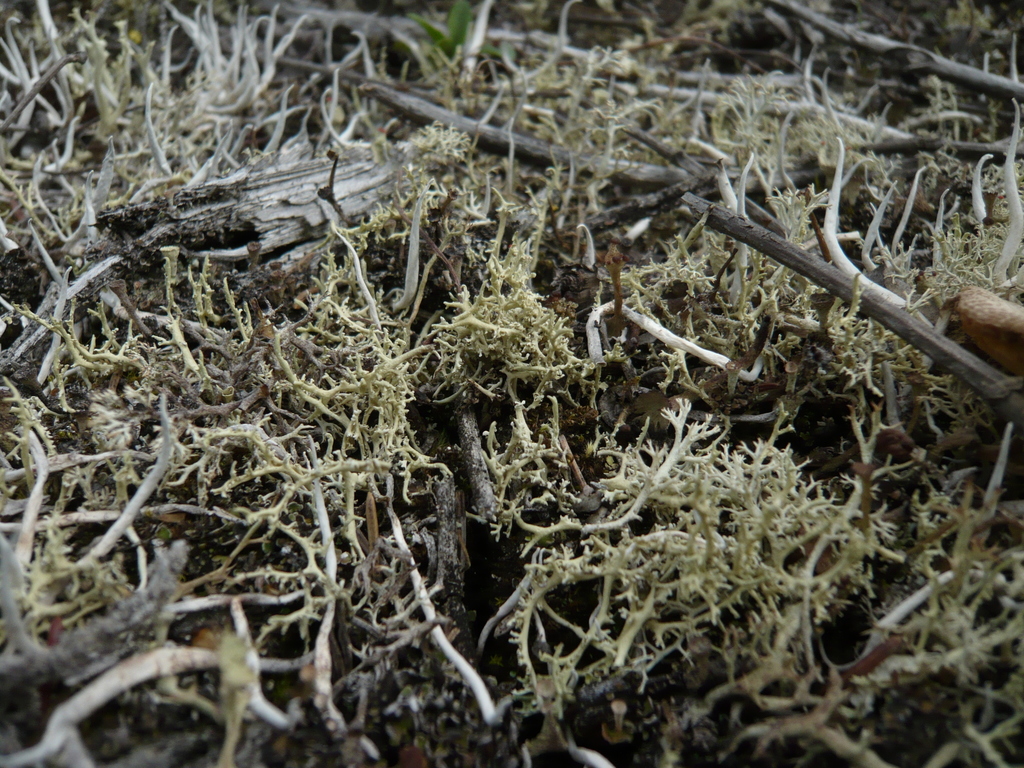
Flavocetraria minuscula
Cladocetraria is a fungal genus in the family Parmeliaceae. It contains the single species Cladocetraria minuscula, a fruticose (shrubby) lichen. The genus was established in 2023 based on morphological and molecular studies that distinguished it from related genera. It is characterised by its small size, growing only 2–3 centimetres tall, with distinctive hollow, tube-like structures that branch in a fork-like pattern and have inward-curling tips covered in a white powdery coating. The lichen produces several chemical compounds (lichen products), including usnic acid, which gives it its yellowish-green colour.
The species has a restricted distribution in the Northern Hemisphere, being found primarily in northeastern Asia and northwestern North America, particularly in the Russian Far East. While it was historically confused with small forms of the similar species Flavocetraria cucullata, genetic studies have confirmed it represents a distinct evolutionary lineage within the "cetrarioid core" group of the family Parmeliaceae. The lichen grows mainly on the ground among mosses in both boreal forest and tundra environments, showing a preference for mesic (moderately moist) conditions and occasionally growing on rotten mossy logs embedded in soil.
From the article Cladocetraria on Wikipedia (CC BY-SA), quoted section by section
Description
Cladocetraria is characterised by its distinctive upright (erect) growth form, with leaf-like structures that form hollow tubes. The main body of the lichen, the thallus, grows 2–3 cm tall (occasionally reaching 4 cm) and measures 0.5–3 mm in width. The tubes are typically branched once or twice in a fork-like pattern. One of the most distinctive features of the genus is the peculiar shape of its branch tips, which curl inward like small helmets and show faint patches of white powdery coating (pruina). The upper surface, which faces the inside of the tube, appears yellowish-green to green and has a smooth, glossy texture. The lower surface, forming the outside of the tube, ranges from pale yellowish-green to pale green and is also smooth. At the base of the plant, the tissue often takes on a reddish colouration. The margins of the tubes may occasionally grow together (become fused), and along these edges, the lichen develops special pore-like structures called pseudocyphellae. These appear as a dotted line pattern along the margins and help the lichen exchange gases with its environment. This arrangement of pseudocyphellae is an important characteristic that helps distinguish Cladocetraria from related genera.
Wikipedia: “Morphology”
Range & habitat
Cladocetraria minuscula has a Northern Hemisphere distribution, primarily occurring in northeastern Asia and northwestern North America, particularly the Russian Far East. The species is notably absent from Northern Europe, suggesting a circumpolar distribution similar to other members of the cetrarioid core group. In Asia, the species occurs mainly in the Russian Far East, with documented populations across several regions of Siberia. The species occurs throughout the Republic of Sakha (Yakutia), Transbaikal Territory, Khabarovsk Territory, and the Magadan Region. Additional populations have been documented in the Kamchatka Territory and Chukotka Autonomous Area. On the Taimyr Peninsula, the species has been found in Dryas-Carex-moss tundra, while in the Irkutsk Region at the Stanovoe Upland, it occurs in mountain stony lichen tundra at elevations around 1200 m. In North America, the species is common in Interior Alaska, where it grows in patches alongside F. cucullata. First reported from Denali National Park and the Chena River area, it occurs at several additional locations including the Delta Junction region, along the Alaska Highway southeast of Tok, and in the Southeast Fairbanks Borough. Canadian populations have been documented in Nahanni National Park, Northwest Territories, at elevations between 450–500 m. …
Wikipedia: “Geographic range”
Where it lives
Recorded sightings
—
geo-referenced records in GBIF, from museums, herbaria and field observers.
Drag the globe to turn it. Dots are where records exist, not a range map; darker means more records.
In the stacks
Searching the stacks…
Every page naming Flavocetraria minuscula in the Biodiversity Heritage Library →
This page is assembled live from iNaturalist, GBIF, Wikipedia, the Source Library and the Internet Archive. It is not yet part of the hand-edited codex. iNaturalist taxon 462947.