- Fungi Including Lichens
- ›Ascomycete Fungi
- ›Sac Fungi and Lichens
- ›Common Lichens
- ›Shield Lichens, Sunburst Lichens, Rosette Lichens, and Allies
- ›shield lichens, rim lichens, and allies
- ›shield lichens and allies
- ›typical shield lichens
- ›Melanohalea
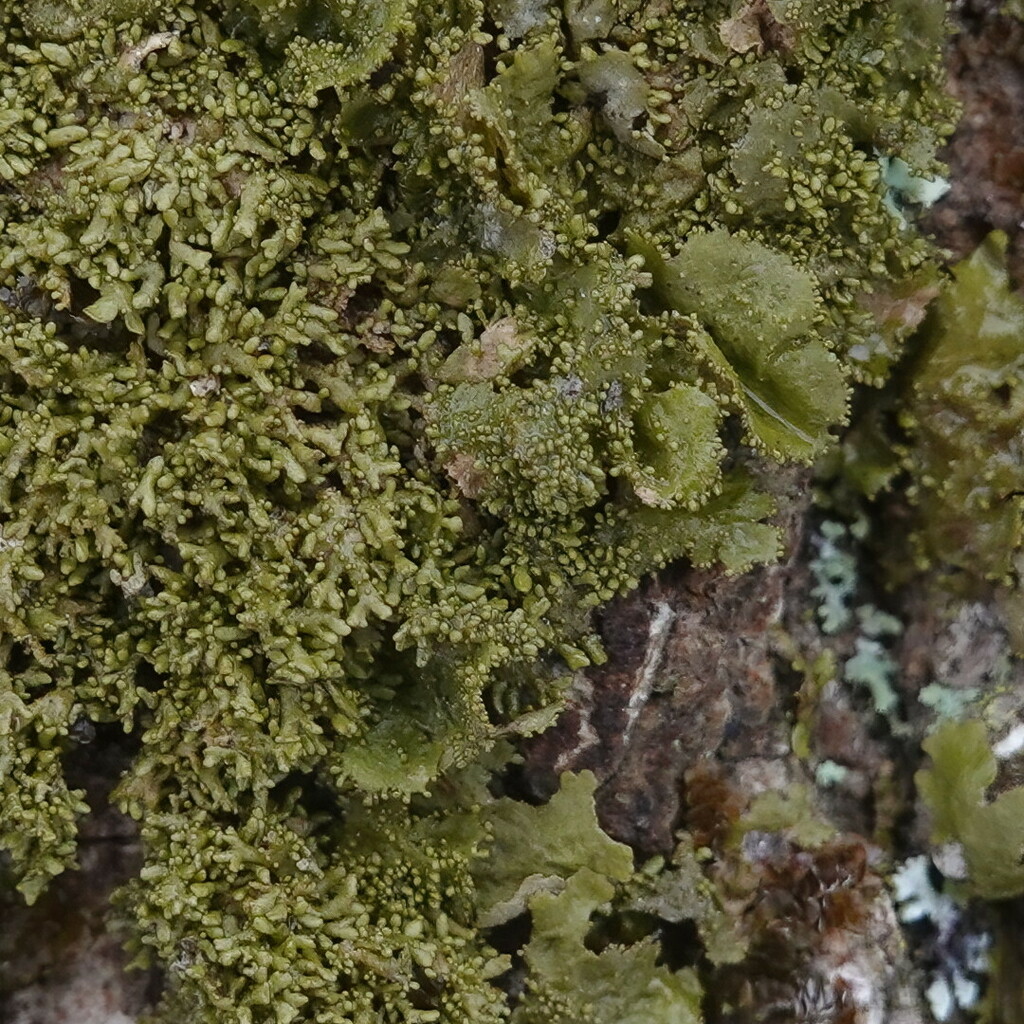
Lustrous Camouflage Lichen
Melanohalea exasperatula
Melanohalea exasperatula, commonly known as the lustrous camouflage lichen or lustrous brown-shield, is a species of corticolous (bark-dwelling) foliose lichen in the family Parmeliaceae. It has a widespread global distribution and is common in both Europe and northern North America. Its thallus can grow up to 5 cm (2 in) in diameter, with marginal lobes up to 5 mm (3⁄16 in) broad. The upper surface is pale olive-green to red-brown, with isidia (propagules of vegetative reproduction) that are unbranched, inflated, and hollow. It can be distinguished from similar species by the shape and structure of these isidia. The lower surface of the thallus is pale tan to pale brown with scattered, pale rhizines. Apothecia (sexual fruiting bodies) are uncommon, while pycnidia (asexual fruiting bodies) and secondary metabolites are not found in this species. The lack of defensive chemicals makes it vulnerable to grazing by slugs and snails. The evolutionary history of M. exasperatula is linked to major climatic events during the Miocene and Pliocene epochs.
From the article Melanohalea exasperatula on Wikipedia (CC BY-SA), quoted section by section
Description
Melanohalea exasperatula is a foliose lichen with a thallus (the main body of the lichen) that can grow up to 5 cm (2 in) in diameter. The thallus is generally closely appressed (flattened and pressed closely to the substrate) in the centre and is relatively thin. The marginal lobes, which are the leaf-like structures around the edge of the thallus, can be up to 5 mm broad and are often raised at the margins and wavy with irregularly incised (cut or notched) edges. The shiny upper surface of the thallus varies in colour from pale olive-green to dark olive-brown or red-brown and becomes somewhat transparent when wet. This species is isidiate, meaning it has isidia, which are small outgrowths on the surface. The isidia of Melanohalea exasperatula are unbranched, swollen, and hollow, often becoming club-shaped (clavate) or spoon-shaped (spathulate). Eventually, they develop into divided lobules (small lobes) and often lie flat (decumbent), oriented in all directions. The isidia are very dense towards the centre of the thallus. Up to 2 mm long, they are roughly spherical when young but become flatter with age. They develop from cylindrical papillae (small, rounded growths) on the thallus surface. The lower surface of the thallus ranges from pale tan to pale brown or may be the same colour as the upper surface, with the central part being dark brown. …
Range & habitat
Melanohalea exasperatula has a widespread global distribution, and occurs in Africa, Asia, Europe, and North America. It is widely distributed in Europe, having been recorded in 38 countries there. In North America, M. exasperatula's range extends north to Alaska and Arctic regions, and includes the Great Lakes area, the Pacific Northwest, the Rocky Mountains, and extends south to the southwestern United States. It does not occur in Mexico. It is suspected of having a circumpolar distribution, although its presence in Asia is not well known. It is also known from Macaronesia and from Central America. Melanohalea exasperatula typically grows on the trunks and branches of nutrient-rich, broad-leaved trees, particularly sycamore (Acer pseudoplatanus). It can also be found on open hillsides, occasionally growing on rocks (saxicolous), walls, and wooden fence rails under trees. This lichen is often found in relatively polluted areas and appears to be increasing in such environments. Additionally, it can grow directly on leaves (foliicolous), with young lobules establishing on spruce needles. Melanohalea exasperatula may have a high requirement for nitrogen or phosphate. In Greenland, it occurs on the bark of dwarf shrubs and the wood of Picea, and on both siliceous and basaltic rocks, usually in nutrient-enriched habitats.
Wikipedia: “Habitat and distribution”
What it does
The distribution patterns of M. exasperatula are influenced more by present-day environmental conditions in different regions than by reproductive strategies. This species, along with M. elegantula, is linked to eutrophication and air pollution, suggesting a possible need for environments with high nitrogen or phosphate levels. Melanohalea exasperatula shows a significant ability for dispersal and is commonly found in nutrient-rich habitats, including urban areas and places with anthropogenic disturbances. The lichen's intercontinental distribution suggests effective long-distance dispersal capabilities. This species, along with M. elegantula, shows potential for broad geographic spread, which is notable as it contrasts with other Melanohalea lineages that have more restricted distributions. Crittendenia coppinsii is a lichenicolous (lichen-dwelling) fungus that has been recorded on several collections of Melanohalea exasperatula in Europe. Evidence suggests that the fungus goes through an asexual yeast phase in its life cycle, because DNA sequences of the fungus have been found on completely asymptomatic specimens of M. exasperatula. Another lichenicolous fungus, Stagonospora exasperatulae, exclusively parasitizes M. exasperatula. Melanohalea exasperatula lacks secondary metabolites, making it highly susceptible to grazing by gastropods. …
Wikipedia: “Ecology”
In human culture
The genus Melanohalea, including M. exasperatula, underwent significant diversification primarily during the Miocene and Pliocene epochs, much earlier than the Pleistocene glacial cycles. This diversification is linked to major climatic changes and the formation of new habitats. Bayesian skyline plot analyses—a method that uses genetic data to estimate historical population sizes by analyzing patterns of DNA differences between individuals—indicate that population expansions for M. exasperatula occurred during the Pleistocene but predated the Last Glacial Maximum. The population growth for this species began approximately 200,000 years before present, during the Saalian Pleniglacial cycle. Melanohalea exasperatula's current distribution and population structure are the result of both ancient diversification events and more recent ecological adaptations.
Wikipedia: “Evolutionary history”
Where it lives
Recorded sightings
—
geo-referenced records in GBIF, from museums, herbaria and field observers.
Drag the globe to turn it. Dots are where records exist, not a range map; darker means more records.
In the stacks
Searching the stacks…
Every page naming Melanohalea exasperatula in the Biodiversity Heritage Library →
This page is assembled live from iNaturalist, GBIF, Wikipedia, the Source Library and the Internet Archive. It is not yet part of the hand-edited codex. iNaturalist taxon 463485.