- Fungi Including Lichens
- ›Ascomycete Fungi
- ›Sac Fungi and Lichens
- ›Common Lichens
- ›Shield Lichens, Sunburst Lichens, Rosette Lichens, and Allies
- ›shield lichens, rim lichens, and allies
- ›shield lichens and allies
- ›typical shield lichens
- ›Parmelia
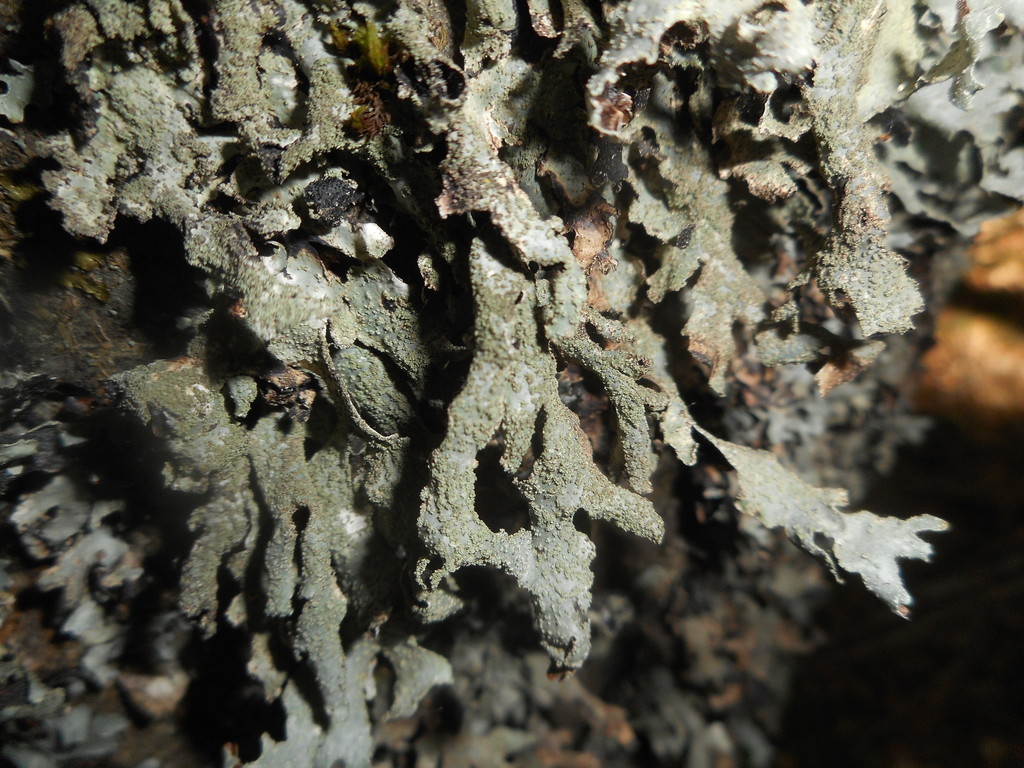
Parmelia submontana
Parmelia submontana is a species of corticolous (bark-dwelling), foliose lichen in the family Parmeliaceae. First described in 1987, it is characterised by a loosely attached, greenish-grey body (thallus) reaching diameters of 10–15 cm (4–6 in), with elongated linear lobes and distinctive powdery structures (isidia-like soredia) for reproduction. The species has a complex taxonomic history, having been independently discovered twice – first in Greece in 1832 and later in eastern Bohemia in 1951 – and was long misidentified as related species before being recognised as distinct. It differs from related species in having simple to forked rhizines—root-like holdfasts that attach it to bark—rather than the bushy, bottlebrush-like squarrose rhizines found in similar species, and its blistered rounded soralia that develop from pseudocyphellae.
Though historically considered a Mediterranean and south-central European species, it has been expanding its range northward since the 1990s, particularly in Fennoscandia. The species shows considerable habitat flexibility, growing primarily on deciduous tree bark in areas with high precipitation and humid, sheltered environments, typically near lakes, wetlands, or along coasts. Molecular studies indicate it evolved as a distinct species during the mid-Pleistocene around 1.3 million years ago, and despite appearing morphologically intermediate between some species, it belongs firmly within the Parmelia saxatilis species group.
From the article Parmelia submontana on Wikipedia (CC BY-SA), quoted section by section
Description
Parmelia submontana is a lichen with a thallus that is loosely attached to the bark of trees, often trailing in well-developed specimens. It has a firm, greenish, mineral-grey thallus that can reach a width of 10–15 cm (4–6 in). The lobes are elongated and linear, measuring up to 30 mm in length and 2–5 mm in width. These lobes are only slightly branched and sometimes weakly channeled. The upper surface is shiny and unbroken, ranging from smooth to slightly wrinkled. It features small, round to irregularly shaped pseudocyphellae (tiny openings on the surface), which are located both on the lamina (the main, leafy part of the thallus) and along the margins. These pseudocyphellae, measuring 0.3–1 mm long, quickly develop soralia (powdery patches used for asexual reproduction) that are initially orbicular to linear, often becoming eroded with age. The soredia—tiny grain-like clusters that reproduce the lichen vegetatively—are granular, sometimes appearing almost like isidia (small outgrowths). The lower surface of the thallus is black and sparsely covered with rhizines (root-like structures), which are simple to sparsely branched and measure 1–1.5 mm in length. The species has simple to furcate rhizines, where secondary branches arise obliquely from the axis, unlike the squarrose rhizines found in some other Parmelia species where secondary branches arise perpendicularly. …
Range & habitat
Parmelia submontana is widely distributed across Europe, occurring in at least 30 countries and territories. The species has been recorded throughout much of Central Europe, including Austria, Belgium, Switzerland, Czech Republic, Germany, and Luxembourg. In Western Europe, it is present in France, the Netherlands, and the United Kingdom. In Scotland, where it was first recorded in 2002, it often grows on introduced (non-native) tree species and may be an accidental garden import. The lichen's range extends into Northern Europe, with populations documented in Denmark, Norway, and Sweden. In Eastern Europe, it has been recorded in Estonia, Latvia, Lithuania, Poland, Russia, Slovakia, and Ukraine. The species is also present across Southern Europe, occurring in Italy, Slovenia, Greece, and Spain. Additional populations are known from several Balkan countries, including Bulgaria, while the species' range extends into Turkey at its southeastern limit. Although previously reported from Belarus, recent comprehensive studies have failed to confirm its presence there. Although traditionally considered a Mediterranean and south-central European species, P. submontana has been documented expanding its range northward in recent decades, particularly in Fennoscandia. …
Wikipedia: “Habitat and distribution”
Where it lives
Recorded sightings
—
geo-referenced records in GBIF, from museums, herbaria and field observers.
Drag the globe to turn it. Dots are where records exist, not a range map; darker means more records.
In the stacks
Searching the stacks…
Every page naming Parmelia submontana in the Biodiversity Heritage Library →
This page is assembled live from iNaturalist, GBIF, Wikipedia, the Source Library and the Internet Archive. It is not yet part of the hand-edited codex. iNaturalist taxon 463981.