- Animals
- ›Arthropods
- ›Hexapods
- ›Insects
- ›Winged and Once-winged Insects
- ›Ants, Bees, Wasps, and Sawflies
- ›Narrow-waisted Wasps, Ants, and Bees
- ›Ants, Bees, and Stinging Wasps
- ›Formicoidea
- ›Ants
- ›Myrmicine Ants
- ›Crematogastrini
- ›Carebara
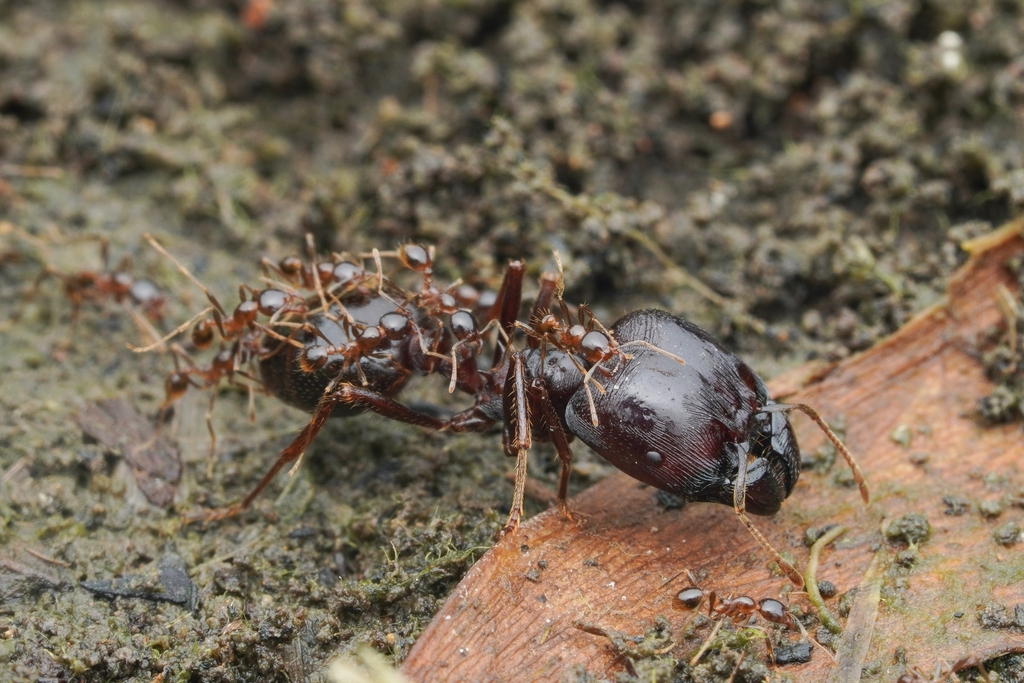
Asian Marauder Ant
Carebara diversa
Carebara diversa, commonly known as the East Indian harvesting ant, is a species of marauder ant widely distributed throughout Asia.
From the article Carebara diversa on Wikipedia (CC BY-SA), quoted section by section
Description
Carebara diversa is a eusocial insect and individuals have continuous allometric variation in size and morphology to facilitate task allocation and partitioning of work. Minor workers are between 1.3 and 2.5 mm in length, but major workers are much larger. Between the smallest minor and largest major workers there are many intermediate forms. The largest workers can have heads approximately 12 times as large as those of their smallest counterparts. The dry weight of a large major worker can be approximately 550 times as heavy of that of its smallest counterpart. These size-related morphological differences correspond with their division of labor. For example, small, young, minor workers specialize in caring for the larvae but extend their activities as they grow older.
Minor workers have yellowish brown to reddish brown bodies. Their mandibles each have five "teeth" and their antennal scapes are short and do not exceed the posterior margin of the head. Minor workers have rectangular heads with weakly convex posterior margins in full face view Major workers have reddish brown to blackish brown bodies. Their heads are proportionately larger and almost square with convex posterior margin in frontal view. Mandibles of major workers are large and triangular, with an acute apical "tooth". Their masticatory margins lack distinct "teeth". …
Range & habitat
Carebara diversa is widely distributed from India through Southeast Asia to Taiwan and the Philippines. Field records of it occurring in Japan are limited although it has been found on two very southern points: Okinawa Island and on Chicchi-jima Island. Specimens taken at the Camp Zama U.S. Air Force base in Kanagawa Prefecture are believed to have originated from commercial introduction from Southeast Asia.
Wikipedia: “Range”
What it does
Carebara diversa forms large colonies which are often found in soil or under rocks. This species preys on small animals such as insects and also collects nectivorous materials. These ants regularly form long columns for foraging and sometimes roof these trails with arcades constructed of soil particles. They use pheromone trails to maintain these lines and if these trails are obstructed it causes chaos and crowding. One study showed that 94% of individuals failed to cross an obstacle in the foraging path and that eventually the column creates a detour around such obstructions. The minors of this species are often observed to be 'hitching a ride' on the large majors so as to save energy while moving along the trail.
Differences between Carebara species and real army ants. Due to their raids, Carebara species are often compared to army ants, but there are some important differences:
Carebara species have permanent nests, while real army ants have only temporary nests (Dorylus) or form a bivouac with their own bodies (Eciton). Colonies of real army ants have only one queen, so when she dies, the workers may try to join another colony, or the rest of the colony also dies; Carebara colonies can have many (up to 16) queens. Carebara species perform a nuptial flight; real army-ant queens have no wings (queens and workers of the Dorylus species are even blind) and mate on soil. In C …
Wikipedia: “Behavior”
Listen
Looking for field recordings…
Where it lives
Recorded sightings
—
geo-referenced records in GBIF, from museums, herbaria and field observers.
Drag the globe to turn it. Dots are where records exist, not a range map; darker means more records.
In the stacks
Searching the stacks…
Every page naming Carebara diversa in the Biodiversity Heritage Library →
This page is assembled live from iNaturalist, GBIF, Wikipedia, the Source Library and the Internet Archive. It is not yet part of the hand-edited codex. iNaturalist taxon 464748.