- Animals
- ›Arthropods
- ›Chelicerates
- ›Arachnids
- ›Scorpions
- ›Neoscorpionina
- ›Orthosterni
- ›Buthida
- ›Flat-tailed and Bark Scorpions
- ›Arrowbreasted Scorpions
- ›Tityus
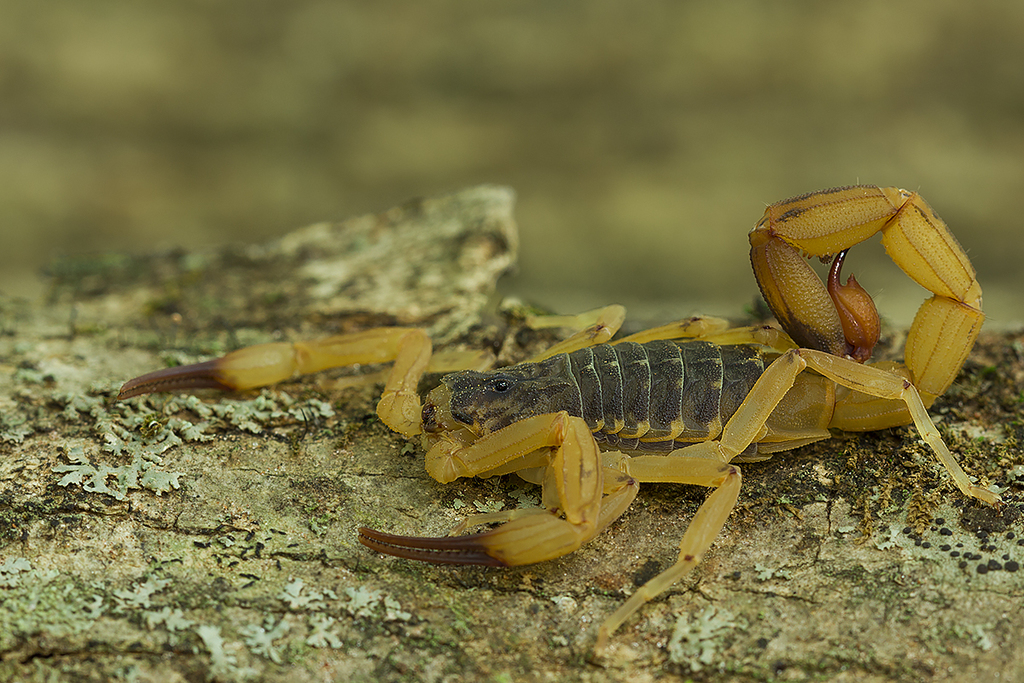
Brazilian Yellow Scorpion
Tityus serrulatus
Tityus serrulatus, the Brazilian yellow scorpion, is a species of scorpion of the family Buthidae. It is native to Brazil, and its venom is extremely toxic. It is the most dangerous scorpion in South America and is responsible for the most fatal cases.
From the article Tityus serrulatus on Wikipedia (CC BY-SA), quoted section by section
Description
Adult specimens typically measure between 5–7 cm (2–3 in) in length. As suggested by its common name, coloration consists of pale-yellow legs (8 in total) and pedipalps, with a darker shade of yellowish brown on the trunk and tip of the legs, pedipalps and tail. Like other members of the family Buthidae, T. serrulatus has a bulbous tail, often carried in a characteristic forward curve over the back, which is segmented, with prominent ridges and serrations. The tail is tipped with a venom-injecting barb capable of immobilizing prey or delivering defensive strikes.
Range & habitat
The species is endemic to Brazil and widely found throughout the country, including the states of Alagoas, Bahia, Ceará, Espírito Santo, Goiás, Mato Grosso, Mato Grosso do Sul, Minas Gerais, Paraná, Pernambuco, Rio de Janeiro, Rio Grande do Norte, Rio Grande do Sul, Rondônia, Santa Catarina, São Paulo, Sergipe, and Distrito Federal. "Due to deforestation and growing urbanization, this species is becoming more and more present," according to Rogério Bertani in an interview with the British newspaper The Guardian. He is a scientist and scorpion specialist at the Butantan Institute in São Paulo. "I personally think that the problem will continue to grow." By 2018 there was a notable increase in the number of T. serrulatus scorpions living in the urban spaces of São Paulo, contributing to an increase in reported scorpion stings in Brazil from 12,000 in 2000 to 140,000 by 2018. An abundance of prey, notably cockroaches, and shelter along with a lack of predators is believed to be a cause of the increase in scorpion numbers in Brazilian cities.
Wikipedia: “Geographic range”
What it does
It has a diet of insects, such as cockroaches, and is suited to life in sewers and trash heaps in urban areas. Having a low metabolic rate, it can survive for months without eating.
Wikipedia: “Feeding”
Where it lives
Recorded sightings
—
geo-referenced records in GBIF, from museums, herbaria and field observers.
Drag the globe to turn it. Dots are where records exist, not a range map; darker means more records.
In the stacks
Searching the stacks…
Every page naming Tityus serrulatus in the Biodiversity Heritage Library →
This page is assembled live from iNaturalist, GBIF, Wikipedia, the Source Library and the Internet Archive. It is not yet part of the hand-edited codex. iNaturalist taxon 468742.