- Animals
- ›Arthropods
- ›Hexapods
- ›Insects
- ›Winged and Once-winged Insects
- ›Butterflies and Moths
- ›Curved-horn Moths
- ›Concealer Moths
- ›Tingena
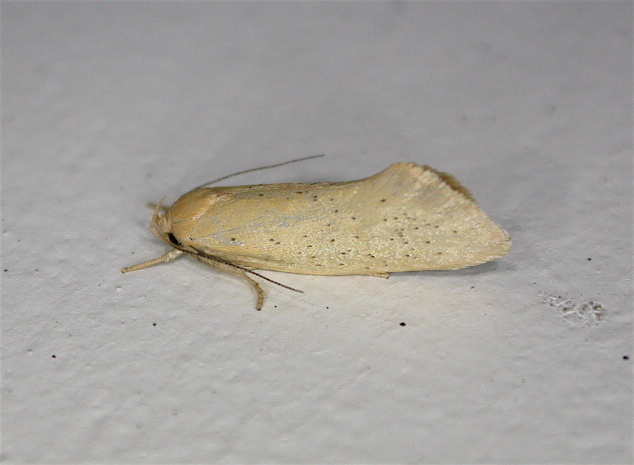
Yellow Litter Moth
Tingena armigerella
Tingena armigerella is a species of moth in the family Oecophoridae. T. armigerella is endemic to New Zealand where it is found in the North Island. The larvae of this species feed on plant litter. It is parasitised by the parasitic wasp Fustiserphus intrudens.
From the article Tingena armigerella on Wikipedia (CC BY-SA), quoted section by section
Description
The larvae of this species are dark brown coloured. The male adult was described by Walker as follows:
Male. Gilded yellow. Palpi nearly twice longer than the breadth of the head; second joint much curved; third shorter than the second. Abdomen, hind wings and under side blackish cinereous. Abdomen extending a little beyond the hind wings. Hind tibiae fringed. Fore wings moderately broad, hardly acute, with many minute blackish points; costa blackish towards the base. Hind wings blackish. Length of the body 3 lines; of the wings 10 lines. The forewing length of the species is between 7.5 and 10 mm. Although there are several other endemic to New Zealand moth species that resemble T. armigerella, this moth can be distinguished from most others by the smattering of dark scales on its mainly yellow forewings.
Range & habitat
This species is endemic to New Zealand. It is found throughout the North Island. It is visually very similar to other yellow species of moth but differs from many of these as it has noticeable dark scales on its wings. It has been hypothesised that observations of T. armigerella in the South Island result from misidentification with these visually similar yellow species.
Wikipedia: “Distribution”
What it does
The adults of this species are on the wing from October to February. They prefer to rest on tree trunks or fences and when disturbed, fall to the ground and seeks shelter in crevices or alternatively rests on their back with wings closed. They are nocturnal and are attracted to light.
Wikipedia: “Behaviour”
Listen
Looking for field recordings…
Where it lives
Recorded sightings
—
geo-referenced records in GBIF, from museums, herbaria and field observers.
Drag the globe to turn it. Dots are where records exist, not a range map; darker means more records.
In the stacks
Searching the stacks…
Every page naming Tingena armigerella in the Biodiversity Heritage Library →
This page is assembled live from iNaturalist, GBIF, Wikipedia, the Source Library and the Internet Archive. It is not yet part of the hand-edited codex. iNaturalist taxon 471074.