- Animals
- ›Arthropods
- ›Chelicerates
- ›Arachnids
- ›Spiders
- ›Typical Spiders
- ›Entelegyne Spiders
- ›RTA Clade Spiders
- ›Meshweavers and Allies
- ›desid spiders
- ›Matachiinae
- ›Badumna
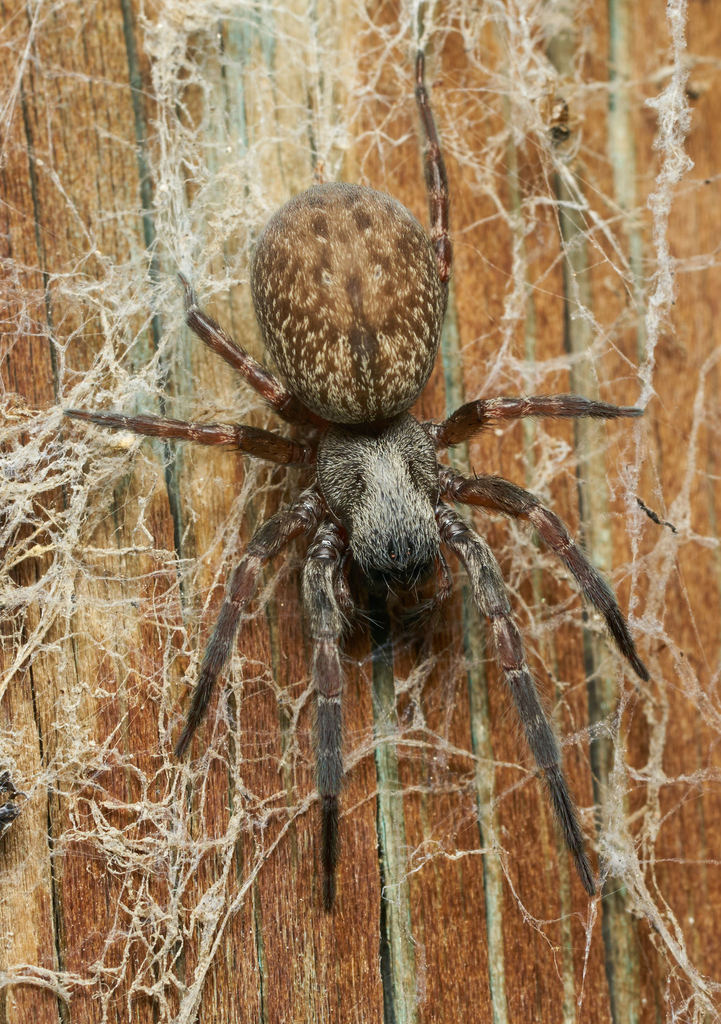
Grey House Spider
Badumna longinqua
Badumna longinqua, the grey house spider, is a species of spider in the family Desidae. Native to eastern Australia, it has been introduced into New Zealand, Japan, the United States, Mexico, Uruguay, Britain, and the Netherlands.
From the article Badumna longinqua on Wikipedia (CC BY-SA), quoted section by section
Description
Badumna longinqua is an average-sized spider, with males attaining a maximum length of no more than 11 millimetres (0.43 in), while females are marginally larger with a maximum body length of 15 mm (0.59 in). Its common name, grey house spider, is due to colouration on the cephalothorax and abdomen, which are carpeted with light-grey hairs and spot-like markings and legs, which are purplish-brown in colour with hairs arranged into stripes on each leg. The similarly coloured brown carapace darkens nearer the chelicerae and eyes. Its eight eyes are small and black, with the front middle pair exceptionally larger at approximately 1 and a half times the size of surrounding eyes. Underneath these setae is an ovate abdomen and legs, which are purplish-brown in colour with hairs arranged into stripes on each leg.
Range & habitat
Badumna longinqua was originally native to eastern Australia. The spider was unintentionally introduced and colonised into New Zealand and now is widespread throughout both the North and South Islands. This species is found throughout the North Island but is selected within the South Island as it is not as common southern and western of the South Island due to unfavourable environmental conditions. The colonisation of this species has increased over the last few decades due to human transport and trade, most likely arriving during colonial times, via inert phoresy on ships, planes, trains, and merchandise. The species was only first reported in New Zealand in the twentieth century. The range expansion of the species is due to human activities. This is because Badumna longinqua is able to spread within goods in transportation such as ships, trains and planes, which, offer warmth and the availability of food. Another speculated arrival method is that of ballooning, a means of dispersal in Araneae where a spiderling lets out a thread of silk called gossamer, which is carried away by wind or a thermal updraft, causing the spider to become airborne. Badumna insignis, a closely related, slightly larger species, commonly named the common black spider or black house spider, has also colonised New Zealand, but only as far as the northern part of the North Island.
Wikipedia: “New Zealand range”
Where it lives
Recorded sightings
—
geo-referenced records in GBIF, from museums, herbaria and field observers.
Drag the globe to turn it. Dots are where records exist, not a range map; darker means more records.
In the stacks
Searching the stacks…
Every page naming Badumna longinqua in the Biodiversity Heritage Library →
This page is assembled live from iNaturalist, GBIF, Wikipedia, the Source Library and the Internet Archive. It is not yet part of the hand-edited codex. iNaturalist taxon 47135.