- Animals
- ›Arthropods
- ›Hexapods
- ›Insects
- ›Winged and Once-winged Insects
- ›Butterflies and Moths
- ›Tortricid Leafroller Moths and Allies
- ›Tortricid Leafroller Moths
- ›Olethreutine Leafroller Moths
- ›Grapholitini
- ›Cydia
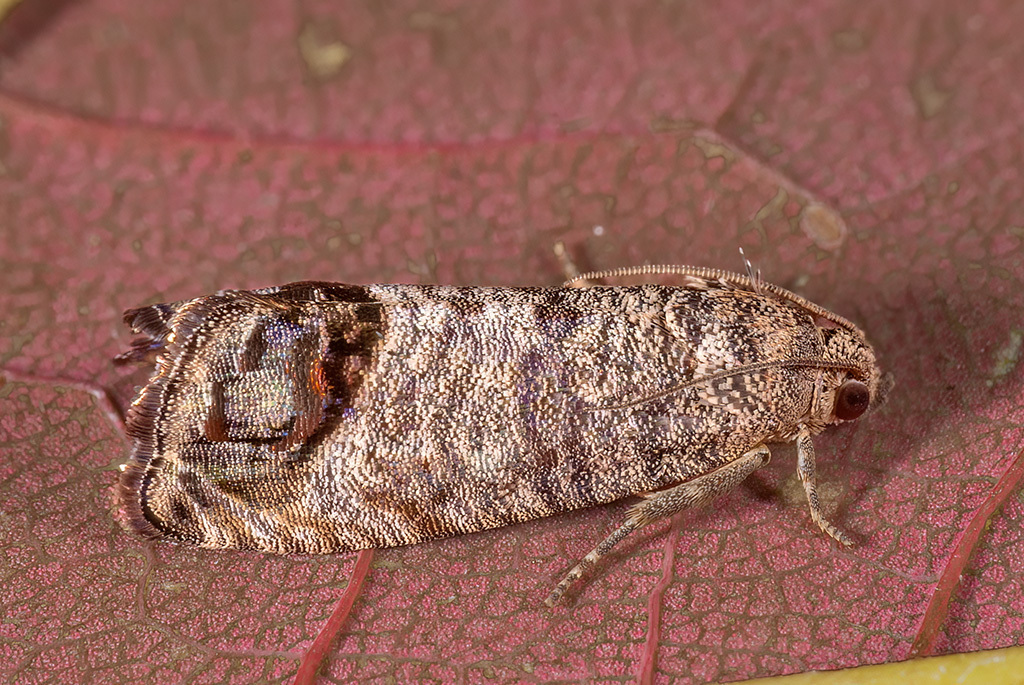
Codling Moth
Cydia pomonella
The codling moth or (especially Australia) codlin moth (Cydia pomonella) is a member of the Lepidopteran family Tortricidae. They are major pests to agricultural crops, mainly fruits such as apples and pears, and a codling moth larva is often called an "apple worm". Along with the apple maggot, it is the worm that people encounter when biting into an infested apple.
Because the larvae are not able to feed on leaves, they are highly dependent on fruits as a food source and thus have a significant impact on crops. The caterpillars bore into fruit and stop it from growing, which leads to premature ripening. Various means of control, including chemical, biological, and preventive, have been implemented. This moth has a widespread distribution, being found on six continents. Adaptive behavior such as diapause and multiple generations per breeding season have allowed this moth to persist even during years of bad climatic conditions.
From the article Codling moth on Wikipedia (CC BY-SA), quoted section by section
Description
Codling moths are not large, as the full grown adult codling moth has an average length of 10 mm and wingspan of 20 mm. The wings fold into a tent-like shape when the moths are resting. They are distinguished from other similar moths in the family Tortricidae by the distinctive patterns on their fore-wings. These brown spots enclosed in gold rings are called "little mirrors" because they resemble small mirrors with a golden rim. The slender antennae are mildly curved near the distal end. The dorsal side of the abdomen is smooth and bare, while the ventral side is covered in scales. Though most of the moths are brown or gray in color, it has been observed that the maturity of the fruits the larvae feed on can lead to variation in color in the adult moth.
Wikipedia: “Morphology”
Range & habitat
Although the geographic origin of codling moths is unclear, there are theories of these moths originating from either Europe or the Mediterranean. Scholars believe that the codling moths were introduced to the Americas in the mid-1700s. There is still debate on whether or not these moths have been distributed by humans. Today, the codling moths are spread all over the world, ranging from Europe, Asia, Africa, North and South America, Australia, and islands in the Pacific.
Wikipedia: “Geographic distribution”
What it does
The codling moth caterpillars bore into a fruit within 24 hours of hatching from their eggs, usually traveling between 1.5 m to 3 m in search of a fruit. Because they are susceptible to predation, drying up, or being washed away between the period of hatching and boring into a fruit, the caterpillars are prompt in finding a fruit to feed on. Although apples are their dominant food source, they are polyphagous, feeding on a wide variety of fruits from pear, walnut, quince, apricot, peaches, plums, cherries, and chestnuts. They are unable to survive by feeding on leaves of the fruit trees. It was previously believed that the searching behavior of the caterpillar for fruit to feed on or for a pupation site was random. However, the caterpillar is exposed and susceptible to predation, parasitization, drying up, and even energy depletion during this searching period. Thus, it was hypothesized that the searching behavior uses thigmotactic sense, which means the caterpillars use contact reflex to search. Caterpillars also use phototaxis to locate fruits to feed on. They are photopositive, which means they move towards light. This is adaptive because fruits tend to be located at the ends of the branches where there is most sunlight. …
Wikipedia: “Feeding behavior”
Listen
Looking for field recordings…
Where it lives
Recorded sightings
—
geo-referenced records in GBIF, from museums, herbaria and field observers.
Drag the globe to turn it. Dots are where records exist, not a range map; darker means more records.
In the stacks
Searching the stacks…
Every page naming Cydia pomonella in the Biodiversity Heritage Library →
This page is assembled live from iNaturalist, GBIF, Wikipedia, the Source Library and the Internet Archive. It is not yet part of the hand-edited codex. iNaturalist taxon 47153.