 NL·0354
Herbarium of the Nature Library
- Name
- Ciconia ciconia
- Family
- Ciconiidae
- Native to
- Breeds in Europe, North Africa, Turkey, the Middle East and Central Asia; winters in sub-Saharan Africa, with some in South Asia and increasingly in Iberia
- Habitat
- Wetland, Farmland, Temperate grassland
On eBird ↗
White Stork
Live sightings near you, the range map, bar charts of when it is seen, and Macaulay Library photos and recordings.
White stork
Ciconia ciconia
Also calledLaqlaq (Arabic) · Laklak (Persian) · Leylek (Turkish) · Weißstorch (German) · Ooievaar (Dutch) · Bocian biały (Polish) · Cigüeña blanca (Spanish)
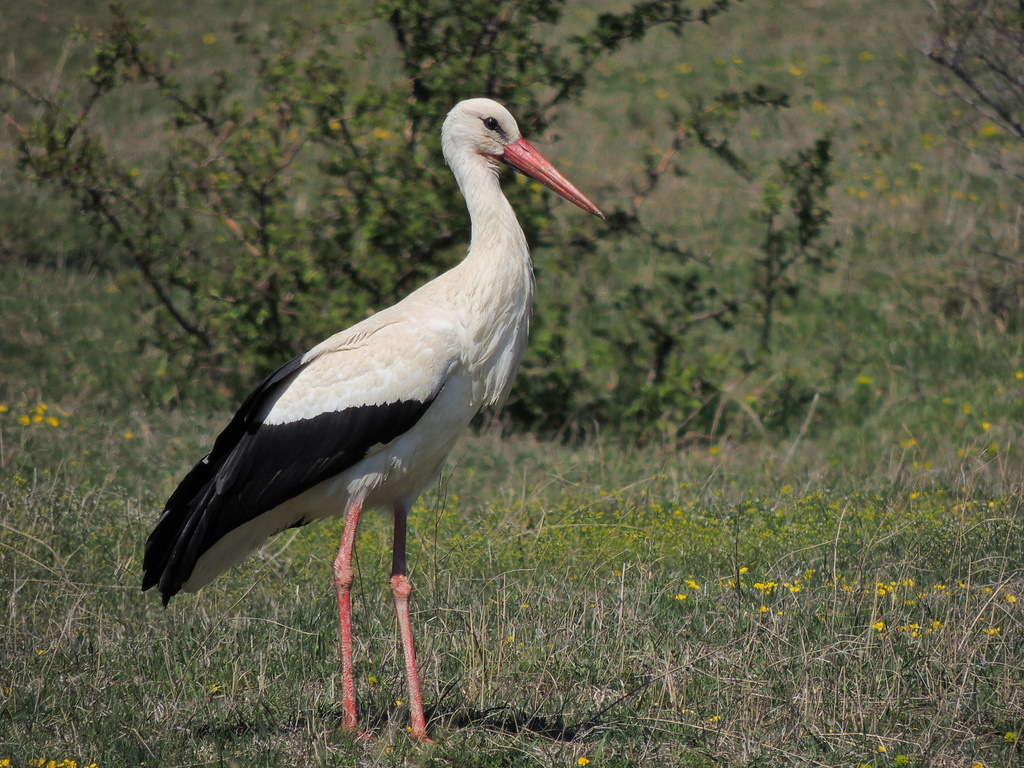
A tall white wader with black flight feathers and a red bill, which nests on rooftops, church towers and pylons. Its soaring migrations funnel over Gibraltar, the Bosphorus and Israel in hundreds of thousands on the way to Africa.
The white stork is a large bird in the stork family, Ciconiidae. Its plumage is mainly white, with black on the bird's wings. Adults have long red legs and long pointed red beaks, and measure on average 100–115 cm (39–45 in) from beak tip to end of tail, with a 155–215 cm (61–85 in) wingspan. The two subspecies, which differ slightly in size, breed in Europe north to Finland, northwestern Africa, Palearctic east to southern Kazakhstan and southern Africa. The white stork is a long-distance migrant, wintering in Africa from tropical Sub-Saharan Africa to as far south as South Africa, or on the Indian subcontinent. When migrating between Europe and Africa, it avoids crossing the Mediterranean Sea and detours via the Levant in the east or the Strait of Gibraltar in the west, because the air thermals on which it depends for soaring do not form over water. Wikipedia
What it can do
- iSoars on thermals to save energy, avoiding long sea crossings
- iiCommunicates by bill-clattering, as it is almost voiceless
- iiiReuses enormous stick nests for decades; some nests weigh hundreds of kilograms
- ivMany Iberian storks now winter on rubbish tips instead of crossing to Africa
In the field
Field marks
- aWhite body with black flight feathers
- bLong red bill and red legs
- cFlies with neck outstretched and legs trailing
- dJuveniles have dull, dark-tipped bills
- Voice
- Adults are nearly silent except for loud bill-clattering; chicks make hissing and mewing sounds.
- Not to be confused with
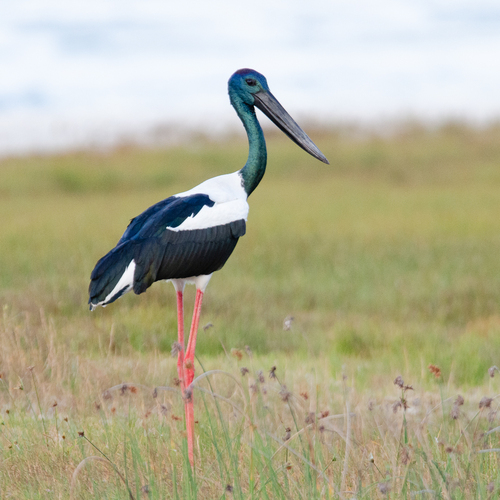
- Black stork is glossy black above with a white belly. Common crane is grey with a black-and-white head. Great white egret is all white with a yellow or dark bill and flies with its neck folded.
- Where to see it
- Rooftop colonies in Alsace, Extremadura, Poland (Żywkowo) and Morocco; mass migration at the Strait of Gibraltar, Istanbul's Bosphorus and the Hula Valley, Israel.
- When
- Summer visitor Feb/Mar–Aug; migration peaks in late August and in March
Listen
Looking for field recordings…
Life & habits
- Diet
- Frogs, insects (especially locusts and grasshoppers), worms, small mammals, fish and reptiles
- Habitat
- Wet meadows, farmland, river valleys and marshes near villages
- Size
- 100–115 cm long; wingspan 155–215 cm; 2.3–4.5 kg
- Lifespan
- Often 8–10 years; may exceed 30
Mates greet each other at the nest by throwing back their heads and clattering their bills like castanets.
Where it lives
Recorded sightings
—
geo-referenced records in GBIF, from museums, herbaria and field observers.
Native range
Breeds in Europe, North Africa, Turkey, the Middle East and Central Asia; winters in sub-Saharan Africa, with some in South Asia and increasingly in Iberia
Drag the globe to turn it. Dots are where records exist, not a range map; darker means more records.
In the old herbals & bestiaries
Woodcuts and engravings matched from the Source Library’s scanned books by name. Plates marked “relative” show a close kin rather than this exact species. Click a plate to read the page it came from, with translation.


In the stacks
Searching the stacks…
Every page naming Ciconia ciconia in the Biodiversity Heritage Library →
Marginalia
In 1822 a stork shot in Klütz, Germany, carried a central African spear in its neck; this 'Pfeilstorch' helped prove that birds migrate rather than hibernate. Across the Islamic world storks were revered as pilgrims that travelled towards Mecca each year, and in Turkey the bird is still affectionately called 'hacı leylek', the pilgrim stork.
Curiosity
The European legend of storks delivering babies is linked to their return each spring and their faithful nesting on houses.
Kinship

Fact-checked: 1 correction made to this sheet. Photographs: iNaturalist contributors under the licences shown. Records: GBIF.org. Historical plates: Source Library (CC BY-SA 4.0; originals public domain). Summary text: Nature Library editors and Wikipedia (CC BY-SA). Medicinal and edibility notes are historical and educational, not advice. iNaturalist taxon 4733.