- Animals
- ›Arthropods
- ›Chelicerates
- ›Arachnids
- ›Spiders
- ›Typical Spiders
- ›Entelegyne Spiders
- ›Orbweavers and Allies
- ›Comb-footed Spiders
- ›Latrodectinae
- ›Latrodectus
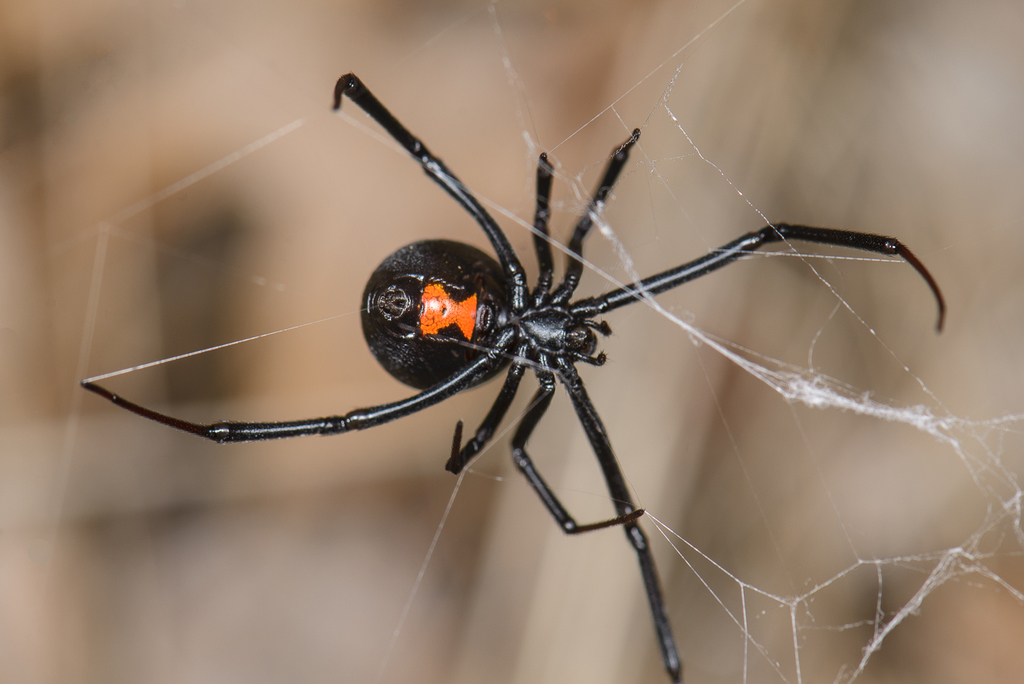
Western Black Widow
Latrodectus hesperus
Latrodectus hesperus, the western black widow spider or western widow, is a venomous spider species found in western regions of North America. The female's body is 14–16 mm (1/2 in) in length and is black, often with an hourglass-shaped red mark on the lower abdomen. This "hourglass" mark can be red, yellow, and on rare occasions, white. The male of the species is around half this length, and generally a beige color with lighter striping on the abdomen. The population was previously described as a subspecies of Latrodectus mactans, and it is closely related to the northern species Latrodectus variolus. The species, as with others of the genus, build irregular or tangled webs. Unlike the spiral webs or the funnel-shaped webs of some other spiders, the strands of a Latrodectus' web have no obvious overall organization.
Female black widows have potent venom containing a neurotoxin (α-latrotoxin) active against a range of organisms. In humans, symptoms of this venom include pain, nausea, vomiting, goosebumps, and localized sweating.
From the article Latrodectus hesperus on Wikipedia (CC BY-SA), quoted section by section
Range & habitat
Latrodectus hesperus can be found in the South-western regions of Canada, from British Columbia to Manitoba, along the Pacific Coast and throughout Texas, Oklahoma and Kansas in the U.S., and in Mexico. They are commonly found near the Canada-US border, as well as less commonly throughout the grasslands of the Canadian Prairies in Western Canada.
Wikipedia: “Range”
What it does
The female is stimulated upon contact of a male's web, and vice versa. Male and female L. hesperus produce sexually-specific scents that are combined with their silk; each sex responds by initiating mating when it comes in contact with a web of the opposite sex. On initiating courting, the male L. hesperus will utilize its tarsi to tap the threads of the female's web. The male will continue this tapping gesture with its pedipalps as it actively begins to explore the web. This exploration is intermixed with resting bouts. The male's body spasms, producing a high frequency vibration throughout its abdomen. In many instances, the female will not accept the male's sexual display and will scare the male away. In some instances, the females will violently jerk their abdomen, similar to courting male displays, which ultimately leads to a positive reaction from the males and a more successful insemination. One strategy performed by the male L. hesperus to ensure a successful courtship is to minimize the female's escape route options within its own web. This is accomplished by the male severing the female's web at various locations that it believes could provide the female with a course of action to avoid the male. Once the male has successfully made contact with the female's body, it swoons the female by gently stroking various parts of its body. …
Wikipedia: “Courtship behavior”
Toxicity
Latrodectus hesperus' bite is similar to that of other Latrodectus species because of their relatedness. The venom is exuded from the spiders' fangs and injected into the predator or prey. The spiders' prey is paralyzed by the venom, which enables their future digestion. For humans, the venom behaves like a neurotoxin (α-latrotoxin), affecting the neurotransmitter acetylcholine. This causes a condition known as latrodectism, with symptoms such as nausea, vomiting, pain at the bite, stomach pain, and goosebumps. The female is more of a threat than the male in this species, however it is only aggressive when it is protecting its eggs. Not only are the females fangs larger than the males, but their venomous glands are also more distinct. The venom is composed of proteins, peptides, and proteases. The venom causes an excess release of neurotransmitters which can cause a slew of symptoms. Treatments include painkillers and antivenom if the toxicity is severe enough.
Wikipedia: “Venom”
Where it lives
Recorded sightings
—
geo-referenced records in GBIF, from museums, herbaria and field observers.
Drag the globe to turn it. Dots are where records exist, not a range map; darker means more records.
In the stacks
Searching the stacks…
Every page naming Latrodectus hesperus in the Biodiversity Heritage Library →
This page is assembled live from iNaturalist, GBIF, Wikipedia, the Source Library and the Internet Archive. It is not yet part of the hand-edited codex. iNaturalist taxon 47382.