- Animals
- ›Molluscs
- ›Cephalopods
- ›Octopuses, Squids, and Cuttlefishes
- ›Octopuses and Vampire Squids
- ›Octopuses
- ›Incirrate Octopuses
- ›Typical Octopuses, Giant Octopuses, and Allies
- ›Typical Octopuses
- ›Octopus
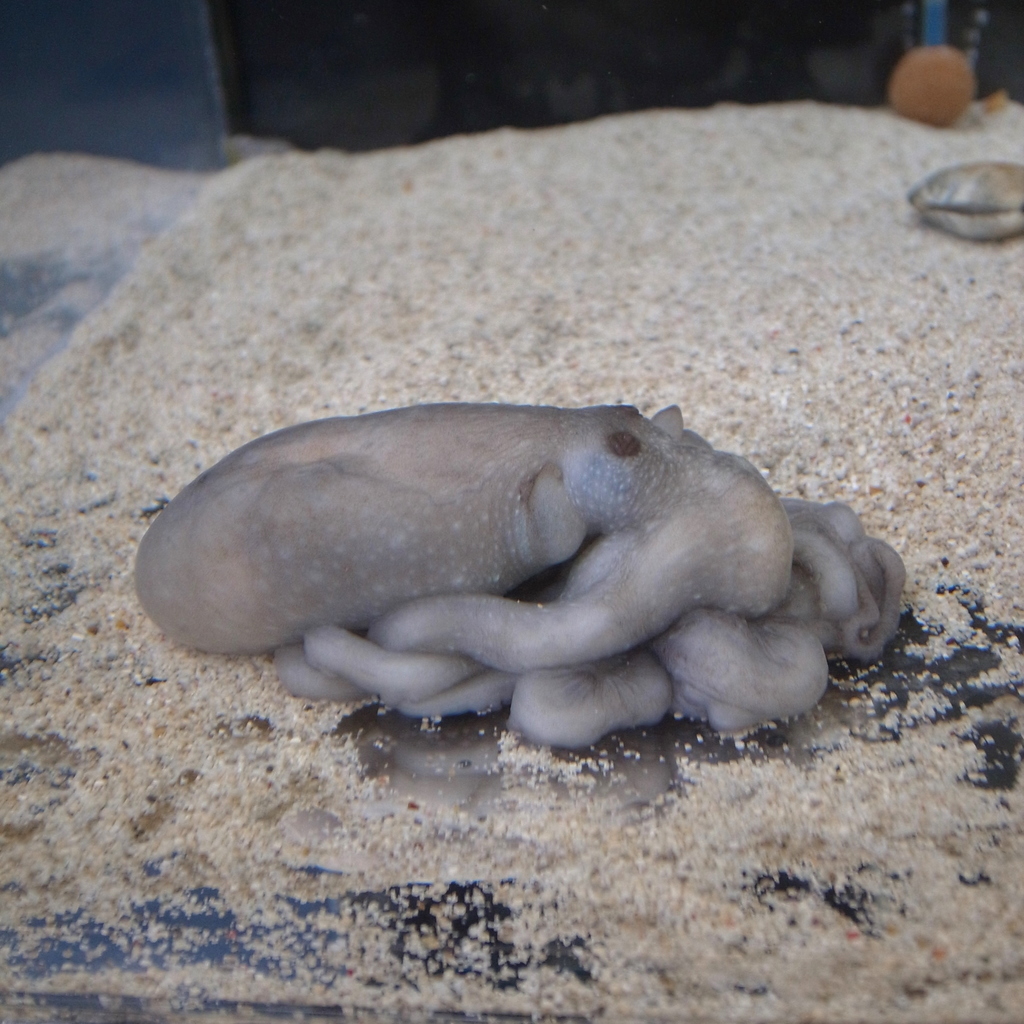
Whiparm Octopus
Octopus minor
Octopus minor, commonly known as the long arm octopus or the Korean common octopus, is a small-bodied octopus species distributed along the benthic coastal waters bordering China, Japan, and the Korean Peninsula. It lives at depths ranging from the sea surface to 200 metres (650 feet; 100 fathoms). O. minor is commonly found in the mudflats of sub-tidal zones where it is exposed to significant environmental variation. It is grouped within the class Cephalopoda along with squids and cuttlefish.
O. minor carries cultural and economic value in the countries in which it is found. It is important commercially to the fishing communities in Korea, where it is known as nakji, and contributes to the $35 million octopus industry. It is a Korean seafood, commonly referred to as nakji (Korean: 낙지). The octopus is served both cooked and raw, and is often a snack during sporting events.
From the article Octopus minor on Wikipedia (CC BY-SA), quoted section by section
Description
O. minor, similar to the rest of its order Octopoda, is bilaterally symmetrical along a dorsoventral axis with two eyes and mouth surrounded by eight webbed arms. These arms contain two-thirds of the octopus's neurons. On the underside of these arms, O. minor has "suckers" which are circular, adhesive suction cups. These are predominantly used for manipulation, navigation, and for preparing food. O. minor has a bulbous mantle and visceral hump which contains the majority of its fundamental organs. O. minor is small and soft-bodied with long arms, hence its nickname "long-arm octopus", or "whiparm octopus". Japanese common name is also "long-arm octopus" (テナガダコ, 手長蛸, tenaga-dako). Their body surface is mostly smooth, with small pimples scattered on the dorsal surface. Live O. minor shows red-brown with light yellow spots on dorsal surfaces. It can be identified by its grey colouring which matches the sandy plains in which it is commonly found, however when it finds itself threatened or in danger, it will shift its coloration to a dark red. Arms are thin and remarkably unequal in length. The first arm, the longest one, is about 80% of total length, which is twice length of third or fourth arms. Funnel organ is VV-shaped. Male has a hectocotylized arm to use for the mating. It is formed on right third arm, about half length of the left third arm. …
Wikipedia: “Anatomy”
Range & habitat
The habitats of O. minor vary greatly between rocks, reefs and the ocean floor. It is a benthic octopus, meaning it lies at the lowest body of water, around the sediment surface and rock or coral cover. O. minor is located within the mudflats of sub-tidal zones surrounding the south western coast of the Korean peninsula. O. minor residing within the mudflats of coastal regions are exposed to high salinity, temperature and water movement conditions. The O. minor is found in rocky areas such as Jeju Island. The O. minor is commonly found in the Yellow Sea. This is a segment of the Western Pacific Ocean situated between the Korean Peninsula and mainland China, connected to the Gulf of Bohai. The sea extends over 950 kilometres from North to South and 700 kilometres wide. The sea has a cyclone current and semidiurnal tides with temperatures that range from -10 degrees Celsius to 28 degrees Celsius.
Wikipedia: “Habitat”
What it does
O. minor, like other octopus populations, possesses predatory traits. O. minor's diet coincides with that of other bottom-dwelling octopuses, with over 50% of its prey being fish, 25% by shellfish such as whelks and clams, the remainder being made up of crustaceans such as crabs, along with annelids and nematodes, other commonly found species sharing their habitat with O. minor. The smaller size of the octopus means rejection of larger species including rock scallops and large fish.
The benthic nature of O. minor allows it to move between rocks and through crevices. Once it has identified its prey, it makes a sudden pounce, using its suckers to grip on and pull it in. The O. minor preys on smaller animals by trapping them in the web-like structure of its legs. The O. minor injects its prey with a paralyzing saliva, using miniature teeth at the end of its salivary papilla to dismember them. When targeting shelled molluscs, the O. minor creates a toxic saliva that enables the calcium carbonate of the shell to be broken down. Once the outer protection is penetrated, the prey's muscles relax, allowing the octopus to remove and eat its prey's soft tissues. Feeding intensities differ between the males and females of the species. Different intensities revolve around the ovarian maturation calendar of the female octopus. …
Wikipedia: “Feeding”
At the table
Within most parts of Korea, O. minor or Nakji, is a culinary option, being served most commonly as a snack either raw, cooked or poached.
Nakji-bokkeum (cooked). For this dish, O. minor is chopped, then stir-fried with vegetables such as carrots, onions and cabbage. It is marinated with a local Korean red pepper sauce, then served hot with warm rice, somyeon, or bean sprouts.
San-nakji (raw). For this dish, O. minor is either chopped or whole and served raw on a plate. It is often served with sesame oil and sesame seeds. The significant number of nerve endings in the arms of the O. Minor combined with its sophisticated nervous system, allows for a variety of movements when disconnected from the brain, meaning the octopus performs movements whilst being served. As the suction cups are still active on the cephalopod's arms, they may grip to one's throat, therefore consumers are at risk of choking.
Nakji-yeonpo-tang (soup). For this dish, O. minor is boiled in stock, before being chopped into fine pieces then served in the soup with spring onion, chilli and minced garlic. The dish is traditionally offered during funeral processions.
Wikipedia: “Culinary use”
Toxicity
A large percentage (22%) of O. minor have been found to host a dangerous parasitic benthic crustacean. Their increased susceptibility is due to its lack of external shell compared to other molluscs, such as snails. The presence Octopicola huanghaienis parasite is identified by a spike at the end of its labrum lap. The parasite is a health concern when O. minor is served raw.
Wikipedia: “Dangers”
Where it lives
Recorded sightings
—
geo-referenced records in GBIF, from museums, herbaria and field observers.
Drag the globe to turn it. Dots are where records exist, not a range map; darker means more records.
In the stacks
Searching the stacks…
Every page naming Octopus minor in the Biodiversity Heritage Library →
This page is assembled live from iNaturalist, GBIF, Wikipedia, the Source Library and the Internet Archive. It is not yet part of the hand-edited codex. iNaturalist taxon 474817.