- Plants
- ›Vascular Plants
- ›flowering plants
- ›monocots
- ›grasses, sedges, cattails, and allies
- ›grasses
- ›bamboos, canes, and allies
- ›Arundinarieae
- ›Fargesia
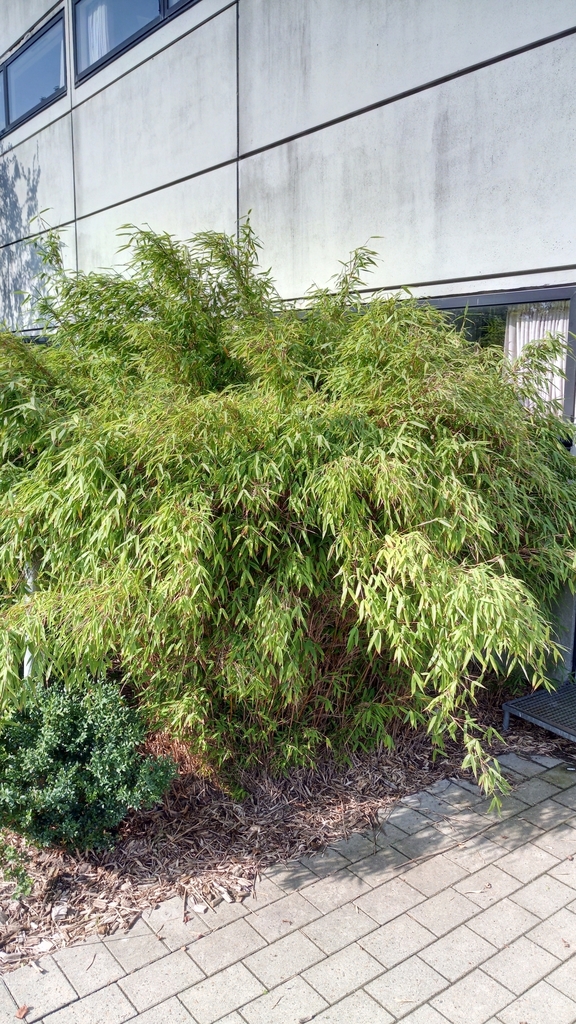
Umbrella Bamboo
Fargesia murielae
Fargesia murielae, the umbrella bamboo, is a species of flowering plant in the family Poaceae. It is a large, clump-forming evergreen bamboo, closely resembling Fargesia nitida in the same genus, but with yellow canes....
From the article Fargesia murielae on Wikipedia (CC BY-SA), quoted section by section
Description
Considered one of the most beautiful bamboos in cultivation, Fargesia murielae is native to the mountains of central China, introduced by Ernest Henry Wilson in 1913 and named after his daughter. Its common name "umbrella bamboo" describes the graceful weeping habit of this plant. It grows at elevations of 6,500–10,000 ft (1,981–3,048 m). It usually grows up to 10–14 ft (3–4 m), with a diameter of about 0.5 inch, and is hardy to −15 °C (5 °F) . Its USDA plant hardiness zone is 5 through 9 which is not desirable in climates with high heat and humidity such as southeastern states. The leaves are longer than they are wide, have pointed ends, and are arranged singly along the leaf stem. It quickly forms a dense clump of closely spaced canes that are hard to see under a mass of foliage. The new shoots are light blue with tan culm sheaths, aging to a yellowish-green. Its growth and appearance is facilitated in an environment that receives afternoon shade and sunlight throughout the day. Like all other fargesias, it does not have running rhizomes and needs no containment to prevent spread. It will maintain its green-pigmented foliage throughout the winter, though it will most likely shed a few leaves in late fall.
Range & habitat
Fargesia murielae has been known to grow in regions of various climates that range from dry mountainsides to jungles, but in general prefers moderately fertile soil which is moist but well-drained and well aerated. It also favors a slightly acidic environment where it is best fit. This species is most common in southeast Asia, China, and Japan. Bamboo in the Orient is harvested for food, paper and timber. In Europe and the United States, it is grown as an ornamental.
Wikipedia: “Habitat”
In human culture
1892: The French missionary P. Farges collects a herbarium specimen of an unknown flowering bamboo in Sichuan Province, China. In 1893, the French taxonomist A. Franchet assigns it to a new genus, Fargesia, with the specific name spathacea. 17 May 1907: On his first expedition to China for the Arnold Arboretum, E. H. Wilson collects plants and three sterile herbarium specimens of an unknown bamboo at Fang Xian, Hubei. [1910]: Wilson makes note of a single plant from his collection growing in the "greenhouses and frames" area of the Arnold Arboretum. 10 June 1910: On his second Arboretum expedition to China, Wilson revisits Fang Xian. 12 December 1913: One plant of Wilson's is received by Kew Gardens from the Arnold Arboretum. The plant is divided into six pieces that are planted out in the bamboo area. 1916: Wilson labels this Arundinaria sp. in volume II of Plantae Wilsonianae, but lists the wrong collection date. 1920: This collection is given the name Arundinaria murielae by J. S. Gamble. 1935: T. Nakai of Japan reclassifies Arundinaria murielae as Sinarundinaria murielae. 23 December 1959: U.S. National Arboretum botanist F. Meyer arranges for the importation of plants of Sinarundinaria murielae from the Royal Moerheim Nurseries, Dedemsvaart, Holland. The plants are probably divisions of Wilson's collection. …
Wikipedia: “History in the West”
Where it lives
Recorded sightings
—
geo-referenced records in GBIF, from museums, herbaria and field observers.
Drag the globe to turn it. Dots are where records exist, not a range map; darker means more records.
In the stacks
Searching the stacks…
Every page naming Fargesia murielae in the Biodiversity Heritage Library →
This page is assembled live from iNaturalist, GBIF, Wikipedia, the Source Library and the Internet Archive. It is not yet part of the hand-edited codex. iNaturalist taxon 480755.