- Animals
- ›Cnidarians
- ›Sea Anemones and Corals
- ›Hexacorallians
- ›Sea Anemones
- ›Enthemonae
- ›Metridioidea
- ›Sagartiidae
- ›Cereus
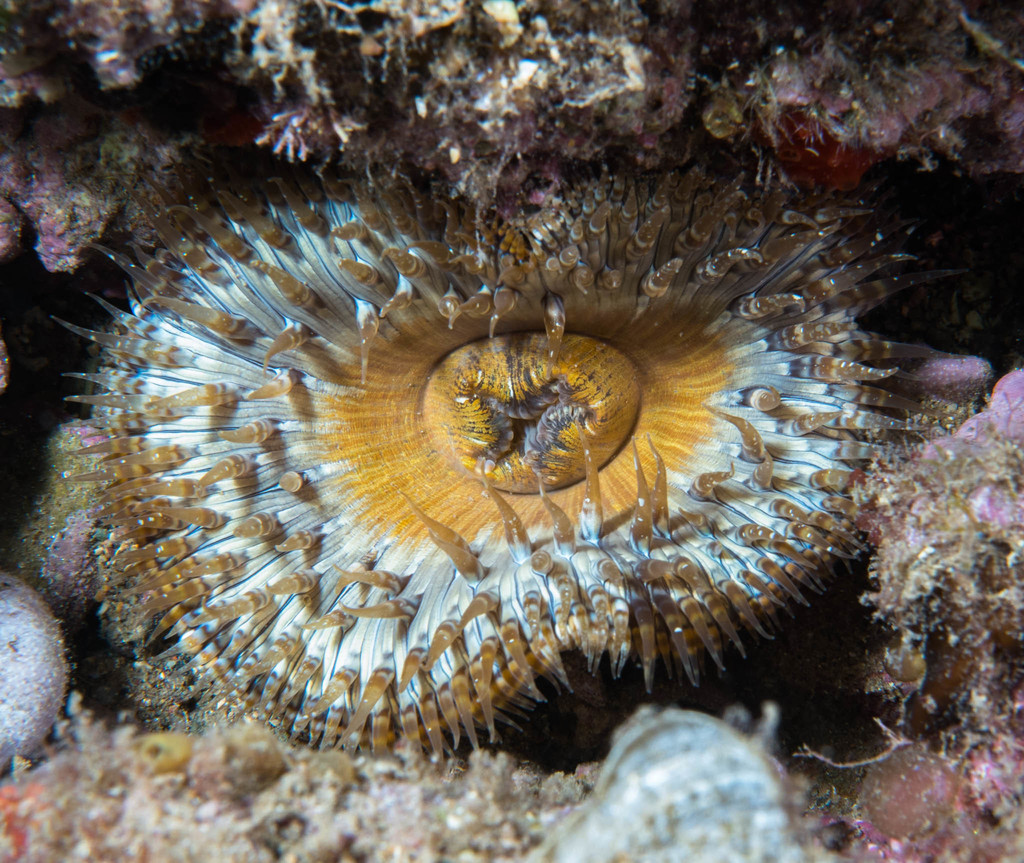
Daisy Anemone
Cereus pedunculatus
Cereus pedunculatus, commonly known as the daisy anemone, is a species of sea anemone in the family Sagartiidae. It is found in shallow parts of the northeast Atlantic Ocean and in the North Sea and the Mediterranean Sea. It functions as an omnivore, predator, and scavenger.
From the article Cereus pedunculatus on Wikipedia (CC BY-SA), quoted section by section
Description
Cereus pedunculatus has a base that is sometimes frilled at the edge. It is wider than the trunk which is covered with small dots and can be cream, pink, brown or violet. The trunk may be stalk-like and up to ten centimeters tall, or shaped more like a trumpet. Both these forms can retract back into a squat, tentacle‑fringed mound. The oral disk may be seven centimeters wide or even wider. There are more than 500 short, flaccid tentacles which may be a plain color, banded or speckled.
Range & habitat
Cereus pedunculatus is found in the northeast Atlantic Ocean south to the Azores, in the North Sea and the Mediterranean Sea at depths down to 50 meters. It is common around the southern and western coasts of the British Isles. It may grow in rock pools, often with the base and column concealed in a crevice, or it may be found in muddy gravel where it is anchored to a stone or other subsurface object. In this case, the tentacles are the only part that project and the whole animal can be withdrawn into the substrate if danger threatens.
Wikipedia: “Distribution and habitat”
Where it lives
Recorded sightings
—
geo-referenced records in GBIF, from museums, herbaria and field observers.
Drag the globe to turn it. Dots are where records exist, not a range map; darker means more records.
In the stacks
Searching the stacks…
Every page naming Cereus pedunculatus in the Biodiversity Heritage Library →
This page is assembled live from iNaturalist, GBIF, Wikipedia, the Source Library and the Internet Archive. It is not yet part of the hand-edited codex. iNaturalist taxon 481214.