- Animals
- ›Arthropods
- ›Hexapods
- ›Insects
- ›Winged and Once-winged Insects
- ›Ants, Bees, Wasps, and Sawflies
- ›Narrow-waisted Wasps, Ants, and Bees
- ›Ants, Bees, and Stinging Wasps
- ›Formicoidea
- ›Ants
- ›Myrmicine Ants
- ›Stenammini
- ›Novomessor
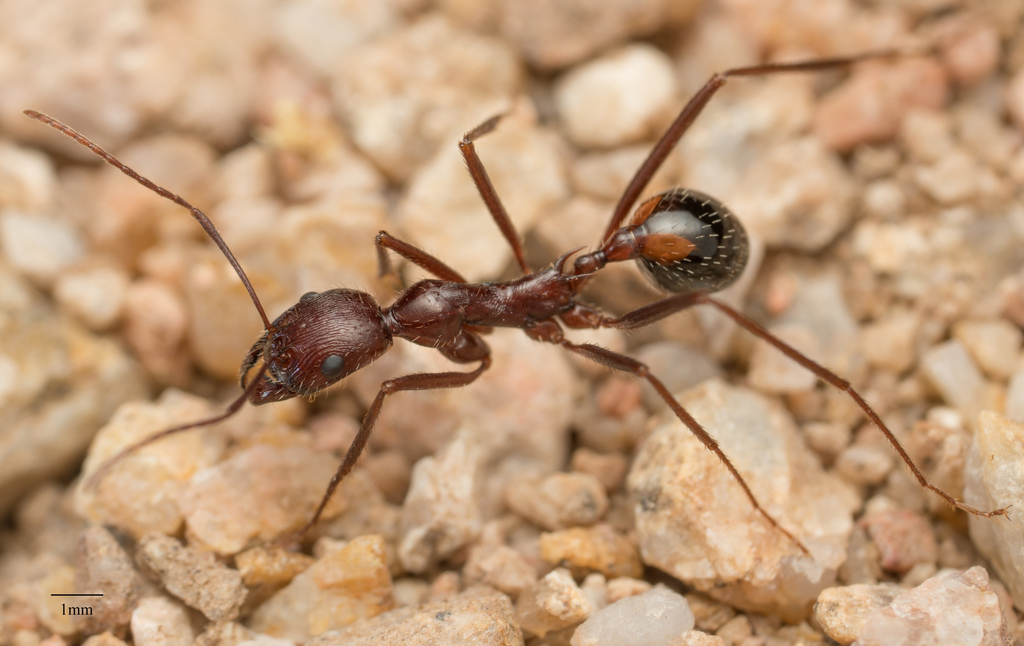
Novomessor cockerelli
Novomessor cockerelli is a species of ant in the subfamily Myrmicinae. It is native to the deserts of the Southwestern United States and Mexico. It lives in large underground colonies in which there is a single queen. The worker ants leave the nest daily to forage for seeds, plant material and dead insects.
From the article Novomessor cockerelli on Wikipedia (CC BY-SA), quoted section by section
Description
Novomessor cockerelli is a large brown ant with a blackish gaster, long legs and an elongated head. It can be recognised by the two distinctive spines on the propodeum. It can be distinguished from the rather similar Novomessor albisetosus by the shape of its head. It cannot sting but is very aggressive and has a powerful bite.
Range & habitat
Novomessor cockerelli is found in arid areas of the Southwestern United States including Texas and the Franklin Mountains, New Mexico, Arizona, Nevada and California. It is also present in northern Mexico in the states of Sonora, Chihuahua, Durango, Coahuila and Nuevo León. Its typical habitat is upland plains includes desert areas with ocotillo (Fouquieria splendens), cactus, creosote bush, mesquite, sagebrush and thorn scrub at altitudes of between 518 and 1,877 m (1,699 and 6,158 ft) above sea level.
Wikipedia: “Distribution and habitat”
What it does
Novomessor cockerelli forms large underground colonies, sometimes with multiple entrances, on open ground or beside rocks. The nest tends to be surrounded by a midden, a circle of tiny pebbles and plant remains. The worker ants normally leave the nest to forage in the early morning and in the evening, at which times the ground temperature is within the range 20 to 40 °C (68 to 104 °F). During the winter they may forage throughout the day. Seeds and plant material are collected but nearly half of the diet consists of the corpses of insects. These ants scavenge around carcases for dead insects such as flies. When a prey item is found that is too large for a single ant to carry, other ants are recruited by the use of pheromones. The original ant liberates a glandular secretion which attracts other workers within about two metres (yards) of the release point. If this fails to summon enough assistance, it releases a further secretion on the ground and lays a trail back to the colony. Other ants are attracted to follow the trail and then work co-operatively to transport the food item back to the nest. The trail is short-lived and soon evaporates. In the Chihuahuan Desert, Novomessor cockerelli competes for resources with another seed-eating ant species, the red harvester ant (Pogonomyrmex barbatus). It has been found that workers of N. …
Wikipedia: “Behavior”
Listen
Looking for field recordings…
Where it lives
Recorded sightings
—
geo-referenced records in GBIF, from museums, herbaria and field observers.
Drag the globe to turn it. Dots are where records exist, not a range map; darker means more records.
In the stacks
Searching the stacks…
Every page naming Novomessor cockerelli in the Biodiversity Heritage Library →
This page is assembled live from iNaturalist, GBIF, Wikipedia, the Source Library and the Internet Archive. It is not yet part of the hand-edited codex. iNaturalist taxon 482380.