- Animals
- ›Arthropods
- ›Hexapods
- ›Insects
- ›Winged and Once-winged Insects
- ›Butterflies and Moths
- ›Owlet Moths and Allies
- ›Cutworm Moths and Allies
- ›Acronictinae
- ›Acronicta
- ›Triaena
- ›Acronicta psi
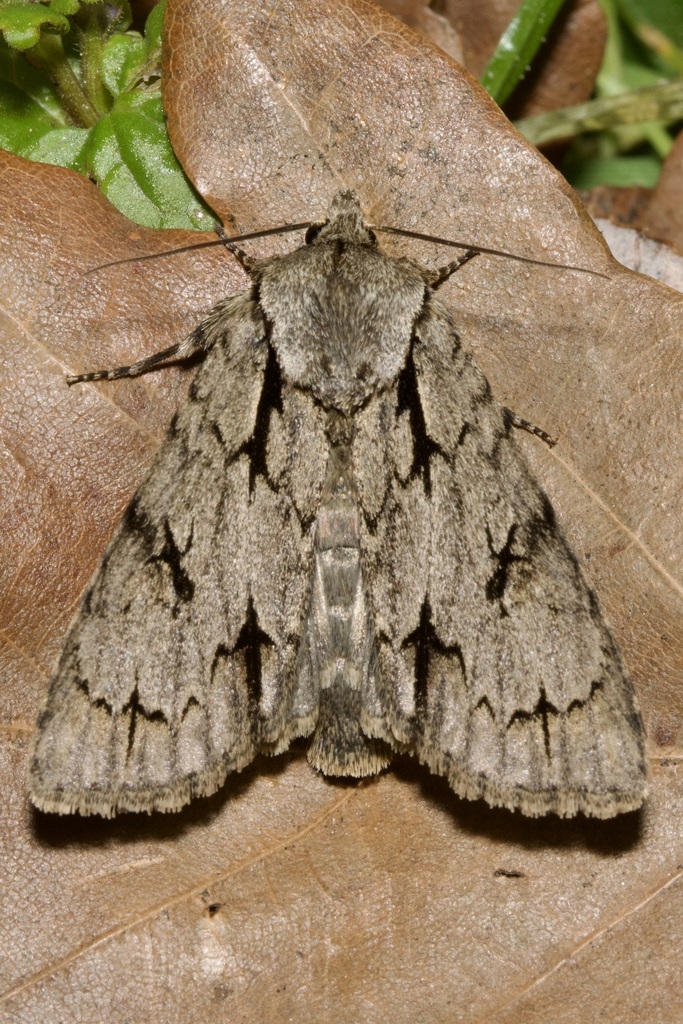
Dark Dagger
Acronicta tridens
The dark dagger (Acronicta tridens) is a moth of the family Noctuidae. The species was first described by Michael Denis and Ignaz Schiffermüller in 1775. It is distributed throughout Europe (from southern Fennoscandia to the Balkans and Italy), Turkey, the Near East, the European part of Russia, southern Siberia, the Ural, the Russian Far East (Primorye, southern Khabarovsk, southern Amur region and Sakhalin), the Korean Peninsula, China and Japan (Hokkaido).
This species has grey forewings marked with bold black "daggers". The hindwings of the males are white, those of the females dirty grey. The wingspan is 35–43 mm (1.4–1.7 in). Adults of this species are extremely similar to the grey dagger (Acronicta psi). Despite the common name, the dark dagger is usually the paler of the two species and the white hindwings of the male are usually diagnostic. However, the only reliable way of distinguishing adults of the two species is by examination of the genitalia. The larvae, however, are very different. This species flies at night in June and July and is attracted to light and sometimes to sugar.
From the article Dark dagger on Wikipedia (CC BY-SA), quoted section by section
At the table
Betula (birch) Caragana Crataegus (hawthorn) Malus (apple) Prunus Pyrus (pear) Rhamnus (buckthorn) Rosa (rose) Salix (willow) Sorbus (rowan)
Wikipedia: “Recorded food plants”
Listen
Looking for field recordings…
Where it lives
Recorded sightings
—
geo-referenced records in GBIF, from museums, herbaria and field observers.
Drag the globe to turn it. Dots are where records exist, not a range map; darker means more records.
In the stacks
Searching the stacks…
Every page naming Acronicta tridens in the Biodiversity Heritage Library →
This page is assembled live from iNaturalist, GBIF, Wikipedia, the Source Library and the Internet Archive. It is not yet part of the hand-edited codex. iNaturalist taxon 483480.