- Animals
- ›Arthropods
- ›Hexapods
- ›Insects
- ›Winged and Once-winged Insects
- ›Butterflies and Moths
- ›Owlet Moths and Allies
- ›Cutworm Moths and Allies
- ›Cutworms and Dart Moths
- ›Arches
- ›Apameina
- ›Apamea
- ›Apamea sordens
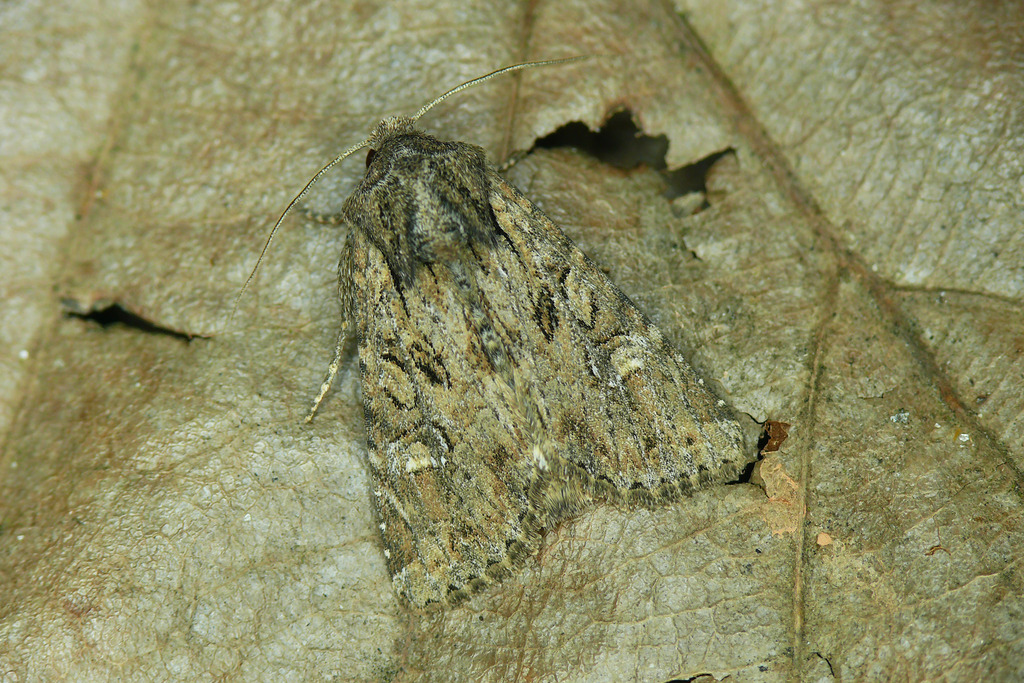
Large Nutmeg
Apamea anceps
Apamea anceps, the large nutmeg, is a moth of the family Noctuidae. The species was first described by Michael Denis and Ignaz Schiffermüller in 1775.
From the article Apamea anceps on Wikipedia (CC BY-SA), quoted section by section
Description
The wingspan is 35–40 mm. Forewing grey speckled with darker, and more or less tinged with brown; the veins dark; inner and outer lines double, dark filled in with pale ground colour, conversely lunulate-dentate; the inner line sometimes forming a sharp outward angle below vein 1, meeting the median line, sometimes rounded ami remote from it: claviform brown, darker edged, variable in size, often quite small; orbicular and reniform pale with dark centres, the latter with white dotted annulus and often followed by a pale patch; marginal area dark grey beyond the pale submarginal line, which is preceded by brownish patches at costa and on both folds: hindwing dirty whitish, with darker cellspot, veins, and outer line, the terminal area diffusely fuscous, with the submarginal line showing paler along termen; in typical sordida the brown tints are confined to the two folds: -in anceps Hbn. these brown tints pervade more or less the whole forewing: - ochracea Tutt has the ground colour paler and the suffusion more rufous brown; renardii Bsd. is a very pale form with the markings subobsolete; while engelhartii Duurloo represents a renardii pale form from eastern Jutland with indistinct markings; - ab. mediana ab. nov. …
Listen
Looking for field recordings…
Where it lives
Recorded sightings
—
geo-referenced records in GBIF, from museums, herbaria and field observers.
Drag the globe to turn it. Dots are where records exist, not a range map; darker means more records.
In the stacks
Searching the stacks…
Every page naming Apamea anceps in the Biodiversity Heritage Library →
This page is assembled live from iNaturalist, GBIF, Wikipedia, the Source Library and the Internet Archive. It is not yet part of the hand-edited codex. iNaturalist taxon 483495.