- Animals
- ›Arthropods
- ›Chelicerates
- ›Arachnids
- ›Mites and Ticks
- ›Acariformes
- ›Sarcoptiformes
- ›Endeostigmatan Mites
- ›Eriophyoidea
- ›Gall and Rust Mites
- ›Eriophyinae
- ›Aceriini
- ›Aceria
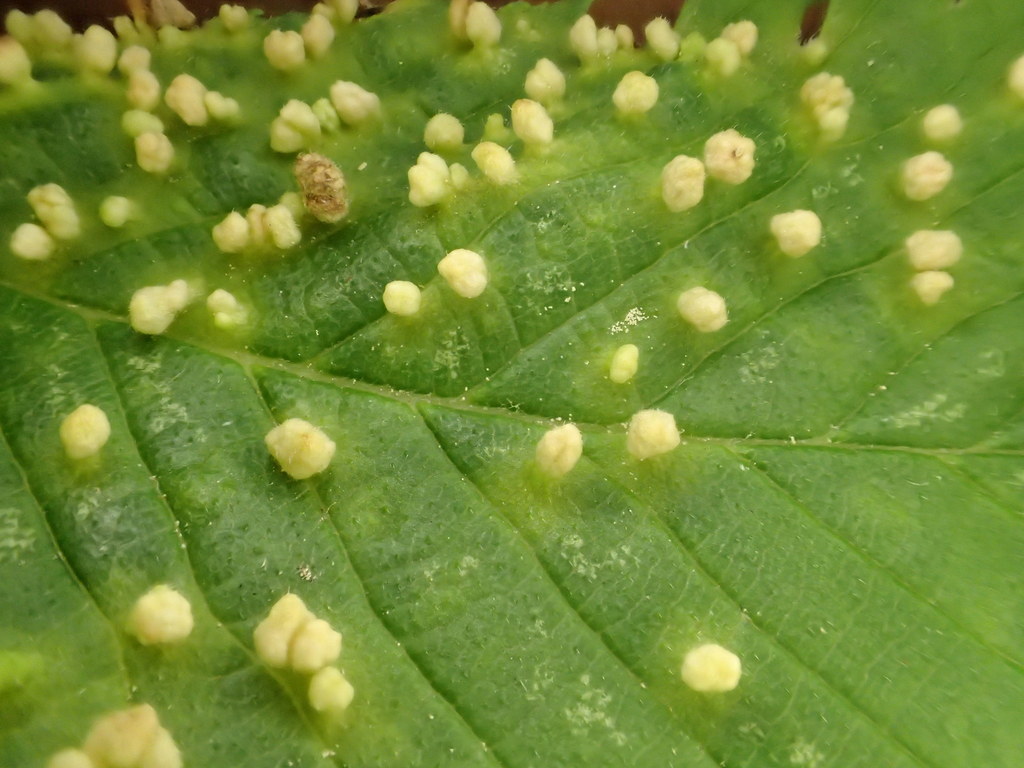
Elm Leaf Gall Mite
Aceria campestricola
Aceria campestricola, is a species of mite in the family Eriophyidae. The mite causes galls on the leaves of elms (Ulmus species) and was described by Georg Ritter von Frauenfeld in 1865.
From the article Aceria campestricola on Wikipedia (CC BY-SA), quoted section by section
Description
The mites pass the winter hidden in bark crevices and in the spring attack the leaves. The gall is a small pimple or pouch, 1–2 mm across, on the blade or the veins. They are rounded above and have a hairy opening below, with or without a conical projection. Galls are greenish-yellow and redden when exposed to sun, they can be numerous and contain mites. There is some disagreement as to which species is involved in forming the galls. Mite pimples on elms with small leaves, vary in size and some of the large galls have stalked dimples The small galls have been described as Aceria ulmicola (Napela) and the stalked galls as Aceria brevipunctata. Galls have been found on the leaves of the following trees; wych elm (Ulmus glabra), Dutch elm Ulmus x hollandica, European white elm (Ulmus laevis), field elm (Ulmus minor).
Where it lives
Recorded sightings
—
geo-referenced records in GBIF, from museums, herbaria and field observers.
Drag the globe to turn it. Dots are where records exist, not a range map; darker means more records.
In the stacks
Searching the stacks…
Every page naming Aceria campestricola in the Biodiversity Heritage Library →
This page is assembled live from iNaturalist, GBIF, Wikipedia, the Source Library and the Internet Archive. It is not yet part of the hand-edited codex. iNaturalist taxon 487129.