- Animals
- ›Arthropods
- ›Hexapods
- ›Insects
- ›Winged and Once-winged Insects
- ›Butterflies and Moths
- ›Owlet Moths and Allies
- ›Underwing, Tiger, Tussock, and Allied Moths
- ›Tiger Moths and Allies
- ›Tiger Moths
- ›Spilosomina
- ›Metacrias
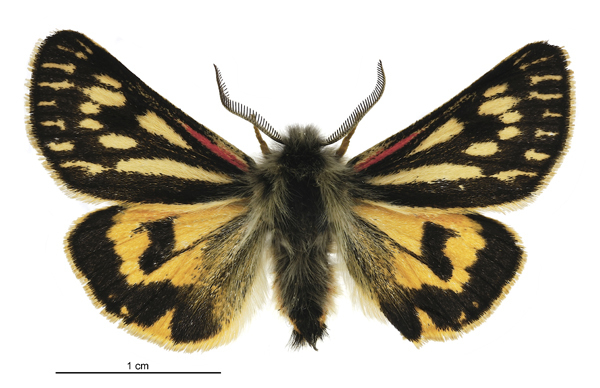
Eastern Tiger Moth
Metacrias huttonii
Metacrias huttoni, known as the Alpine tiger or Alpine tiger moth, is a species of moth in the family Erebidae. This species is endemic to New Zealand, where it is known from the eastern areas of the South Island. The female of the species is flightless and buff coloured whereas the male is brightly coloured and flies during the day.
From the article Metacrias huttoni on Wikipedia (CC BY-SA), quoted section by section
Description
The larvae of this species are approximately 2.5 cm (0.98 in) long, black and very hairy. The hairs on the terminal segments are the longest and the shortest hairs are reddish-ochreous-brown. There is are blue dots around each segment except the second. Adults males are brightly coloured and diurnal, while females are buff coloured and extremely short winged. Butler described the species as follows:
primaries pale ochraceous, with the borders and veins rather broadly black, a submarginal transverse black line or stripe, or these wings might perhaps better be described as black, with an abbreviated basal dash, a cuneiform discoidal dash, an interno-median longitudinal streak, five subconfluent longitudinal discal dashes, and a submarginal series of small conical spots pale ochraceous; a basal subcostal carmine streak; secondaries bright ochreous, greyish on interno-median area; an oblique black spot on the discocellulars; outer border, to beyond the first median branch, broadly black, uniting with a large subanal marginal black spot, and intersected by an interrupted macular ochreous line close to the margin; fringe ochreous; body black, with sordid whitish fringes to the tegulae; abdomen with ochraceous borders; wings below ochreous with black discocellular spots; outer borders black, intersected by a series of ochreous dots; costal borders dark orange, the primaries with an i …
Range & habitat
This species is endemic to New Zealand. It is known from the eastern areas of the South Island.
Wikipedia: “Distribution”
What it does
The female of the species is semiapterious and remains within her cocoon for mating and egg laying. As a result of this, the population disbursal of the species is limited to the wanderings of the larvae. The male of the species is diurnal and is on the wing from December to March. Males are attracted to females by pheromones. Males of this species can be attracted to the scent of females of different species within their genus. Researchers have used females as lures to take advantage of this behaviour to detect males in new localities. The larvae hibernates during winter. Pupae cocoons are normally found beneath stones.
Wikipedia: “Biology and behaviour”
Listen
Looking for field recordings…
Where it lives
Recorded sightings
—
geo-referenced records in GBIF, from museums, herbaria and field observers.
Drag the globe to turn it. Dots are where records exist, not a range map; darker means more records.
In the stacks
Searching the stacks…
Every page naming Metacrias huttonii in the Biodiversity Heritage Library →
This page is assembled live from iNaturalist, GBIF, Wikipedia, the Source Library and the Internet Archive. It is not yet part of the hand-edited codex. iNaturalist taxon 488360.