- Plants
- ›Vascular Plants
- ›flowering plants
- ›Dicots
- ›Nances, Willows, and Allies
- ›Spurge Family
- ›Euphorbioideae
- ›Hippomaneae
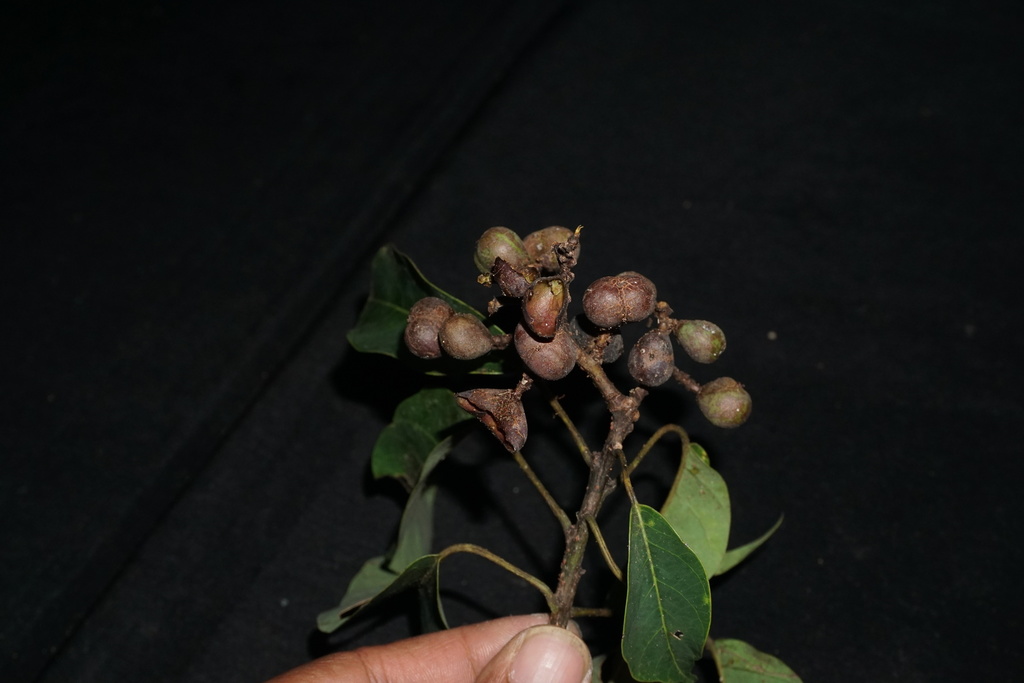
Balakata
Balakata is a genus of trees in the family Euphorbiaceae first described as a genus in 1999. It is native to Southeast Asia, southern China, the Himalayas, and New Guinea. The genus name was inspired by balákat-gúbat ("shoulder-tree"), the Philippine common name for B. luzonica.
Balakata baccata grows up to 26 meters tall, while B. luzonica can reach 36 metres (118 ft). These trees have alternately arranged leaves 3.5 to 11 centimetres (1.4 to 4.3 in) long, usually with large basal glands on the undersides. The undersides are also whitish in color in B. baccata, but not in B. luzonica. The former has longer petioles than the latter. The trees are monoecious, with inflorescences containing several male flowers and usually at least one female flower at the base. The fruit is smooth and fleshy. That of B. baccata usually contains two seeds, while the fruit of B. luzonica has a single seed.
2 branches of this genus, most-observed first
See this branch on the Wheel of Life →
Where it lives
Recorded sightings
—
geo-referenced records in GBIF, from museums, herbaria and field observers.
Drag the globe to turn it. Dots are where records exist, not a range map; darker means more records.
In the stacks
Searching the stacks…
Every page naming Balakata in the Biodiversity Heritage Library →
This page is assembled live from iNaturalist, GBIF, Wikipedia, the Source Library and the Internet Archive. It is not yet part of the hand-edited codex. iNaturalist taxon 490158.