- Animals
- ›Arthropods
- ›Hexapods
- ›Insects
- ›Winged and Once-winged Insects
- ›Butterflies and Moths
- ›Butterflies
- ›Swallowtails and Parnassians
- ›Swallowtails
- ›Birdwings, Cattlehearts, and Pipevine Swallowtails
- ›Battina
- ›Battus
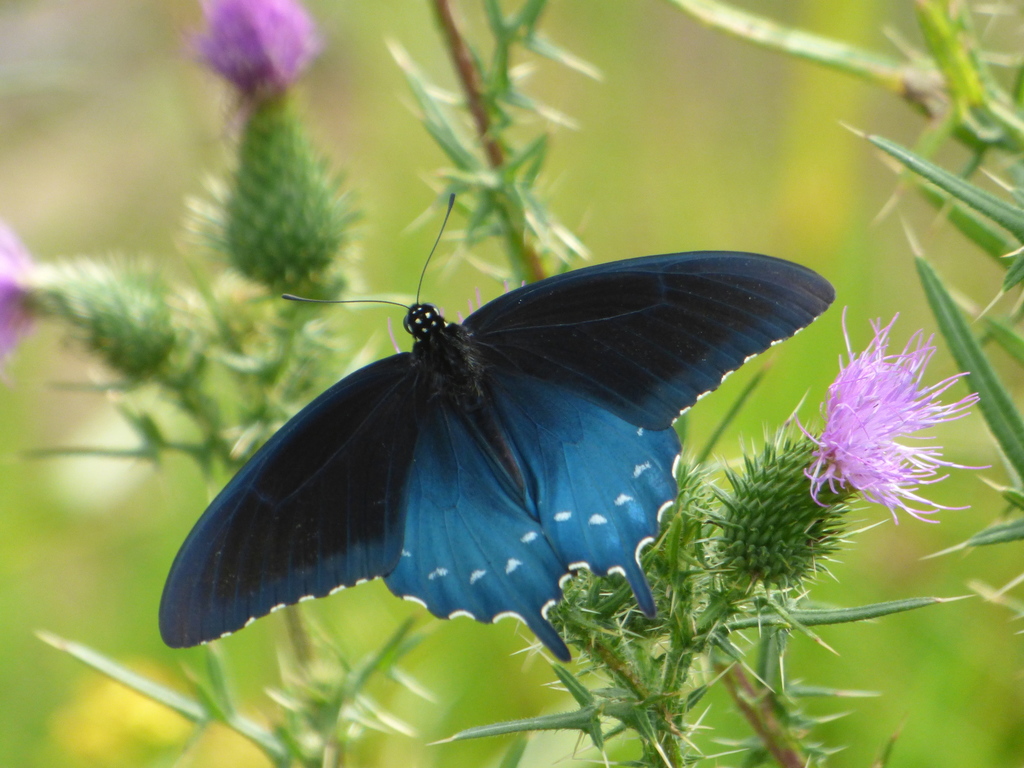
Pipevine Swallowtail
Battus philenor
Battus philenor, the pipevine swallowtail or blue swallowtail, is a swallowtail butterfly found in North America and Central America. This butterfly is black with iridescent-blue hindwings. They are found in many different habitats, but are most commonly found in forests. Caterpillars are often black or red, and feed on compatible plants of the genus Aristolochia. They are known for sequestering acids from the plants they feed on in order to defend themselves from predators by being poisonous when consumed. The adults feed on the nectar of a variety of flowers. Some species of Aristolochia are toxic to the larvae, typically tropical varieties. While enthusiasts have led citizen efforts to conserve pipevine swallowtails in their neighborhoods on the West coast, the butterfly has not been the subject of a formal program in conservation or protected in legislation. The butterfly is however of "Special Concern" in Michigan, which is on the Northern limit of its range.
From the article Battus philenor on Wikipedia (CC BY-SA), quoted section by section
Range & habitat
The pipevine swallowtail has a wide distribution across the Northern Americas. In the United States, the butterfly is found in New England down to Florida west to Nebraska, Texas, New Mexico, Arizona, California, and Oregon. There is also an isolated population in central California. They have been observed as far south as Mexico and as far north as Ontario, although these sightings are inconsistent. The butterfly frequents warmer, more temperate environments, and can be found mostly in open grasslands, woodlands, meadows, and backyard gardens. They favor anywhere pipevine (Aristolochia) can grow in abundance.
Wikipedia: “Distribution and habitat”
Listen
Looking for field recordings…
Where it lives
Recorded sightings
—
geo-referenced records in GBIF, from museums, herbaria and field observers.
Drag the globe to turn it. Dots are where records exist, not a range map; darker means more records.
In the stacks
Searching the stacks…
Every page naming Battus philenor in the Biodiversity Heritage Library →
This page is assembled live from iNaturalist, GBIF, Wikipedia, the Source Library and the Internet Archive. It is not yet part of the hand-edited codex. iNaturalist taxon 49972.