- Animals
- ›Arthropods
- ›Hexapods
- ›Insects
- ›Winged and Once-winged Insects
- ›Butterflies and Moths
- ›Owlet Moths and Allies
- ›Underwing, Tiger, Tussock, and Allied Moths
- ›Toxocampinae
- ›Apopestes
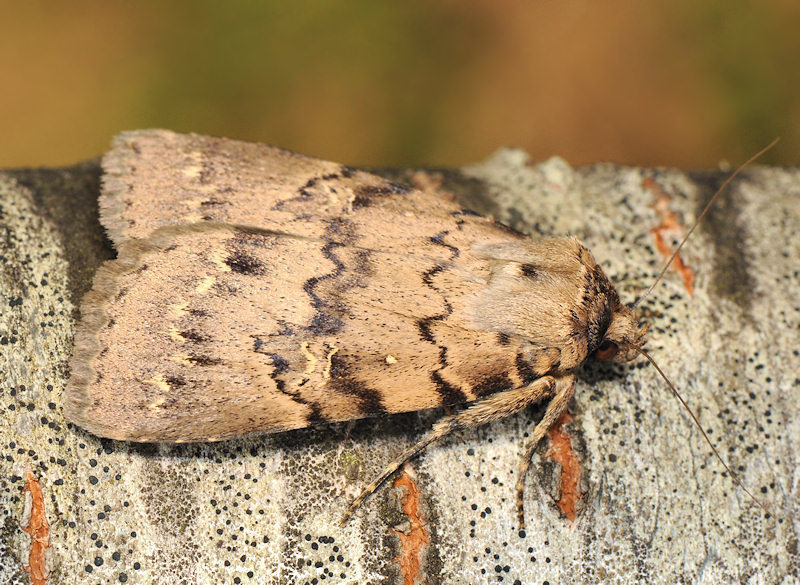
Apopestes spectrum
Apopestes spectrum is a species of moth in the family Erebidae first described by Eugenius Johann Christoph Esper in 1787.
From the article Apopestes spectrum on Wikipedia (CC BY-SA), quoted section by section
Description
Apopestes spectrum has a wingspan of 74–82 mm. The forewings of this large moth are light brown, with dark brown markings. In the postdiscal area near the inner edge there is a dark spot. The hindwings have a pale brown color. The caterpillars are slender and yellow, with two black stripes and irregular black markings on each side. The head shows whitish and black dots. The chrysalis is reddish brown.
There is one generation per year (univoltine). Caterpillars can be found from late April to June. They feed on Papilionaceae species, including Genista, Sarothamnus, Spaltium, Glycyrrhiza and Retama raetam. The moths overwinter from July up to March of the following year.
Range & habitat
This species has a Mediterranean distribution. It can be found in many European countries (Albania, Bosnia, Bulgaria, Croatia, France, Greece, Italy, Portugal, Slovenia, Spain, and Switzerland) and from Maghreb, to western Turkey, Lebanon, Israel and Jordan.
Wikipedia: “Distribution”
Listen
Looking for field recordings…
Where it lives
Recorded sightings
—
geo-referenced records in GBIF, from museums, herbaria and field observers.
Drag the globe to turn it. Dots are where records exist, not a range map; darker means more records.
In the stacks
Searching the stacks…
Every page naming Apopestes spectrum in the Biodiversity Heritage Library →
This page is assembled live from iNaturalist, GBIF, Wikipedia, the Source Library and the Internet Archive. It is not yet part of the hand-edited codex. iNaturalist taxon 500350.