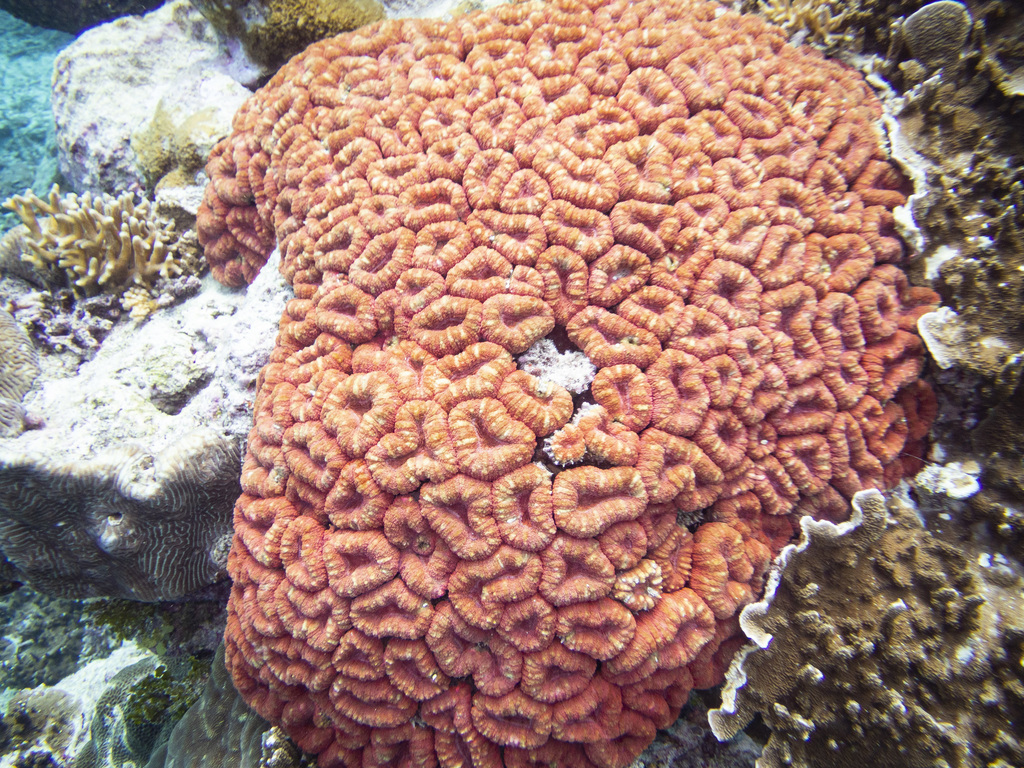
Brain Root Coral
Lobophyllia corymbosa
Lobophyllia corymbosa, also known as lobed cactus coral or brain root coral, is a species of large polyp stony coral in the family Lobophylliidae. It occurs on reefs in shallow waters in the Red Sea, off the coast of East Africa, and in other parts of the tropical Indo-Pacific.
From the article Lobophyllia corymbosa on Wikipedia (CC BY-SA), quoted section by section
Description
Lobophyllia corymbosa is a coral that either forms flat sheets or hemispherical domes. Though usually under 50 cm (20 in) in diameter this coral is sometimes several times that size. In the Red Sea, particularly large specimens are found. The individual lobes of the coral are united at their bases and are 15 to 30 cm (6 to 12 in) long and 5 to 10 cm (2 to 4 in) wide. The polyps are large and each one secretes a corallite or stony cup around itself. These are irregular in shape and form the skeleton of the coral. There is a distinct wall between the corallites, each one of which has numerous radiating vertical ridges known as septa. These septa are narrow within the corallite but thicker and longer on the walls. Their blunt teeth give the coral a prickly appearance. The corallites tend to be the shape of an hourglass and the polyps inside are thick and fleshy. They are normally retracted in the daytime but extend their tentacles at night to feed. The colour of the polyps is bluish or greenish-grey, or yellowish-brown. This colour is due to the zooxanthellae, the minute symbiotic dinoflagellates which reside within the tissues of the coral. These photosynthetic algae use sunlight to create organic compounds and the coral is able to use these as part of its nutritional needs.
Range & habitat
The type locality of Lobophyllia corymbosa is the Red Sea. It is also found in the tropical Indian Ocean and the central and eastern Pacific Ocean at depths down to about 40 metres (130 ft). Its western range includes Mozambique, Madagascar, the Seychelles, Réunion, Mauritius, Aldabra and Chagos. It also occurs further east in Australia, Indonesia, Japan and the East China Sea. It is found on upper reef slopes and is common in some localities, but less so than the closely related Lobophyllia hemprichii.
Wikipedia: “Distribution”
Where it lives
Recorded sightings
—
geo-referenced records in GBIF, from museums, herbaria and field observers.
Drag the globe to turn it. Dots are where records exist, not a range map; darker means more records.
In the stacks
Searching the stacks…
Every page naming Lobophyllia corymbosa in the Biodiversity Heritage Library →
This page is assembled live from iNaturalist, GBIF, Wikipedia, the Source Library and the Internet Archive. It is not yet part of the hand-edited codex. iNaturalist taxon 503604.