- Animals
- ›Arthropods
- ›Chelicerates
- ›Arachnids
- ›Scorpions
- ›Neoscorpionina
- ›Orthosterni
- ›Buthida
- ›Flat-tailed and Bark Scorpions
- ›Arrowbreasted Scorpions
- ›Parabuthus
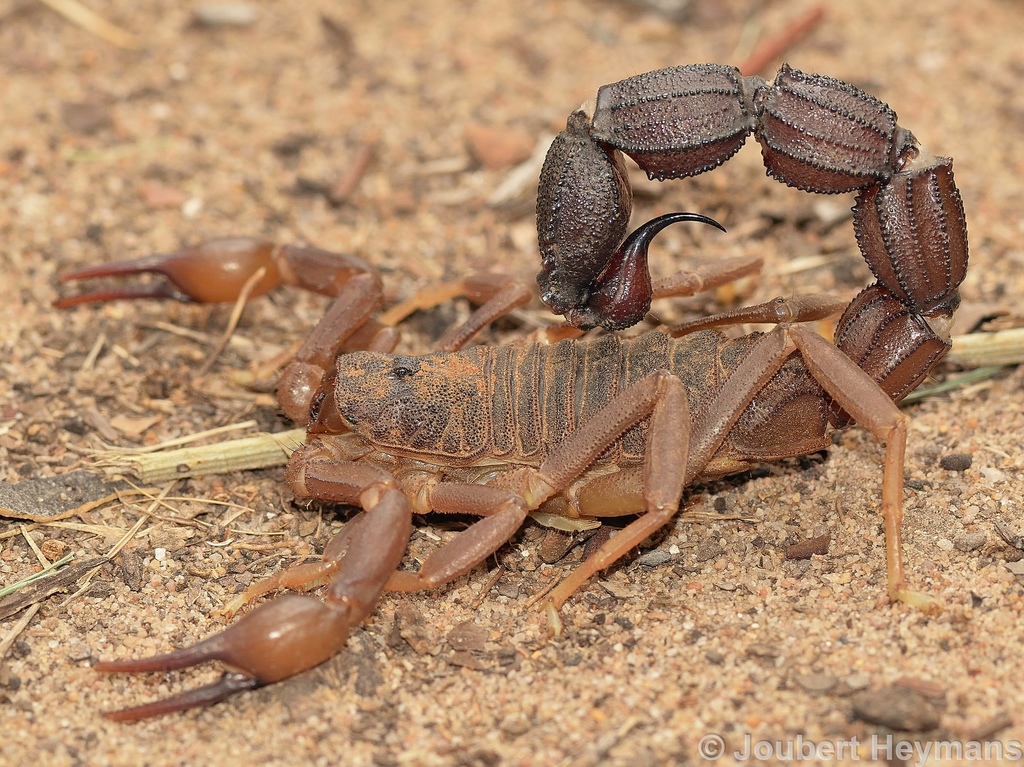
Granulated Thick-tailed Scorpion
Parabuthus granulatus
Parabuthus granulatus, commonly known as the granulated thick-tailed scorpion, a large species of scorpion from the drier parts of southern Africa. It measures some 11.5 cm, and is dark yellow to brown in colour. It has a relatively small vesicle, but is one of the more venomous scorpion species of the region. Of all scorpion species, it causes most of the serious cases of envenomation in South Africa, and a few people die each year from their sting.
From the article Parabuthus granulatus on Wikipedia (CC BY-SA), quoted section by section
Range & habitat
It is native to southern Angola, Namibia, Botswana, western Zimbabwe and South Africa. In South Africa it occurs in the Western Cape, Northern Cape, Eastern Cape and Limpopo. It is sparsely distributed, but forages actively in the open, causing it to come into contact with humans. They burrow at the base of grass tufts, shrubs, logs or stones, and prefer stable sandy or gritty soil.
== References ==
Wikipedia: “Range and habitat”
Where it lives
Recorded sightings
—
geo-referenced records in GBIF, from museums, herbaria and field observers.
Drag the globe to turn it. Dots are where records exist, not a range map; darker means more records.
In the stacks
Searching the stacks…
Every page naming Parabuthus granulatus in the Biodiversity Heritage Library →
This page is assembled live from iNaturalist, GBIF, Wikipedia, the Source Library and the Internet Archive. It is not yet part of the hand-edited codex. iNaturalist taxon 510214.